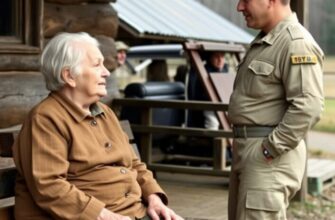
The bus jerked a few times and came to a halt.
The driver jumped out of the cabin, shrugged, and announced:

— That’s it! The engine’s dead.
The passengers grew noisy, began complaining. The driver raised his hands to calm them:
— Folks, I’ll call another bus.
Whoever can — walk to the village, it’s only six kilometers.
But for those staying — just a heads-up: there’s no heating.
A plain-looking woman called out loudly:
— What’s the fuss? They said — if you can walk, then walk. If not, stay.
She threw a worn backpack over her shoulder and stepped outside.
Light snow was swirling outside, and the frost wasn’t too bad.
Rita — that was the woman’s name — resolutely set out down the road.
“One hour’s walk,” she thought, glancing at her old phone.
But soon everything changed. A harsh wind rose, and a blizzard began.
Snow whipped in heavy flakes, the road disappeared — you couldn’t tell asphalt from shoulder.
Rita stopped and looked around. The bus had vanished behind the white wall of snow.
No idea which direction it was.
Her feet sank knee-deep into snowdrifts.
“What do I do now?” she wondered.
It was getting dark fast. She turned on her phone flashlight, but it died almost immediately.
In despair, she noticed a light in the distance.
“A village!” Rita thought, hopeful, gathering her last strength.
She reached a small house on the edge of the village.
It stood alone, its windows shuttered.
She barely made it to the porch and knocked on the door:
— Please, let me in… — she whispered through frozen lips.
No answer. She tried the handle — the door gave way.
Inside, it smelled cold and damp.
“At least it’s out of the wind,” she thought and stepped inside.
She lit an old kerosene lamp she found and looked around.
There was a stove in the room, with a bucket of kindling and firewood nearby. Rita lit a fire and warmed her hands.
“Thank God I won’t freeze,” she sighed in relief.
Rita was an orphan who grew up in a children’s home.
Later, she became a plasterer and painter and married a village boy.
They lived well, worked, and raised a son.
When their son joined the army, Rita moved to the city — she wanted to save up for his wedding, as he had found a fiancée.
But happiness never came. One day she got a call from the village council — their house had burned down, and her husband and son had died from smoke inhalation.
Rita returned home to find only charred remains.
She screamed so loudly she remembered that scream for the rest of her life.
Neighbors offered shelter, and the chairman offered temporary housing.
But it was as if Rita had gone mad: every day, she visited the graves and wandered through the ashes.
Eventually, she left for the city.
She couldn’t find work — too many migrant laborers now, and her health was failing — her heart bothered her, she struggled to breathe.
So she began wandering — begging, sleeping wherever she could.
The years passed unnoticed.
And now, she had decided to return to her late husband’s village — maybe someone would help.
That’s how she ended up on the broken-down bus.
When the house warmed up, Rita settled on the stove bench and fell asleep.
In the morning, a ray of light through the shutters woke her.
The fire had long since died out, and the room was cold.
Rita took out some bread and juice from her backpack and had breakfast.
When she stepped outside, she saw footprints on the porch — children’s, likely from felt boots.
On the step lay a bright red mitten with a snowflake pattern.
“Strange, someone was here before me,” Rita thought.
The tracks led behind the house but ended abruptly. So she followed some fresh tire tracks.
In a few minutes, she reached the church gates.
An old bus stood in the yard, and the church door was slightly open.
Rita entered. Inside, there was scaffolding, and two men were plastering a wall.
The warm floor gave off a pleasant heat.
— Not like that, Father, this way! — one man said.
The priest tried to repeat it, but the plaster fell with a crash.
— Sigh, it’s not for me, — the priest sighed.
— Don’t give up, Father! — encouraged the assistant.
The priest noticed Rita:
— Hello. What brings you here?
— Good day. Whose mitten is this? I found it near the house where I spent the night.
The priest shrugged and called out:
— Liza!
A young woman in a headscarf came down the stairs.
— Is this yours? — he asked, showing the mitten.
— Possibly, — Liza replied. — It’s Katya’s. Today she ran to that house, said she saw smoke.
— Really? — the priest was surprised. — And did she find anyone?
— No. The shutters were closed, and there were no tracks — though the blizzard could’ve covered them.
Liza looked at Rita:
— Where exactly did you find it?
— On the porch. I stumbled there after the bus broke down.
I thought I’d freeze, but there was firewood — I managed to warm up a bit.
— And where were you headed?
— Sovy Yar.
— Oh, you’re way off! — all three exclaimed. — This is Lenskoe village. Sovy Yar is still ten kilometers away.
Rita raised her hands:
— Then fate brought me here.
She looked at the priest:
— I’m a painter, plasterer, and tiler. I can help with the repairs.
— Really? — the priest was delighted. — That’s a blessing!
I’m hopeless at this — nothing turns out right.
Father Andrey approached Rita, smiling:
— Let’s introduce ourselves. I’m the head priest, Father Andrey.
And this is my wife, Liza, the matushka. We’ve been looking for skilled workers — no one wants to come to our remote place.
— Margarita, — the woman introduced herself. — Can I start right away?
She was already eagerly holding a trowel.
— No, no, — the priest stopped her. — You just arrived; you probably haven’t even eaten.
Eat first, then we’ll get to work.
He nodded to his wife, and she went to a small building next to the church.
It was a dining hall, where several women were already setting the table.
They served Rita hot fish soup, salad, tea, and a pastry.
She hadn’t had homemade food in a long time and tried to eat slowly so as not to reveal her hunger.
Suddenly one of the women asked:
— Rita, are you from Sovy Yar by any chance?
— That’s right, — she replied and recognized her former neighbor, Valentina.
— Oh, Valya, it’s you! I thought we didn’t have a church.
— I come here now. And you? Didn’t the chairman give you a house?
— I sold it, — Rita said quietly. — Then it was given to a settler family.
— Where do you live now?
Rita just shrugged. She noticed Valentina leaning toward Liza and whispering something.
Liza raised her brows in surprise.
— How interesting! — the priest’s wife said. — Father was just asking where we could house a skilled worker.
Why don’t you move into the same house where you spent the night?
We’ll fix it up, bring some firewood — and you can live there!
Rita smiled. Such a simple solution had seemed impossible.
She asked for tools and examined the walls. The work began.
She could hear Father Andrey and his assistant singing hymns as they prepared for service.
Rita felt light and joyful — she was doing what she loved.
It didn’t matter how much they’d pay or where she’d live.
Her reward was simply restoring those beautiful walls.
By evening, Father Andrey gently took the trowel from her hands:
— That’s enough for today, Margarita. Yuri Nikolaevich is pleased with your work.
Now — time to rest.
He invited her to dinner at their house. At first, Rita hesitated:
— Oh no, look at me, how I’m dressed.
— Not a problem, — Liza said. — We’re about the same size.
We’ll find a robe, towel, everything you need.
You’ll bathe and rest in the warmth.
Just then, a curly-haired four-year-old girl ran in, her eyes full of laughter.
Rita unexpectedly agreed — who could resist that look?
— Did you find my mitten? — the little girl asked.
— Thank you so much! I cried so much, thought I’d lost it.
At the priest’s home, they had three biological children and three adopted — orphans.
— Sasha came to us on his own, — Liza said.
— We saw him near Christmas five years ago — standing in a corner, praying.
Our parish women asked around: he was an orphan.
Buried his mother, stepfather in prison, and he was headed to an orphanage.
He ran away and somehow made it to us. We adopted him.
Liza looked fondly at the twelve-year-old boy playing in the corner.
— We met Vika in the orphanage while delivering gifts.
All the kids were laughing — except her, sitting there deep in thought.
— Mom, can I bring the teddy bear to school tomorrow? — Vika asked.
— Sure, just take care of it.
— I’ll clip it to my backpack, — Vika promised and ran off.
— And Katya is special, — Liza continued.
— A young woman came here looking for her fiancé at a certain address.
She found only ashes. She screamed so loud she went into labor.
She was hospitalized, but after giving birth, she vanished.
She only managed to say the baby was from Volodya Shmelyov.
We took the girl in and raised her as our own.
She even nursed our little Slava at the time.
Rita trembled and clutched her heart:
— My God… That’s my son’s daughter!
— Margarita Yefimovna! — Valya cried out.
— That means you’re her grandmother! We registered her as Ekaterina Vladimirovna Shmelyova, hoping her family would be found.
— Is this really possible? — Rita burst into tears.
— I never believed anything good could still happen in my life.
Liza hugged her, and the priest added:
— Then it’s settled, Margarita Yefimovna — you live with us now, as Katya’s grandma.
She’s like a daughter to us, but you’re her blood — we won’t let you go! — he joked.
— And there’s room — the parish helps.
— Kids! — he called. — Meet your new grandma Rita.
She’s going to live with us now.
The children gathered around her.
— Can you tell stories? — Katya asked.
— Of course, sweetheart. We read lots in the children’s home.
— So you’re from an orphanage too! — Vika and Sasha cheered.
— We thought only little kids live there.
— I was little too, when I lived there. Then I grew up and started working.
— What do you do? — they all asked.
— I’m a plasterer, — Rita replied, and the kids burst out laughing:
— Dad can’t do it! Every night he tells Mom how bad he is at it!
Rita’s knees buckled from sudden happiness.
She didn’t know who to thank — God, fate, or these kind people.
The next day, the younger children came with Father Andrey to the church to watch their “grandma” work.
They eagerly watched how smoothly the plaster went on — no bubbles or bumps.
And they told everyone:
— This is our grandma! She paints, tiles, and will make this place beautiful!
By spring, the interior was finished.
The parish prepared for Easter.
A few days before the holiday, Liza received a letter from Ostrogozhsk.
It said Katya’s grandfather on her mother’s side had left her a house in the historic town.
It explained that he had never forgiven his daughter for having a child out of wedlock, and they had quarreled.
When he found out about his granddaughter, he was heartbroken.
He wanted to leave her a will, but didn’t trust anyone with it for years.
Only before his death did he ask a neighbor to find the girl.
— So, — said Liza. — Our Katya now has a home.
We’ll go see it after Easter.
The whole family took Father Andrey’s bus to Ostrogozhsk — to process the inheritance and rent the house to kind people.
That trip became one of the most memorable events in their extraordinary, trial-filled life.