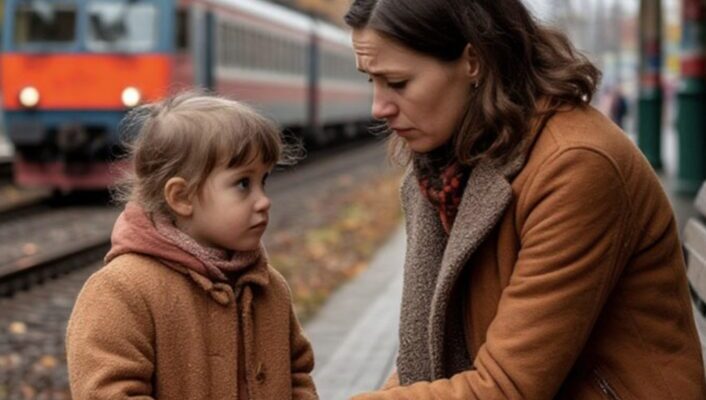
A draft pierced through the empty waiting hall of the provincial train station.
Irina wrapped her four-year-old daughter more tightly in a scarf.

Katya, pressed against her mother, shivered on the hard bench, her breath forming small clouds in the cold air.
Outside the dusty windows, a blizzard raged, pounding the glass with icy pellets.
Everything beyond that gloomy hall seemed foreign, hostile, and mercilessly cold.
In their old backpack—their only possession—lay the last loaf of bread and a few crumpled bills.
It would be enough for a ticket to the nearest station, but where would they go? No one was waiting for them anywhere.
Irina broke off the biggest piece for her daughter and left only the dry crust for herself.
She had no appetite, only the bitter taste of despair in her mouth.
Just a couple of days ago, at least they had a roof over their heads—even if a shaky one.
Now, all that remained was the icy bench and the howl of wind outside the window.
Irina stared blankly at the dirty glass when a swirl of snowflakes and dim streetlights suddenly took on familiar features.
A woman passed by the window—thin, gray-haired, hunched against the wind.
It was Margarita Andreyevna… her former mother-in-law. “Just my imagination,” whispered Irina, closing her eyes.
“From hunger and exhaustion. A hallucination.”
But it couldn’t have been a hallucination. Her ex-husband Denis had long ago sent the woman who raised him to a nursing home.
He was always quick to discard anyone who showed weakness.
After the divorce, all her relatives turned away from Irina, as if she had some disease.
Only Margarita Andreyevna continued to help—bringing milk, warm clothes for Katya, or simply offering a kind word and a hug.
Her support became a fragile thread keeping Irina connected to humanity.
Now, the image of that woman appeared like a vision, a ghost from a lost past.
Her memory conjured up the image of her last humiliation: Irina, exhausted, on her knees, scrubbing the floors of a wealthy woman’s apartment.
Larisa—cold, confident in her superiority—looked over the work with disdain:
“Filthy. Are you blind? I’m not paying for this.”
“Please… I have a child,” Irina begged, her strength failing.
“Everyone has problems,” the woman snapped. “Igor! See her out.”
Her son emerged from the other room—tall, hunched, with a vacant look.
Without a word, he took Irina by the arm and almost shoved her out the door.
“Pathetic mama’s boy,” flashed through her mind. “Living off his mom and can’t even say no.”
The door slammed. She was left in the dark stairwell, empty-handed, hollow inside.
When Irina turned to her neighbors for help, she was met with indifference.
Some looked away, others suggested going back to her ex-husband.
But just the thought of Denis filled her with fear—his drunken outbursts, threats, that wild gleam in his eyes…
No, asking him for help would be like running into the arms of a predator.
Behind her back, people whispered: “Give the girl to an orphanage. At least she’ll be fed and clothed.
Maybe she’d even be better off…”
Those words struck harder than any slap. Better off without her mother?
Irina picked up the sleeping Katya, slung the backpack over her shoulder, and stepped out into the freezing night.
The train station became their only shelter.
Sitting on the cold bench, hugging her daughter, Irina wondered: why in such a vast country are there no shelters for mothers with children who end up on the street?
Why are people like Larisa, who have everything, so cruel to those with nothing?
Does motherhood—this hard, selfless labor—count for nothing?
Her thoughts were interrupted by the voice of the station police officer—a tired, gray-eyed man named Semyon:
“You can’t stay here overnight.”
“Nowhere to go,” Irina replied quietly. “My child will freeze.”
The man paused, sighed, and walked away. About ten minutes later, he returned and handed her a bag.
Inside were warm potato pies and a bottle of kefir.
As Irina gratefully accepted the food, he slipped a crumpled bill into her pocket without a word.
She pretended not to notice. She broke the pie and gave most of it to the now-awake Katya.
“Sometimes the warmest kindness and help come not from relatives but from strangers,” thought Irina, watching the policeman.
He stepped aside but didn’t leave—his presence shielding them from curious passersby.
That modest man became their silent guardian angel through the long, icy night.
Early in the morning, as the station came to life, someone gently shook Irina’s shoulder.
She opened her eyes—it was the woman she thought had only been a hallucination.
“Irochka? Katyusha? How did you end up here?” Margarita Andreyevna’s voice was filled with pain and disbelief.
They embraced. The pain and tears Irina had bottled up for so long finally burst forth.
In broken sentences between sobs, they shared their stories.
It turned out Denis had indeed had Margarita declared legally incompetent to take her apartment and put her in a care home.
Only with the help of her old friend, Valentina Semenovna, had she managed to escape.
Now they were heading to her—to another town to start over.
“How did you ever get involved with that man, Irochka?” whispered Margarita Andreyevna, gently stroking her hair.
Irina fell into thought. Her past resurfaced: the orphanage, loneliness, fear of each new day.
Denis had seemed like a savior, a chance for family, warmth, love…
And when Katya was born, she believed she had found real happiness.
How wrong she had been…
Their conversation was interrupted by a lively woman in her sixties, wearing a bright headscarf and sparkling eyes.
She approached with a warm smile.
“Well, Margo, found your people? I told you—heart never lies!”
It was Valentina Semenovna. She greeted Irina and Katya like old friends.
“Come on, girls. You’re coming with us. There’s room for everyone. Your problems are my problems now.
I’ve got enough connections to call a minister if I have to!” she winked.
“Oh, and by the way—Semyon was on duty here just for you. He’s my nephew and wouldn’t let anything happen to you.”
Semyon, the officer who had helped them, smiled shyly and gently picked up their backpack.
The train left, taking them away from cold, fear, and despair.
What lay ahead was unknown, but for the first time, it wasn’t frightening—it brought hope.
Valentina’s apartment was spacious and cozy. She immediately welcomed them like family.
Her energy was astonishing—within a day she had a plan of action.
By morning, the legal wheels were turning to help Irina apply for a support program for orphanage graduates and to get in line for public housing.
A few months later came news about Denis. After Margarita regained her legal rights, he lost control completely.
He drank even more, and one day his body was found on the street—either from a beating or the cold.
Irina received the news with icy indifference. To her, he had stopped existing long ago.
Valentina helped Margarita claim her rightful share of the property, which they then fairly split, setting aside a portion in Katya’s name.
Gradually, life found its rhythm. Margarita and Irina became a true family.
They ran the household together, cared for the child, and supported one another.
Shared pain and joy had bound them tighter than blood.
Semyon became a frequent visitor. He brought toys for Katya, played with her, and looked at Irina with warmth he no longer hid.
Valentina, watching them, teased:
“Well, Irina, fate gave you a golden helper. Don’t let him slip away!”
Irina blushed, but felt something new and bright stirring in her heart, once torn by hardship.
Just over a year passed—a year that changed their lives. Irina received a small but cozy apartment.
Margarita sold her share and bought a place nearby to always be close.
Katya started at a new kindergarten and quickly made friends.
One early autumn evening, Semyon proposed to Irina.
The wedding was modest—just close family. But the day felt bathed in light and love.
Margarita Andreyevna and Valentina Semenovna, holding back tears, watched the newlyweds with motherly pride.
But the happiest one there was Katya—twirling in a white dress, telling everyone: “Now I have the best dad in the world!”
One evening, Irina overheard her daughter telling a friend, “When I grow up, I’ll be a lawyer. Like Aunt Valya. I’ll help people in trouble.”
Margarita and Valentina were already planning how to redesign Katya’s room in Irina’s new place.
They were sure: soon, this big and loving family would welcome another little one.
One night, over tea, after Katya had gone to bed, they all gathered in the kitchen.
Irina, looking at her rescuers, said:
“I’ve realized something. Real kindness doesn’t make noise and doesn’t demand thanks.
It just comes—at the moment when you think nothing can help anymore.”
They sat in silence, each lost in thought.
Thinking how strange and wonderful human lives intertwine, how from pain, fear, and despair, something new and precious is born—fragile, but full of hope.
Ask ChatGPT