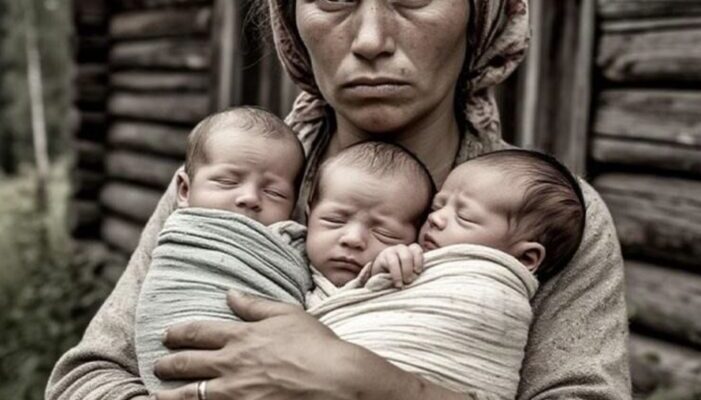
The Girl from the Riverbank
Anna never aimed for anything special.

She didn’t dream of great achievements or a bright life beyond the village.
She was born at dawn on a quiet morning, in a house that smelled of stove smoke, homemade pastries, and earth after rain.
Her parents were simple people: her father — strong like an oak, working to exhaustion; her mother — gentle, with warmth in her eyes, always knowing what to say to comfort the soul with words.
Life in the village was monotonous but alive. From early morning — chickens, cows, running around the yard.
The day passed between garden beds, the well, and the old creaky washing machine.
In the evening — tea with jam, sometimes songs accompanied by guitar, but most often — silence full of thoughts and memories.
Anna grew up kind but not naive. She knew how to listen, noticed small things, valued simplicity.
Her eyes shone not with shallow joy, but with some inner confidence.
It seemed she knew life was not only about beauty, but also work, patience, and love that comes when you are ready to accept it.
Youth passed in games with friends, first flowers from boys who followed like shadows, and silent looks toward the future.
But Anna’s heart stayed calm for a long time.
No glance, no smile could disturb it.
And then one summer day, when the grass had not yet faded in the sun and the air was full of the scent of blooming bird cherry, he came to the village — Mikhail.
Tall, broad-shouldered, confident in every movement.
They said he owned several market stalls in the city — vegetable stands, fruit pavilions.
To the locals — almost a wealthy man.
Women buzzed around him like bees around honey.
He laughed, accepted compliments, but looked away. And once — at Anna.
“You’re different,” he told her one evening as they walked along the path by the river, lit by the sunset.
“With me, it’s easy. Calm. Like home.”
She blushed. Didn’t believe it at once.
It seemed to her that such men were not for people like her.
A simple girl from a village street, with mud on her boots and calluses on her hands.
But he came back again. And again. And then he proposed.
The wedding was modest — at the local club, with a homemade cake decorated with marzipan, and dancing to music from a phone.
Anna didn’t want extravagance.
She was content that there was a person next to her who chose her.
She was happy.
**A Wife No One Asked to Be Perfect**
Anna tried to be a good wife. A real one.
Every day started at the market, where she chose the freshest vegetables; every evening — a hot dinner on the table.
She ironed shirts, washed, cleaned, cooked.
She hummed to herself while clearing the table.
Sometimes she looked at Mikhail and thought, “How lucky I am.”
But… he was cold. Reserved. Didn’t say “I love you,” didn’t hold her hand, didn’t really look into her eyes.
Sometimes it seemed he didn’t notice her at all.
But Anna did not lose heart. “Men are different.
They don’t know how to show feelings.
You have to endure. It will get better with time.”
And then one evening he said at dinner:
“We should think about having children.”
These words sounded like the beginning of something bigger. Anna’s heart fluttered.
“So he really wants a family. A real one.”
Thoughts spun like a whirlwind: bedtime stories, a child’s first step, morning pancakes, hugs, laughter, a name that would sound like a melody.
For the first time, she felt truly happy.
**Triple Hope**
Life flowed steadily. The house was in order, the husband busy, money was coming.
Anna waited. Dreamed. Revolved around her dream like a cat around a Christmas tree.
Mikhail increasingly mentioned “children” in plural, and Anna began to hope: maybe very soon?
And then two lines on the test became brighter. Brighter than the sunset. Brighter than her smile.
She cried — quietly, with happiness that couldn’t be kept inside.
She was expecting. They would be a family. Full. Real.
When the doctor said:
“You’re having triplets. Two boys and a girl,”
Anna lost her voice for a second.
“Three?.. Are you serious?”
She left the office in a daze.
Sat on a bench by the hospital, put her hand on her belly, and whispered:
“You are mine. My three. No matter what happens, I won’t give you up to anyone.”
**Fear and Silence**
Anna knew Mikhail. Knew his caution, calculation, fear of uncertainty.
She was afraid of his reaction. So she decided to wait.
Until the term got too big, until he couldn’t change anything.
But time passed. The belly grew fast — too fast. People began to notice.
Anna tried to hold on, but fear often awoke in her soul.
And Mikhail still didn’t notice the changes.
He came home late, brushed off conversations, said:
“I’m tired. We’ll talk tomorrow.”
But tomorrow never came.
One evening she mustered courage.
Sat next to him, poured him soup, and said:
“Misha… I went for an ultrasound.”
He didn’t even look away from his phone.
“Well? Everything okay?”
She gathered her strength.
“We won’t have just one child.”
“Twins?”
“Triplets. Two boys and a girl.”
He raised his eyes. Looked as if he didn’t understand. Then got up, took his keys:
“I have a meeting. We’ll talk later.”
The next morning Anna felt sick. Head was spinning.
Labor pains began suddenly.
She grabbed her belly, called an ambulance, packed a bag, and went to the maternity hospital.
Mikhail didn’t answer. Phone was unreachable.
**Born Together**
The birth was difficult.
But the children were born healthy.
Three tiny bundles. Three hearts. Three lives.
Two days later — a call.
“Where the hell are you?!” he shouted.
“You left without saying a word!”
“I’m working, and you disappear like…”
“I’m at the hospital, Misha. I gave birth.”
Pause.
“You… what?”
When he arrived, he held a plastic bag with baby diapers.
He saw the children — turned pale.
“Are these… all ours?”
She nodded.
He sat down. Was silent for a long time. Then said:
“Maybe… give one away? At least one. It’s economical.”
Anna didn’t immediately realize he was serious.
Then she simply stood up, walked over, and said:
“Take your diapers and go.”
He exploded. Yelled, accused her of naivety, of “setting him up,” talked about money, even hinted the children might not be his.
He slammed the door and left. Never came back.
Anna looked out the window.
His bag lay on the windowsill.
And nearby, in transparent cribs, slept her children. All three. Her happiness. Her fate.
She didn’t cry. Not that day, not the next morning, not when discharged from the hospital.
There was no time for tears — three infants in her arms, emptiness behind her.
Mikhail disappeared. The phone silent. No apologies, no money.
Only the echo of his words: “Maybe one — to the orphanage…”
**A Home Where You’re Expected**
Anna dialed her mother’s number. Her voice trembled, but she held on:
“Mom, I’m coming home… Can I?”
Her father came in an old “Niva” car.
He approached his daughter, looked at the three newborns for a long time.
Then said:
“It’s okay. We’ll make it through.”
The house was just as before: old, with a stove, the smell of milk and earthen floor.
But now it was warm.
At night, her father would get up to rock the grandchildren.
Her mother washed, helped, warmed milk.
And Anna, as soon as she recovered, got a job — packing vegetables on a farm.
During the day — short naps, in the evening — smiles for the children.
Mikhail didn’t call. Not after a week, nor after a month.
Didn’t ask how they were.
Didn’t inquire about their names.
Didn’t send a single kopek.
Anna finally decided — she called him herself.
His voice was tired and irritated.
“Are you kidding me? I have enough problems of my own.
No alimony, no money for you.”
She was silent. Just exhaled.
That evening she sat on the porch.
Her mother sat beside her, handed her a mug of warm milk.
“My grandmother used to smear her face during the war with a herbal mask like this.
It helped with burns and wrinkles.
And then she even sold it at the market — it was enough for the children’s bread.”
Anna smiled.
“You think I’m going to open a beauty salon here?”
“Try. Everything starts somewhere.”
And she tried.
**From Herbs to Success**
That very night, while the children slept, she took out a notebook and wrote down the recipe: chamomile, mint, St. John’s wort, a bit of honey, a spoon of oil, and — a secret ingredient her mother whispered, as if it were magic.
She cooked it. Cooled it. Applied it — on herself and her mother.
In the morning, her skin was smooth like a child’s.
She joked, but inside she felt something like hope for the first time in a long time.
A week later she let a friend try it.
Then another.
Demand grew, and Anna began to fill jars and sell them at the local market.
Then — she created a social media page.
Orders started coming in slowly. More and more.
Soon she had to rent a small space in the district center.
She renovated, set up a table, jars, packaging.
Her mother and father helped.
Money started coming in.
Anna registered as an individual entrepreneur, obtained certificates, and began hiring women from the village.
She had more than just a mask — she had her own brand.
Three years passed.
She had long since divorced Mikhail and didn’t even apply for alimony.
Now she had an apartment in the city, large, bright, with three children’s rooms.
The kids went to a good school, took swimming and drawing classes, and said “mom” with such love that everything inside her stopped.
She bought her parents a new house.
**A Meeting That Changed Nothing**
One day, at a business meeting, she saw Mikhail.
Aged, balding, in a cheap jacket, he stood in the corner flipping through documents.
He saw her — froze.
She approached calmly, in a beautiful suit, with a straight back and confident gaze.
“Hi, Misha,” she said.
“Didn’t think we’d meet.”
He mumbled something about being glad to see her. Embarrassed, fidgeted.
“You said you couldn’t survive without me,” he suddenly recalled, awkwardly smiling.
“And look at you now…”
Anna smiled.
“In the collective farm, as you remember, I didn’t rot.
I survived. And I raised three.”
Mikhail watched her go for a long time.
Six months later, Andrey appeared in her life.
A man who wasn’t afraid of diapers, who read books to the children, and came to bring her tea from a thermos when she stayed late at work.
He didn’t promise stars, didn’t build castles in the air — he simply was there. Every day.
And one day Anna woke up, looked at the three sleeping children, at the man next to her — and realized: she was home.
In her life.
Real.
Not perfect, but happy.