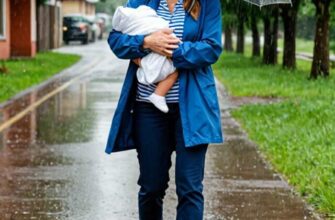
“Klára, someone’s knocking at the door!” shouted János as he lit the kerosene lamp.
“In a storm like this?”
Klára put down her knitting, which she had been doing by the fireplace, and strained to listen.
The wind was howling, the rain was tapping on the windows, but behind the noise, a faint knocking could indeed be heard.
So soft that it could easily have been mistaken for the sound of a broken tree branch hitting something.
“Maybe it’s just the wind…” she looked at her husband, but János was already heading toward the door.
When he opened it, the cold wind rushed into the house, carrying droplets of rain swirling in with the door.
Klára rushed after him and stood in the doorway, staring in shock at the scene before her.
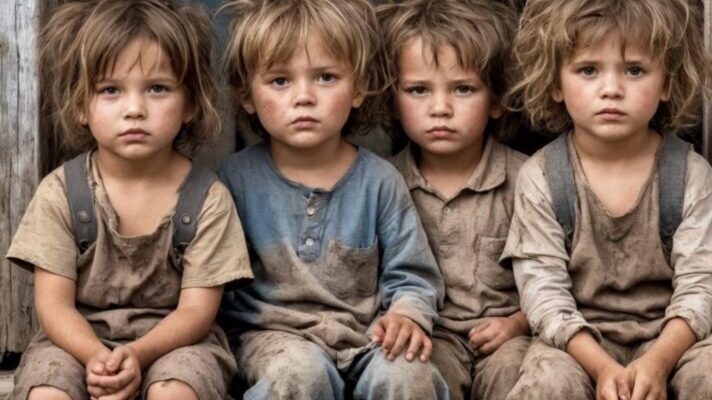
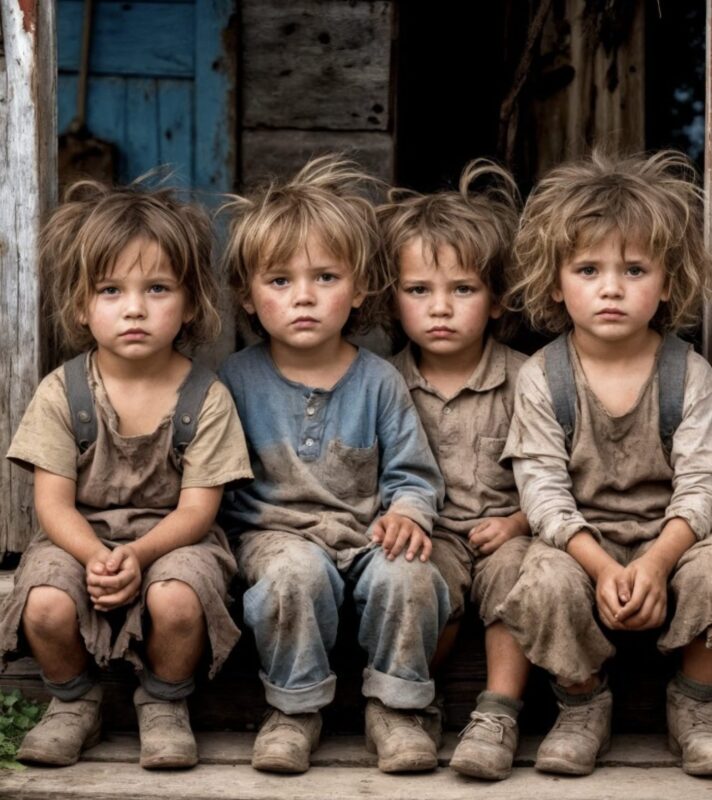
On the wooden veranda, in the dim lamplight, four tiny children were huddled.
Wrapped in old, fraying blankets, they looked like frightened little fledglings.
“Oh my God…” Klára whispered and sank to her knees in front of them.
The children stared at her in silence.
Their eyes were frightened, but also reflected a deep inner exhaustion.
Two girls and two boys — probably about four or five years old, all small and thin.
“Where could they have come from?” asked János, bending down to pick up a soaked piece of paper from the ground.
“There’s a note…”
He unfolded the rain-soaked page and read aloud:
“Help them… We can’t go on any longer…”
“Quick, get them inside!” Klára had already picked up one of the boys, the other was lifted by János, and the two girls stood up and hesitantly stepped inside.
As soon as the door closed, the house filled with the sound of children crying, whimpering, and the thuds of running feet.
From upstairs, Klára’s mother, Aunt Etel, came rushing down, her headscarf half slipping off.
“What happened?” she asked in alarm.
“Mom, help!” begged Klára as she tried to pull the wet clothes off the little boy.
“We need to warm them up, feed them, quickly!”
Etel asked no more questions, just lit the stove, then set a pot of milk to heat.
Within minutes, Klára’s younger brother, Zoli, arrived, who had been sleeping in the nearby shed.
“What’s all this crying?” he asked sleepily, but as soon as he saw the four trembling children, he snapped to attention.
“Good grief…”
“Help me get the old baby clothes out of the chest,” Etel instructed.
“Klára, give them milk — slowly, so their stomachs don’t hurt!”
The children drank the warm milk with trembling hands, and as their bodies thawed, the crying gradually subsided.
By the middle of the night, the four small bodies were sleeping cuddled together on the old, spacious bed.
“Klárikám… these children seem like gifts from fate,” whispered Etel once the house was finally quiet.
“You and János… you’ve suffered so much…”
Klára couldn’t take her eyes off the children.
Over the years, she had dreamed so many times of becoming a mother.
So many times she and János had come home from the doctor empty-handed, hearts aching.
“What should we do with them?” János asked quietly, touching his wife’s shoulder.
“What?” Zoli cut in.
“That’s obvious. They’re ours now. Period.”
“But the law… the paperwork…” János tried to object.
“You know someone at the district office,” Zoli waved his hand.
“You’ll go tomorrow and sort it out. We’ll say they’re orphaned children of distant relatives. We’ll handle it.”
Klára didn’t say a word.
She just crouched down beside the children and gently stroked one of their heads.
“I’ve already thought of their names,” she whispered.
“Lili, Réka, Marci, and Dénes.”
No one slept that night.
Klára sat beside the makeshift crib, eyes wide open, afraid that if she blinked, it would all vanish like a dream.
She watched the children’s calm breathing, their soft snores, and with each tiny sigh that reached her ears, another bud of hope opened in her heart.
Four little lives, four destinies, now entwined with theirs like thin threads that would form a strong rope.
Outside, the sky was beginning to lighten, the wind had calmed, the rain was tapering off.
Between the clouds, a few rays of sunshine broke through, painting the wet rooftops of neighboring houses pink.
János was already preparing the horse-drawn cart when Klára brought him a small bundle: bread, boiled eggs, and a clean shirt.
“Can you do it?” she asked softly.
“Don’t worry, I’ll take care of it,” János nodded, squeezed his wife’s hand, then climbed onto the seat and set off.
János didn’t return until after dark.
His clothes were soaked with sweat, his face looked tired, but when he stepped in, he slapped a slightly battered document folder on the table.
“They are officially our children now,” he declared.
His voice was deep, but carried a quiet pride.
“Old friends helped — it wasn’t easy, but we did it. They belong to us by law.”
Aunt Etel crossed herself, then stepped to the stove and brought out the hot soup from the clay pot.
Zoli silently placed a steaming glass of homemade pálinka in front of his brother and gave his shoulder a firm squeeze.
He said nothing, but that gesture carried everything — respect, pride, acknowledgment.
Klára crouched beside the crib, watching the peaceful faces of the children.
She had carried the pain of childlessness for so many years, like a hidden thorn.
But now her tears were not of loss — they were tears of joy.
Four little hearts beat beside her, and she knew: these children were not of her blood — but they were of her soul.
“I’m officially a father of four now,” János whispered as he stepped beside her and wrapped her in his arms.
“Thank you…” Klára leaned into his chest.
She was afraid to speak, fearing even a word might break this dreamlike reality.
Thirteen years passed.
The children grew up, and the house filled with life.
Extra space was needed at the tables, the clothes grew larger, and the questions grew deeper.
But one day, it was as if something shattered.
“Just leave me alone with all your stupid rules!” Marci snapped, slamming the door so hard the old windowpane nearly popped from the frame.
“I’m not rotting away in this godforsaken dump!”
Klára stood frozen in the kitchen, a bowl of pasta in her hands.
She had never heard her youngest son speak like that.
She put down the bowl, wiped her hands on her apron, and walked out to the hallway.
Marci stood leaning against the wall, face red, trembling with rage.
János was also there, fists clenched.
“Your son has decided he doesn’t need school,” said János darkly.
“He says it’s a waste of time. He’s quitting and going to the city.”
“Why should I waste my life hunched over books?!” shouted Marci.
“So I can spend the rest of my life plowing fields like you?!”
János’ eyes darkened, the muscles in his face tensed.
He stepped forward, but Klára gently stepped between them.
“Let’s calm down first, then talk it through,” she asked quietly, though her heart pounded in her throat.
“There’s nothing to talk about!” Marci folded his arms.
“I’m not alone! Dénes is with me. And the girls are just too scared to tell you they want to leave too!”
Lili appeared in the doorway — she was a tall, serious-faced girl now, loose strands of hair falling across her face.
“I heard everything from outside,” she said quietly.
“What’s going on?”
Here is the English translation of the passage:
—
“Tell them!” Marci turned to her. “Confess everything! Show them what you’re hiding under your pillow!”
Lili flinched, but she didn’t back down.
“It’s true… I want to become a professional painter,” she admitted. “One of my teachers says I have talent. There’s an art program at the central school. I want to apply.”
“You see?!” Marci shouted. “And you only see cows, potatoes, and manure! Meanwhile, the world rushes past us!”
János stepped back as if he had been slapped, then suddenly turned on his heel and walked out into the yard.
Klára tried to swallow the lump in her throat.
“Dinner will be in half an hour,” she announced in a seemingly calm voice, then returned to the kitchen, where the soup was already boiling.
The evening passed in unusual silence. Dénes barely touched his plate, Réka and Lili hardly dared to look at each other, and Marci stubbornly poked the potatoes with his fork. János didn’t even show up at the table.
That night, Klára couldn’t sleep. Her husband snored peacefully beside her, while she just lay there, thinking back to that evening… when she first saw those little children on the doorstep.
She had fed them with a spoon. Taught them to speak their first words. Watched them toddle toward her for the first time…
The morning brought no relief.
Dénes announced that he would no longer help János in the fields.
“I have my own future,” he said during breakfast. “I want to do sports, competitively. Not milk and scythe.”
János quietly stood up and left. A few minutes later, the tractor engine started.
“Do you understand what you’re doing to your father?” Klára burst out. “He dedicated everything to you!”
“We didn’t ask for it!” Marci suddenly shouted. “You’re not even our real parents! Why are we even living here?!”
Silence. Frozen, almost painful silence. Réka jumped up and ran out. Lili buried her face in her palms. Dénes looked shocked, as if hearing such words for the first time.
Klára slowly stepped in front of Marci. She looked deep into his eyes.
“Because we love you… more than anything,” she said softly.
Marci lowered his gaze. Then he ran out the door, and Klára saw him cutting across the field, toward the thickening forest.
Aunt Etel, who had silently observed the scene from the corner, shook her head.
“Teenagers, my dear… It will pass.”
But Klára felt a deep crack in her heart. As if the wall she and János had spent years building from love had now shattered. And no one knew how to rebuild it.
“Dad, wait!” Marci shouted as he pushed his way through the field. He waved his arms so János would see him.
The tractor slowed, then stopped. János wiped the sweat from his forehead, but didn’t look at the boy.
“I’ll manage on my own,” he muttered.
“Oh come on…” Marci stepped closer and put his hand on his father’s shoulder. “We’re faster together. Remember when you taught me how to drive?”
János paused, then nodded. He moved aside to make room in the cab. Marci jumped in beside him, and the tractor started again.
Half a year had passed since that terrible fight that nearly tore the family apart.
Half a year of relearning how to speak to one another. Not just with words, but from the heart. Every day was a small step back toward each other.
The house filled with life again, but in a different way.
Klára remembered the night when Marci didn’t come home. The whole village searched for him — with flashlights, shouting, even checking the stream. They eventually found him in an abandoned hunting lodge, soaking wet, shivering, feverish, paralyzed by fear.
“Mom…” he whispered when he saw Klára. And in that single word, everything was there. Acceptance, apology, longing for closeness.
Marci was sick for a long time. He burned with fever, rambled in his sleep, clung to Klára’s hand. And when he finally recovered, he was no longer the defiant boy he used to be.
Then Lili brought out the old family photos. She showed them to her siblings one by one.
“Look, Dénes, this is you when Dad carried you on his shoulders after you won your first race,” she said.
Dénes’s face trembled, then he quietly began to cry.
Réka spent more and more time in the kitchen with Klára. She used to draw strange, dark pictures — now she painted colorful watercolors of their house, the field, the village’s church tower. One of her paintings even won a prize in the county art competition.
“Mom… I still want to draw and study,” she said one evening while they peeled potatoes together. “But I also want to stay. At least during breaks. Come home.”
That word, which once meant just a wooden house, now had real meaning again.
By the end of eighth grade, the children had come together again.
At the school closing ceremony, János smiled from the heart for the first time in a long while.
He stood in the yard of the village school, his back straight, his gaze serious, and his heart nearly burst as the children were called up one by one to the stage:
“Dénes Jánosfi – certificate for the county running championship!
Lili Jánosfi – first place in the literary competition!
Marci Jánosfi – technician of the year!
Réka Jánosfi – award-winning young artist!”
The Jánosfi children. His children.
That evening, they held a celebration at home. Relatives, friends, and neighbors came.
The tables groaned under the weight of pastries, pickles, and pálinka. There was singing, laughter, music, and accordion tunes. The children excitedly talked about their plans and dreams.
“Mom,” Lili whispered, snuggling up to Klára, “I applied to the art school. But I’m not going to the dorm. I’ll stay home and commute. It’s not far.”
“Me too!” Marci chimed in. “Why live anywhere else when home is here?”
Klára wiped her tears while János wrapped an arm around her shoulders.
“See? Everything falls into place. When they’re eighteen and want to go, they can. We won’t hold them back.”
Klára just nodded and watched her children: laughing, free, grown — but still hers.
From the wall, Aunt Etel and Zoli smiled back at them from old photographs. Both had passed away recently, almost one after the other — but they had lived long enough to see: these children had become PEOPLE.
Outside on the porch, only crickets chirped. The last guests had gone.
Klára stepped onto the porch, her old warm shawl draped over her shoulders, and looked up at the stars.
The sky glittered with thousands of tiny lights, like so many old wishes. Quietly, without words, from her heart, she gave thanks for everything they had received.
Then the floor creaked behind her. János stepped up beside her.
“What are you thinking about?” he asked.
“That family… isn’t about blood. It’s about love,” Klára replied.
Laughter rang out from the dark: the voices of their children, coming home from the meadow.
To them. Home. Where they had always been loved.