
The spring rain fell silently on the pavement as Captain Lívia stepped out of the police car.
Aranyhegyi Road was quiet at dawn – too quiet.
The neighboring houses were dark, with only a few windows faintly glowing.
The amber glow of the streetlamps shimmered on the wet cobblestones.
“We’re here,” grumbled Uncle Sándor, the near-retirement, somewhat tired but experienced detective, as he shut the car door.
“The passerby saw the girl at four in the morning.
She came up the hill alone.”
“Alone?
At this hour?” Lívia asked incredulously as they headed toward the bench cordoned off with police tape.
On the bench sat a thin little girl, no older than eight.
Her wet clothes clung to her skin, and her hair hung in messy strands across her face.
Two officers stood beside her, one trying to offer her a warm drink.
The girl wasn’t crying.
Her eyes… they were empty.
As if she had seen too much.
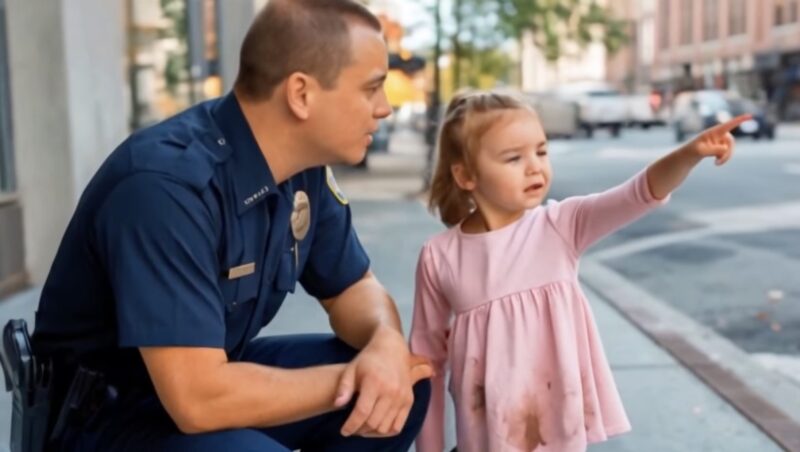
Lívia stepped over slowly and crouched in front of her.
“Hi, sweetheart.
My name is Lívia.
I’m a police officer.
Can you tell me your name?”
The girl trembled, then whispered barely audibly:
“Erika.”
“That’s a lovely name.
Do you know where you are?”
“Here… I came back.
But I don’t know how…”
Her eyes flickered.
“I didn’t want to… I stayed down there.
In the dark.”
Uncle Sándor stepped up beside them, arms crossed as he observed.
“Do you remember where you came from?
The house where you were?”
Erika slowly looked up, and in her eyes was something no child should ever have: terror… and something deeper.
“The house on the hill.
Where the lady lives.
The one who doesn’t move.
The one who watches.”
Lívia and Sándor exchanged glances.
“What lady?” Lívia asked cautiously.
“She doesn’t talk.
She only whispers.
But not with her mouth.
She speaks into my head.
When we’re down in the basement.
With the others.”
Erika’s voice quivered.
“And she always says: don’t tell anyone.”
The air froze for a moment.
A siren wailed in the distance, slicing through the night.
Someone from the neighboring house was watching them from a window, but when Sándor looked up, the curtain shifted and fell back.
“This is heading somewhere really bad,” the old detective muttered.
“This kid… she’s not lying.
Her eyes say everything.”
Lívia nodded.
“Let’s take the girl to the station and check out that house.
Now.”
Erika clung to her when Lívia picked her up.
The girl’s hand was cold—ice cold.
And something else… as if a whisper stirred in the air.
Not from the girl.
From somewhere else.
Sitting in the back seat, Erika spoke again:
“Don’t go back there.
Down there… they’re still there.”
Lívia shivered.
Erika only said this:
“The others.
The ones who can’t leave.
The ones who don’t even remember their names anymore.”
At the police station, the dim lights buzzed, casting a low hum into the silence like a bad omen.
Erika sat wrapped in a blanket in the interrogation room, a child psychologist speaking softly beside her, but the girl only clutched her tea.
Lívia watched from behind the glass.
“She’s too young for what she’s been through,” she said quietly.
Uncle Sándor stepped in behind her, holding a printed map.
“We found the house she mentioned.
On the hill, at the edge of the forest.
Looks empty from the outside.
Neighbors say no one’s lived there in years.
But here’s the twist: four different witnesses saw an old woman in the window in the past two weeks.”
“And no one reported it?” Lívia asked.
“Come on, who reports an old lady looking out the window?
In Hungary, it’s not a crime to watch from behind the curtain.
Not yet.”
Lívia nodded and cast another glance at Erika.
“She said she was in the basement.
And there were other kids with her.”
“Yes, and that the ‘lady’ talks to them inside their heads.
She’s saying things that are hard to even hear.
But listen: there are no reports of missing children in the area.
Not now, not even years ago.”
Lívia furrowed her brow.
“What if it didn’t happen here?”
“What do you mean?”
“What if Erika didn’t just escape now?
What if she disappeared years ago… and somehow came back?”
Sándor hummed.
“Like some… freed prisoner?”
“Or something worse.”
Then the psychologist stepped out of the room.
“She’s not saying much,” she said quietly.
“But now she asked if we could find the ‘door behind the wall.’
She says that’s where they come through.”
“What kind of door?” Sándor asked.
“She says it’s in the house’s basement.
But it only shows up if it’s very quiet.
If no one is breathing.”
Lívia was already moving.
“Get the field team ready.
We’re going there now.”
**The Forest House**
The house on the hilltop had crumbling plaster that glowed pale even in the dark.
The building was abandoned, but fresh tracks led to the back door.
A rusty old lock hung from it—someone had recently broken it off.
“Classic horror opening,” Sándor muttered.
“If a piano starts playing by itself, I’m out.”
Lívia smiled, but the air didn’t allow for jokes.
As they entered, the floorboards creaked beneath their feet.
The air smelled of dust and mold.
In the living room, a stack of yellowed newspapers lay scattered, and on the table was an old, faded photo: an elderly woman with two little girls.
One of them… looked eerily like Erika.
“This… is impossible,” Lívia whispered.
Sándor pointed toward the basement stairs.
“It’s here.
Let’s go.”
The basement was dark and cold.
The flashlight beams warped oddly on the walls, as if the walls were staring back.
At the bottom of the stairs was a worn door—beyond it, thick darkness.
And there… behind the wall… a faint, trembling voice rose.
But not in the house.
In their heads.
“Don’t come down.
You mustn’t see the door.”
Sándor grew dizzy.
“This… this can’t be…”
Lívia was already looking at the wall.
Faint marks on the bricks.
As if someone had scratched from the inside.
And in the center—a barely visible outline of a door.
“Erika told the truth,” she whispered.
“It’s here.”
And then… the door began to creak.
The creaking wasn’t loud.
It sounded more like the lowest key on an old piano—soft but gut-wrenching.
Lívia and Sándor stood frozen like statues.
The air changed suddenly: heavy and stale, as if the entire basement was one giant, ancient lung inhaling.
“We have to leave.
Now,” Sándor whispered.
But Lívia didn’t move.
Her flashlight shook in her hand, as if the lamp itself feared what it illuminated.
The door in the wall opened slightly.
No light came from it—only thick, shifting darkness.
And a voice they both heard… from within.
Buried beneath their own thoughts.
“Remember?
You’re not the first to find…”
“Who’s speaking?!” Lívia cried, but the voice wasn’t outside.
It didn’t echo.
It just… was.
Then, images began flashing in their minds: children’s faces.
Strangers.
All staring back at her from the dark, their faces pale, as if underwater.
They whispered silently.
“Help…”
Sándor grabbed Lívia’s arm.
“We need to go.
Now.
This isn’t… this isn’t a police case.
This is something else.”
But it was too late.
The door opened fully.
And someone was standing there.
Not a monster.
Not a demon.
An old woman.
Her skin waxy, her clothes old, as if from the 1950s.
But her eyes… had seen too much.
“You shouldn’t have brought her back,” she said softly, almost like a scolding parent.
“Erika belongs to me now.”
“What do you mean she belongs to you?!” Lívia demanded.
The old woman smiled.
“Once someone crosses that door, they’re never really here again.
Only a copy.
A shadow.
And you… you looked in.
That’s enough.”
She stepped back—into the darkness from where she came.
The shadows of the children vanished with her.
The door closed without a sound, and the wall looked like smooth stone again.
No trace remained.
Sándor stepped back.
The flashlight now only lit a dusty basement wall.
“They… they won’t believe this at the station,” he whispered.
Lívia only nodded.
“And Erika?”
**Epilogue – Three Weeks Later**
Erika played in the courtyard of the children’s home.
Or at least, it looked like she played.
She was among the other children, yet apart.
Always swinging alone, always with the same motion, always the same distance back and forth.
The caretakers said she was fine.
Sometimes she said strange things, but what child doesn’t?
Only one thing she repeated often—as if it were a song:
“There’s a door that always waits.
It opens quietly, when it’s too late.
A lady guards it, long since dead, but her voice still echoes in your head…”
Lívia sometimes visits her.
They never speak of the incident.
They just sit.
And sometimes, very rarely, Lívia feels that Erika’s gaze doesn’t belong to her.
But to someone else.
Someone who… lives behind the wall.