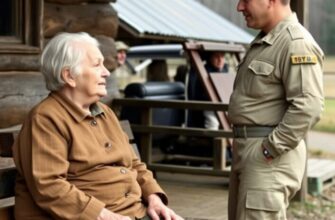
Fate never smiled upon Agafya — she was unwanted, strange, unfinished.
Her face — pleasant enough, even considered pretty.

But her height — almost laughable, just barely over a meter.
Her figure — skinny, dry, like a willow twig. What kind of homemaker could she be?
The lads glanced her way, but none dared to marry her — they joked: “You’ll crush her by accident at night and end up at the elder’s court.”
And the years passed, like forest trails in the fog: trees grew, but people didn’t — gardens were being prepared for them, but for her, unwanted by all, a place at the cemetery.
So she lived alone — wrinkled, but never bent. She walked upright and lightly, as if carried by the forest wind.
From behind, she looked like a girl, but turn around — her face was dry, as though carved from damp mezo wood.
And her eyes — kind, bright, with a childlike innocence. She always smiled, always greeted, even when standing alone by the fence.
Even before thirty, they called her “Spinster Girl.” Not out of cruelty — just habit.
At first behind her back, then to her face. Since she was neither wife nor maiden — she remained the Spinster.
She lived on the edge of the village — in a crumbling hut, the cemetery creeping right up to her fence.
Few passed by — just the garden, then the woods.
And she sat on her crooked bench, smiling at everyone.
— “Aren’t you scared to live alone, granny?”
— “No, dears, the dead won’t harm you. The living… the living are scarier.”
Her hut — old and slanted. The wind had shifted the roof, the shutters hung loose.
No master’s hand — she could’ve used a man’s help. But she had no one.
As old age approached, the Spinster started visiting neighbors — to listen, to smile, to warm herself by their fire.
In the evenings she stood silently at the threshold, smiled, laughed — happy they tolerated her.
Even the young ones didn’t drive her away.
Then people noticed: she wasn’t around during the day. No fire in the stove, no smoke from the chimney.
The yard overgrown, the path vanished — just grass now.
Neighbors whispered, but soon forgot — everyone was busy.
In that village lived Yefimka — a dashing lad. Handsome, lively, a ringleader.
Where there was noise — he was there; where there was dancing — his feet flew; where there was laughter — there he was.
Girls squealed, men approved — he was a good guy, even if wild.
Yefimka burned with energy — sang under windows, joked with water buckets, and at fairs could jump into a brawl.
But kind-hearted: he helped, settled broth arguments, cheered up neighbors. And the ladies — they noticed. He was the real deal!
One evening, at a village gathering, old Nikifor started telling scary stories about the dead:
— “At night, the dead walk through houses, knock on windows, howl through chimneys…”
The girls clattered their teeth, boys crossed themselves. But Yefimka just laughed:
— “Tall tales! Ghosts? I’ll go to the graveyard right now — not scared!”
Nikifor smirked:
— “Want to prove it? Go to the old mill past the graveyard.
They say a black dog with burning eyes lives there — if you see it, you’ve got three days left to live!”
Yefimka didn’t flinch:
— “Ten of those dogs — I’ll tie them all up! And I’ll take the Spinster-girl with me! Wait for us!”
He turned to Agafya — she stood smiling, eyes shining.
— “Coming, granny?”
She nodded. And off they went — he, proudly, shoulders squared; she, light-footed and quiet.
Night, moon, crickets. They walked — he kept glancing around: would a monster leap out?
— “Granny, I’m no hero… but I’ll see you safely there…”
She smiled. Then the mill appeared — old, crumbling, creaking.
— “Come in, dear,” whispered the Spinster softly from the dark porch.
Yefimka felt scorched — his knees buckled.
— “I’m not a coward, but…”
But her face — calm and gentle.
— “Inside,” came the whisper.
— “Light the splinter.”
With a trembling hand, he lit the wood chip. The house — pitch dark, smelled of gunpowder and rot. And on the stove — the Spinster.
Her body — thin, dry, hands folded. And in the shadows — no one else.
He realized: this was no joke. For the first time, he thought: no whistling, ears not on top, heart…
But Yefim — had a good soul.
“God’s soul. I’m no coward. Then I must help.”
He took off the cover, wrapped her, carried her out. The house creaked. And the moonlight — lit her face.
— “Now, granny, I’ll build you a real home.”
He gathered planks, sawed, worked with an axe. By morning, he’d built a coffin — not a masterpiece, but from the heart.
Neighbors woke up and came out.
— “What are you doing?..”
— “I’m burying the Spinster-girl. Whoever wants to help — grab a shovel.”
And they made a grave. She was buried with the sign of the cross; some read “Rest with the saints.”
When the earth settled, Yefim said loudly:
— “Granny, now rest in peace. I’m going to the church to light a candle.”
And for the first time, he went to light a candle.
Since then, he stopped partying, bragging, flirting.
When fights started, he’d stop them:
— “Enough. It’s a sin.”
Girls were afraid to flirt — he’d changed.
The village whispered:
— “The women say: Granny Agafya guided him from the other side.”
Yefimka crossed himself more and more often.
A year later, at the memorial, he stood and spoke:
— “Brothers and sisters…
I’m going to a monastery — to save my soul.”
And he left. No accordion, no cheer, just a plain shirt and a bundle.
And that night, by the old mill, someone saw shadows:
One — tall, in robes with a staff… and the other — tiny, Agafya, nodding after him:
— “Glory to God… Glory…”