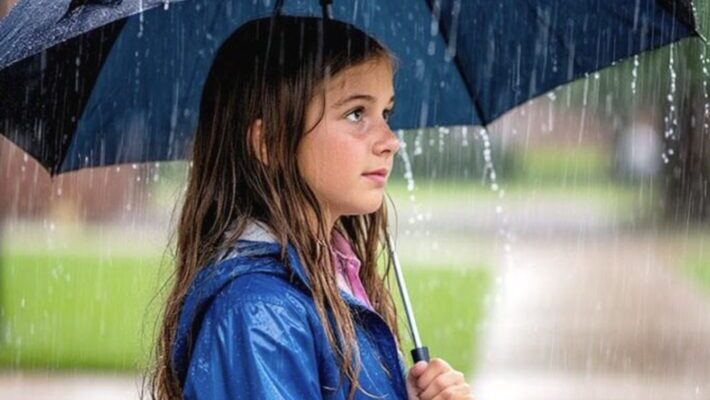
Evening, heavy with rain and silence, slowly descended upon the city.
Large drops tirelessly drummed against the panoramic school windows, as if trying to remind of something important, but long forgotten.
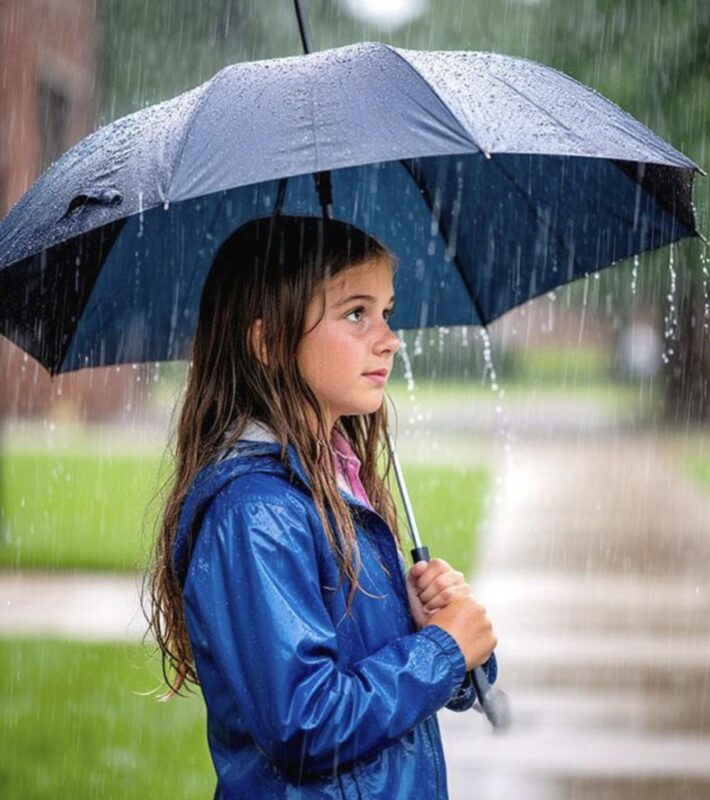
In the building’s hall, where just a few hours ago the hustle and bustle of children’s voices reigned, deep quiet had settled.
Only the monotonous ticking of an old clock on the wall broke the silence, as if counting not minutes, but lost hopes.
In this silent space, all alone, sat the girl. She was waiting.
She had been waiting a long time — far too long for a child who was promised to be picked up exactly at five.
Six o’clock had struck long ago, and with the last bell in the hall, the final footsteps of departing students faded away.
One by one, parents appeared under bright, colorful umbrellas, greeting their children with joyful embraces, and those laughingly ran home.
But she remained alone.
Her backpack lay nearby, pressed into a corner, a symbol of helplessness.
Her umbrella was inside — neatly folded, never opened.
Because it could not help her out of a situation where adult words lose weight and promises crumble like sand slipping through fingers.
Meanwhile, somewhere far from the school entrance, in a small apartment smelling of cheap tobacco and alcohol, life flowed very differently.
The girl’s mother laughed, sipping wine from a glass, allowing herself to forget everything in the world.
Her dress slipped off one shoulder, and her thoughts — even further away from reality.
Next to her was a man whose words were full of drunken charm, and whose promises were as weightless as hers.
Daughter, school, promise — all of it was somewhere there, out of sight, out of mind.
Only when the phone in her pocket buzzed again did the half-dressed, sleepy woman awaken.
The dispatcher’s voice, distant and almost unreal, conveyed something important, but her head was pounding and buzzing as if a whole orchestra was playing the march of the guilty.
The word “police” cut through her consciousness like a knife.
She jumped up, forgetting even to button her coat, ran outside, where the rain met her with a cold gust, washing away the remnants of nighttime madness, leaving only fear and the realization that time was gone and her daughter… was gone.
A police car was already waiting at the school entrance.
Its flashing light flickered in time with the rain, like the heart of the city, worried about the incident.
At the very steps, soaked to the bone, lay a backpack.
From one pocket poked the corner of a drawing — colorful, childlike, with a naive dog drawn in crayons.
It was not just a drawing. It was a piece of her little daughter.
And then the woman fell to her knees, clutching the backpack as if it could replace an embrace, and wailed, drowning out the rain and the voice of her conscience.
The police officer watched with a look of sympathy and slight contempt — he had seen many like this before.
Meanwhile, the girl walked on. Not looking back, not knowing where.
Only forward.
Away from the school, away from promises that turned out empty, away from the mother who forgot that love requires more than words.
Tears rolled down her cheeks, mixing with the rain, flowing down, leaving traces of bitterness and pain on her face.
The city in the distance glowed with lights, beautiful and foreign, beckoning with a warmth she so desperately craved.
But ahead — only rain, darkness, and a road where no one hurried to stop and ask — are you lost?
Her thin jacket long ceased to protect her from the cold.
The wind pierced her through, leaving a chill in her body that no blanket could warm.
The street lamps along the sidewalk cast dim patches of light on the wet asphalt, creating whimsical shadows, as if tracing the outlines of her fear.
Cars rushed past, splashing mud, but no one stopped.
No one asked why a child was alone, why she was crying, why she walked in such weather.
The city was indifferent.
Her feet no longer felt the road, but she kept walking.
Because stopping meant accepting what had happened.
And she did not want to accept.
Did not want to return to a place where promises are worthless.
In her hands, she tightly clutched that very drawing — the silly dog she had once lovingly drawn.
It was her only connection to the home that once seemed safe.
And then, in the distance, among the darkness and infinity, a soft light flickered.
A tiny café, warm and cozy, like an island of humanity in this world.
Without hesitation, she headed there, hoping to warm herself a little, to find at least a drop of care.
The door jingled, greeting her with rushing warmth and the aroma of fresh coffee.
The café was almost empty; only a few people sat at tables, lost in their thoughts.
Behind the bar stood an elderly man with kind eyes that immediately noticed the wet child, shrinking from cold and fear.
He approached silently and quietly asked:
— Are you lost, dear? Would you like some hot tea?
The girl nodded silently, unable to speak.
The tears she had held back all day choked her, but for the first time in a long while, she felt a little relief.
The man seated her by the radiator, brought a large cup of fragrant tea with lemon and a plate of fresh buns.
She devoured the food like a hungry little animal, and with each sip, her chest felt a little warmer.
Gradually, under the influence of kindness and attention, the girl began to speak.
About the quarrel at home, about how she felt no one loved her, that she was unwanted.
The man listened attentively, without interrupting or judging.
He understood how hard it was to be a child in a world where adults often lose their way.
When she finished, he gently said:
— I understand, you’re in a lot of pain. Running away seems like a way out, but in reality, it’s just the beginning of new pain.
Your parents love you; they just sometimes don’t know how to show it properly.
Maybe you could call them? They’re probably worried.
He handed her his phone. She stared at it for a long moment before dialing a familiar number.
On the other end was her mother’s voice — trembling, filled with tears.
She begged her to come home, promised to change.
The girl too could no longer hold back her tears.
She realized she had been wrong.
That love is not perfect, but it exists.
And maybe it’s worth trying to start over.
The man in the café gave her not only physical warmth but also the inner support that helped her return home.
He became an angel in the guise of a stranger who reminded her that there is still room for kindness and compassion in the world.