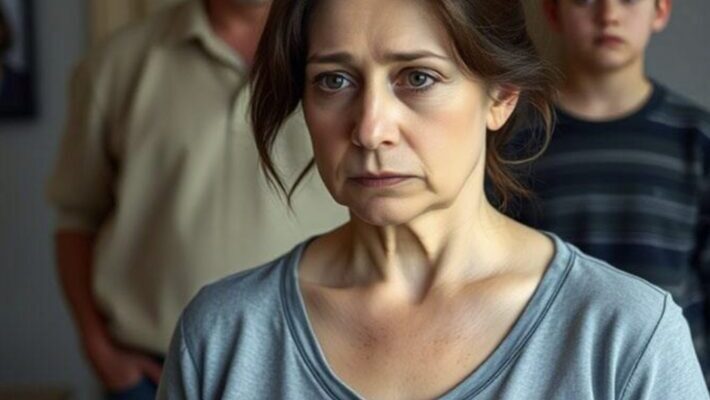
Marina was just finishing loading the laundry into the washing machine when Andrei appeared in the kitchen doorway.
He looked tired, his clothes covered in road dust, and there was something unusual in his eyes — almost determination, but not yet fully realized.
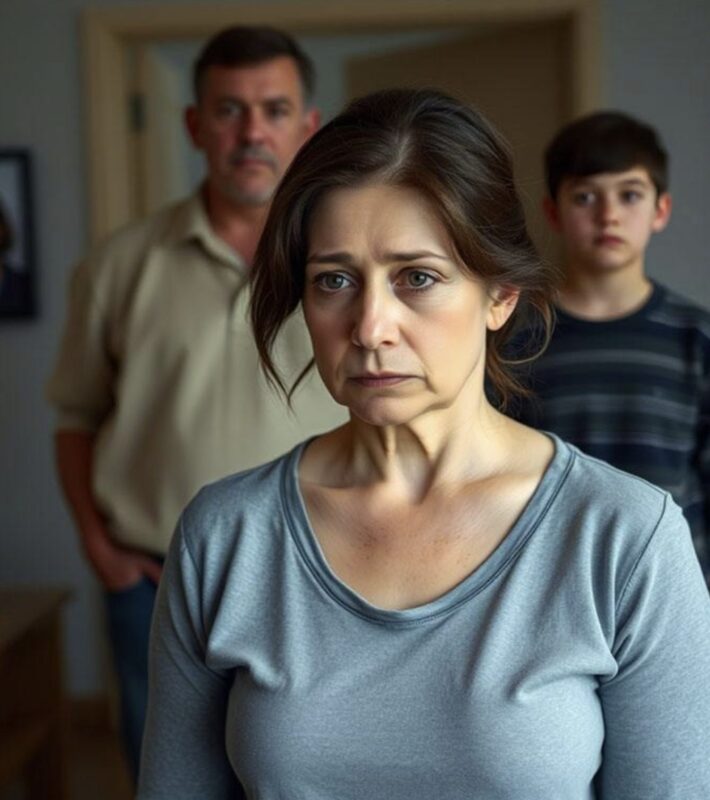
Without taking off his shoes, he walked straight into the kitchen and said abruptly, without preamble:
“We’re going to have another child.”
Marina turned around, not immediately understanding what he was talking about.
She slowly wiped her hands on her robe.
“What do you mean?”
“We’re adopting a boy. I’ve already handled everything.”
“Are you serious? Is this a joke?”
“No,” Andrei replied shortly. “I signed the papers. It’s done.”
Marina froze. Her mind refused to accept that her husband, with whom she was raising little Alina, could make such a major decision without even talking to her, without her consent.
She tried to object, but he interrupted her:
“If you won’t accept this… I’ll leave.”
He looked her straight in the eye, not with anger, but with such certainty that it sent a chill through her.
Marina suddenly realized: he wasn’t bluffing. He really was ready to leave.
To walk away. From their home, their family, everything they had built together.
The next evening Andrei didn’t return alone.
In the dimly lit hallway, slightly hiding behind his back, stood a boy — skinny, with shadows under his eyes, in an old, oversized jacket.
He clutched a worn bag in his hands, as if ready to run away at any moment.
Marina came out of the nursery where she had just put Alina to bed and froze in place when she saw them.
Her gaze darted from her husband to the unfamiliar child.
“Is this a joke?” she asked coldly. “You brought your son home?”
“Wait, Marina…”
“So that’s why you were hiding something! You had another woman, and now you’re trying to cover it up with noble intentions?”
Andrei sighed. He sat down next to the boy, put an arm around his shoulders, then slowly stood and looked Marina in the eye:
“This is your son, Marina. You just forgot about him…”
The words hit like thunder from a clear sky. The world tilted. “Your son.”
Those words echoed with pain in her chest, in her head, in her very soul. Impossible.
Nonsense. What son? She had one pregnancy. One child. One grief. One cross to bear.
But the boy was there. Standing still, not crying.
Just looking at her — with eyes too old for his age, full of pain and loneliness.
And in that silence, something broke inside, like an ancient board cracking under the weight of ice.
It was long ago. It felt like another life.
At the time, Marina was a fourth-year student — free, bold, in love with cinema and with her professor — Artyom Viktorovich.
He quoted Brodsky, wore turtlenecks, played guitar, and looked at her as if she were the only one.
Everything happened quickly. And beautifully. Almost like a movie.
He said there was something special between them. That things were difficult at home. That he wasn’t promising anything, but he felt something.
Marina believed him. Or wanted to believe. She was twenty.
He was nearly forty. He seemed like a grown man to her. The real deal.
When the test showed two lines, she called him at night.
He arrived by taxi. His cigarette trembled in his hand.
He listened in silence. Then said:
“I can’t. Not now. I have a family. Wait.”
“Things will work out later. But for now — don’t tell anyone. Especially at the university.”
She sat, nodding, as if that was normal. As if he had the right to decide whether this child should live or not.
She gave birth in a city hospital. Cold walls, neon lights, unfamiliar hands.
Pain, fear, then — silence. And the doctors who said:
“The child didn’t survive. He had serious pathologies.”
Marina didn’t scream. Didn’t cry. Just lay there staring at the ceiling, repeating to herself: “He’s gone.”
Artyom came three days later. Put a white lily on the table and disappeared.
She never saw him again. Then — university, work, a new life.
Marriage. Alina. Family. And everything was fine.
As if nothing had happened. As if the boy had never existed.
But he did exist.
The past was just a scar that didn’t hurt. You could love again, raise a daughter, drink coffee on weekends.
But when that boy walked into her house, for the first time in ten years, Marina felt like she didn’t know who she really was. Or had been.
His name was Sasha.
He didn’t know who his mother was. Didn’t understand why other kids brought lunch to school and he had to beg for coins from strangers. He learned to vanish unnoticed, hide in basements, not cry from hunger or cold.
His mother, Larisa, still tried sometimes. Sometimes stroked his head when she was sober.
But those days grew rarer. She yelled, broke dishes, disappeared for days.
His grandmother would take him off the street, wash him, feed him. He loved her.
She was everything to him. But when he turned six, she died in her sleep.
And Larisa sank into the abyss completely.
He learned to boil pasta for himself, cure his colds, and not believe in fairy tales.
Teachers complained, but no one came for him. Until one day Larisa got seriously ill.
Stomach, blood, hysteria. “I’m dying! Call an ambulance!” And Sasha just stood by the door, teeth clenched, thinking: what if she doesn’t die?
He called anyway. They came. Took her. It was too late. Sepsis.
Pregnancy. A festering abscess. No one knew who the father was.
That’s when Andrei first saw him. A routine call. A filthy, neglected apartment.
A woman in critical condition. And a child at the doorstep. Dirty.
Frozen. With eyes that had no childhood left in them.
Andrei took him to the shelter, but something kept tugging at him. That look. That silence.
A few days later he returned to the shelter — to check how the boy was doing.
They told him: Sasha Artyomov. The name struck a nerve.
Too familiar a surname.
He went to Anna Sergeyevna — a former nurse, now an active volunteer.
He asked directly: who is this child? Where did he come from? Why does the paperwork say “mother refused” with the signature of a doctor he unfortunately knew?
And then a disturbing puzzle began to come together.
Turns out the birth was handled by Viktor Artyomovich — a doctor, brother of Artyom, Marina’s old professor.
He was there ten years ago.
And when he realized whose child Marina had been carrying, he acted quickly. Signed papers, handled it quietly.
The boy was given to another woman — no questions asked, with forged documents.
All for the sake of “protecting the reputation,” for the sake of his brother’s family.
“I didn’t mean her harm,” he later told Andrei, not meeting his eyes.
“I just… thought it would be better this way.”
Andrei left the office, stunned. His hands trembled.
All he could see was Marina, their daughter, that boy.
He already knew what he had to do.
Sasha had to come home.
At home, tension filled the air. Marina became more withdrawn.
She mechanically did her duties — cooked, cleaned, cared for Alina, but inside she seemed distant.
The boy had been living with them for three days. He asked for nothing, didn’t complain, ate silently on the edge of his chair.
Sometimes he stared out the window, as if waiting for someone.
Andrei stayed late at work more often. Or maybe he was just hiding.
He believed things would settle over time. Because he knew the truth. But Marina — not yet.
That truth came from the hospital. From a hallway saturated with the smell of medicine and despair.
A few weeks ago Andrei responded to a call — a woman with severe abdominal pain, neglected pregnancy.
While the doctors worked, he noticed a boy at the door. Dirty, thin, with inflamed eyes.
He didn’t cry. Just watched. Long and silently.
“Yours?” Andrei asked the woman.
“Screw you…” she muttered through clenched teeth and turned to the wall.
Later he learned: she died a day later. Sepsis. No relatives.
No documents. No father’s name. No chance at a family.
The boy went to a shelter. Andrei thought of him at night. There was something in that look.
Something too familiar. Not in appearance — deeper. Like he’d seen him before.
Somewhere in the past. In someone’s old thoughts or photographs.
So he went to Anna Sergeyevna — a woman who always knew more than she should.
She looked through papers, checked dates, the doctor’s name.
“You know who this is?” she asked, eyes still on the files.
Andrei nodded. He’d already guessed. It was terrifying to believe, but there were too many coincidences.
He met with Viktor Artyomovich. He didn’t deny it. Just covered his face with his hands and whispered:
“I thought I was protecting the family. I didn’t want to hurt anyone. Things just happened… from above.”
Andrei didn’t listen further. He stepped outside. The city spun in his vision. His heart pounded.
He drove to the shelter. Found Sasha. Took his hand.
“Let’s go home,” he said.
The boy stood up. No words. No questions.
He didn’t tell Marina right away. Not out of fear — he simply couldn’t find the words.
How do you tell your wife that her past has returned?
That the son she mourned as dead now stands in their hallway — barefoot, with a worn backpack and a stranger’s gaze?
But silence doesn’t last forever.
On the third day, Marina couldn’t take it anymore. Everything burst out — fear, pain, resentment.
She found them in the living room: Andrei was teaching Sasha how to fix a cabinet.
And the boy was laughing. Really laughing. Lightly. As if he didn’t know what grief was.
“Are you insane?!” she screamed. “Do you even understand what you’re doing?!
You brought some stranger’s boy into our home and are playing house with him?!”
Andrei stood. Slowly, as if every movement took effort.
He looked at her and quietly said:
“He is your son, Marina.”
Silence fell like a storm cloud. Sasha knew it was time to vanish — he slipped into the nursery. Only the two of them remained.
“Don’t say that!” Marina whispered. “I don’t have a son. My son died.”
“No,” Andrei said. “He lived. All these years. In an orphanage. On the streets. With an alcoholic. It’s him. Your son.”
Marina sat down. Then laughed — hysterically, almost madly.
Then she cried. Truly. For the first time in years.
Andrei didn’t embrace her. He just stayed near.
When the tears dried, and she walked toward the room where the boy lay, he knew: the moment had passed. And everything had changed.
Marina gently opened the door.
Sasha wasn’t asleep. He was staring at the ceiling.
She sat beside him. Tentatively touched his hand.
“I’m sorry…” she whispered.
He didn’t answer. But he didn’t pull away either. He just closed his eyes. And for the first time in a long while, slept peacefully.
A week passed. The house felt different. Not loud, not immediate, but noticeable.
There was more silence, but not cold — warm. Like a forest after rain.
The tension disappeared. There were the sounds of children’s steps, Alina’s soft laughter, evening talks in the kitchen.
Sasha was adjusting. Carefully, on tiptoe. He still didn’t call Marina “Mom,” but he was starting to come closer, to look longer — as if he were recognizing her. She didn’t rush him.
She was simply there. Watching him eat. Checking if he was cold at night.
Catching in his face the features of the baby she was never allowed to hold.
One evening, after the kids had fallen asleep, Marina walked into the room where Andrei was reading the news.
She sat next to him. Was silent for a long time. Then softly said:
“Thank you.”
He put down the tablet, looked at her.
“For what?”
“For him. For not walking past. For seeing it through.”
Andrei smiled — for the first time in a long while.
“I just felt it was the right thing to do.”
Marina squeezed his hand.
“I don’t know how things will go. But I feel… like I’ve been forgiven.
By him. By you. Even by the version of me who once had no choice.”
They sat in silence, listening to the quiet breathing of two children in the nursery — their daughter, and the boy she’d once lost.
And in that moment, in that weightless silence, there was everything: pain, forgiveness, love.
And a beginning — true, bright, with no secrets or lies.