“Tomorrow, you won’t be here,” she whispered again, standing by the hospital bed and looking at the old man.
And the next morning, a hearse arrived at the hospital…
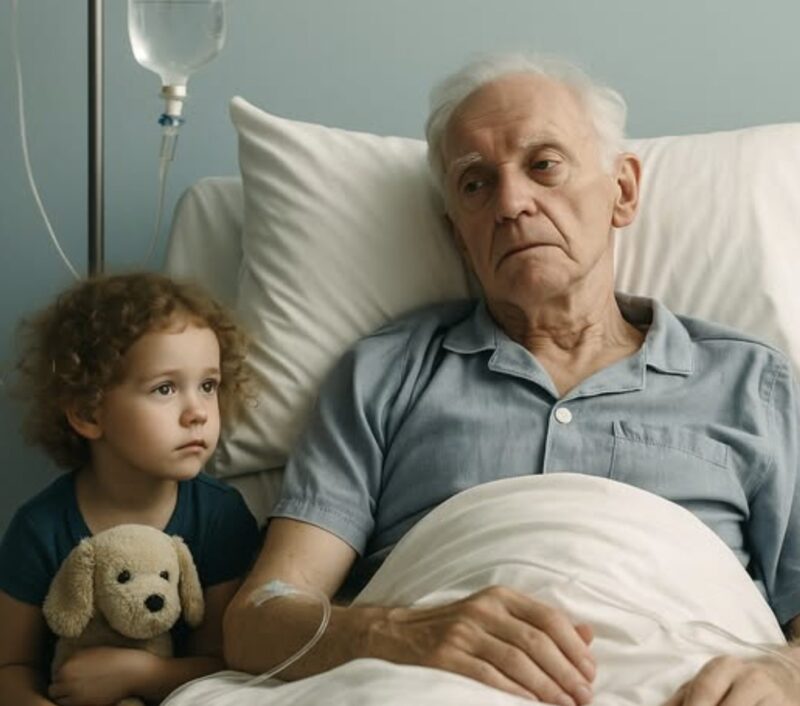
He lay on the bed, staring at the white ceiling, listening to the rhythmic dripping of the IV drip.
The room was filled with a heavy silence, broken only by the faint humming of machines.
Vladimir Sergeyevich Dronov — billionaire, founder of a large corporation, a powerful man whom some respected, others feared, and still others hated.
And now — just a frail old man in a hospital gown, almost devoid of strength.
No one came. Neither the children he had sent abroad to study and had barely seen since.
Nor the grandchildren who grew up without ever hearing his voice.
Nor the wife who had left him long ago in tears and resentment — unable to bear the constant detachment and loneliness beside the “man of business.”
Only an empty room remained, the darkness of night, and shallow breathing.
Towards evening, the door creaked open slightly, and a six-year-old girl silently entered the room.
Curly-haired, with a serious gaze and a soft toy in her hands, she stopped by the chair next to the bed and quietly said:
“Mom says you’re bad… But it seemed to me you’re just sad.”
He barely understood that it was said to him.
“And who are you?” he asked, struggling to speak.
“I’m Alya. I also have an IV drip, but I won’t die.
But you — tomorrow,” she said calmly, as if talking about how it would snow tomorrow.
“But don’t be afraid.
It’s bright there. And if you ask — they forgive.”
He barely smiled. Nonsense. He had always believed in numbers, money, power.
But never in anything afterlife-related. Yet suddenly, real fear gripped him.
Not of death, but of leaving behind nothing and no one needing you.
Never. No one.
“Do you think it’s still possible to fix everything?” he whispered weakly, not as a boss, but as a child lost among people.
Alya nodded and bent down to whisper softly:
“You won’t be here tomorrow.
But while you’re here — there’s still a chance.”
She left, light as a breeze.
He didn’t even notice when he started to cry.
That night, he called his daughter.
He asked for forgiveness.
He wrote letters.
He gave orders to sell his house and donate the money to orphanages.
He sent a voice message to his grandson: “I never knew how to be a grandfather.
But I want to learn… if you give me a chance…”
In the morning, the hearse arrived at the hospital.
But not for him.
Alya had died.
Her heart was too weak to fight the illness.
He sat on the bed, alive, with eyes full of pain.
And new faith.
A year later, he opened a foundation in her name.
When they opened a children’s center, a boy from the orphanage ran up to him, hugged him, and whispered:
“You’re our grandpa now, right?”
He nodded. And in his chest, a whisper stirred: “You fixed everything.”
Since then, everything in his life changed beyond recognition.
Now mornings didn’t start with schedules and stock reports, but with letters.
He wrote to children — asking to meet.
Not in a restaurant or office, but simply in a park, to be close.
To sit in silence.
To hold his granddaughter’s hand — truly for the first time.
At the children’s center named after Alya, life went on.
Children with difficult fates, diagnoses, and losses came there.
And he was with them — not as a patron, but as one of them.
Learning to listen, not pity.
To be there, not lecture.
Not to help with money, but to share time.
“Alya would be proud of you,” a caregiver once told him as he read a story to a boy who was blind.
He froze. His lips trembled.
“Did you know her?” he managed to ask.
The woman nodded.
“She was my daughter.”
He didn’t believe at first, but then she showed him a photo. Alya, laughing, holding that same soft dog toy.
“She had a congenital heart defect.
We lived at the hospital.
She often sneaked off to visit elderly patients.
She told me: ‘They are more afraid than we are.
You just have to stroke their hands.’
That night, she didn’t say where she was going.
I searched for her… then found out who she was with.”**
He found no words.
Just squeezed her hand and cried.
Not from guilt. Not from pain.
But because he felt truly alive for the first time.
Three years passed.
On the hill near the center, a modest monument appeared.
A girl with tousled hair and a toy in her hands. And nearby — a bench.
He came almost every evening.
Sat, talked to her, read letters from his grandchildren.
Sometimes just silent.
On the plaque attached to the pedestal were engraved the words:
“She saved an adult. Because she wasn’t afraid to tell the truth.”
Seven more years passed.
The old man was again lying in a hospital room.
Everything was different — and at the same time, the same: white walls, an IV drip, silence.
But now a small table stood nearby with photographs: smiling grandchildren, children from the center, the daughter who hugged him by Alya’s monument.
He was writing a letter. The last one.
“Alya.
You told the truth then. I wouldn’t have left because of my heart. But because there was emptiness inside.
You gave me another life. A life in which I became different.
I learned to ask for forgiveness — without shame. To listen — without interrupting.
To love — not for something, but just because.
I didn’t become a saint. I became a human being.
Thank you, girl.
If there is light where I’m going, I know you’ll be the first to show it to me.
See you.
Your Grandpa Volodya.”
He carefully folded the paper and put it on the nightstand.
There was a knock. His daughter and grandson entered the room.
“Dad, you weren’t asleep?” she asked.
He smiled.
“No. I was waiting.”
They sat side by side, without a word. Just together. Quietly.
Warmly.
When he left that night, he held their hands.
The farewell was modest. Without pomp, without orchestra. Just sincere words.
And the children from the center. Each holding a plush dog.
His sixteen-year-old grandson read aloud the inscription on the memorial plaque:
“Sometimes the smallest save the biggest.
She whispered — and he heard.
Because he still had time.
And some have it right now.”
Twenty years passed.
The center named after Alya became famous throughout the country.
Children came there not only for treatment but to learn — to understand, to be close, to be human.
People often sat by the monument — some with pain, some with hope, some simply in silence.
And everyone who knew the story changed something inside themselves.
Vladimir Sergeyevich’s daughter became the foundation’s curator.
His grandson — a doctor.
The one children come to without fear.
And those who once crossed the center’s threshold carry the name of the girl who wasn’t afraid to tell the truth.
One evening, a woman came to the center with a little girl.
The girl was silent, but her eyes were like the sky before a storm — deep, anxious, full of something very important.
She approached the monument, laid a drawing beside it, and whispered:
“Alya, may I try to save someone too?”
And a new line appeared on the plaque:
“Words spoken with love can become the start of a miracle.
Even if it’s just the whisper of a little girl.”
And the wind gently rustled the leaves on the hill.