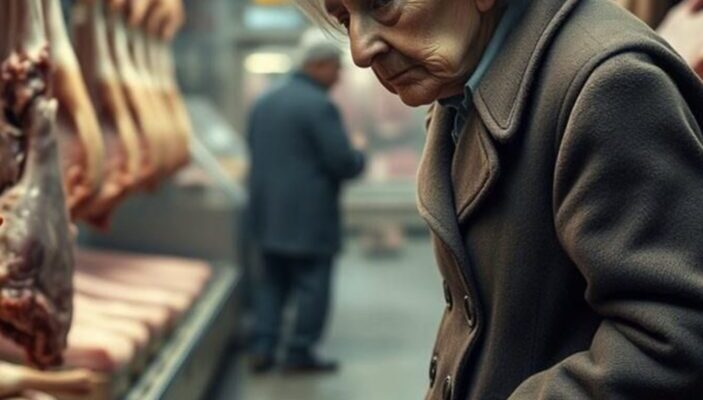
Kirill automatically sliced the meat, confidently guiding the heavy knife over the cutting board.
The blade slid easily through the fibers, fat fell away without resistance, and his movements were precise and practiced.
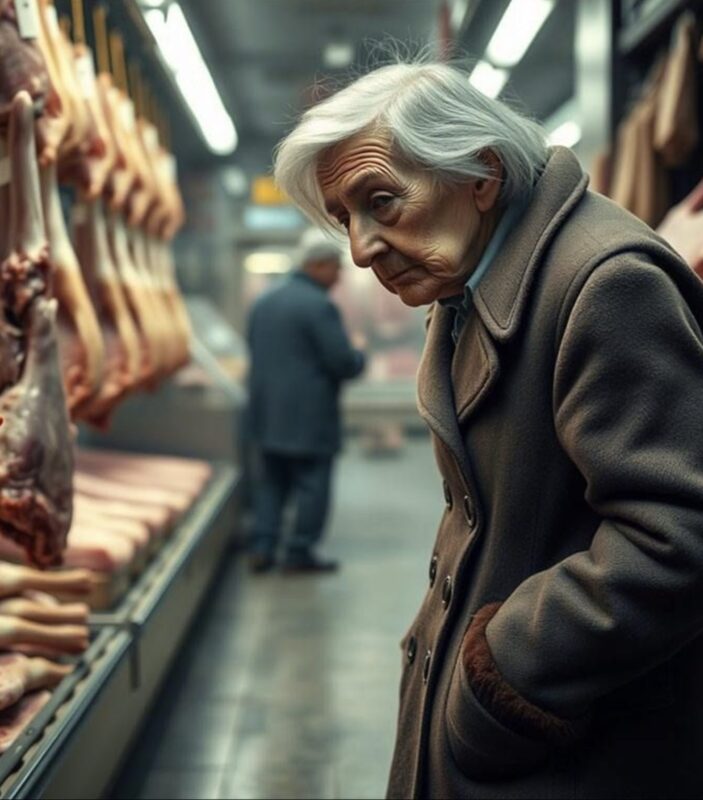
Just another ordinary day: the murmur of customer voices, the chime of the cash register, the smell of fresh meat—which he had long stopped noticing.
But something caught his attention.
At the counter stood a small, hunched figure. An elderly woman—in an old, worn-out coat that no longer kept out the cold.
Her headscarf had slipped slightly, revealing wrinkled cheeks, and her shoulders trembled—whether from a chill or nervousness was unclear.
In her hands, she held a tattered plastic bag, coins clinking softly inside.
She stared at the display case for a long time, but Kirill immediately noticed: her eyes weren’t on the juicy cuts of meat that usually sold first, not the tenderloins, not the appetizing steaks.
She was looking at the bones.
The kind people buy for pets—to give their modest diets a little variety.
Kirill slowed his cutting, watching her closely.
He didn’t even hear the knife slip from his hand and hit the cutting board.
The old woman mumbled to herself, calculating something:
“If I make broth… Maybe it’ll last three days… Yes, it’ll be enough…”
She spoke matter-of-factly, as if this were a regular situation she faced every day.
Kirill wiped his hands on his apron and slowly approached her, feeling something tighten inside his chest.
“Granny, who are the bones for? Feeding a dog?” he asked, trying to keep his tone casual.
The old woman flinched, as if she hadn’t expected anyone to notice her.
For a second, there was embarrassment in her eyes, then she lowered her gaze.
“What dog, dear…” she replied quietly, with a faint, bitter smile.
“Just trying to feed myself… A week until my pension, so I’m counting how to stretch it.”
She said it without complaint, simply stating a fact she had to live with.
Kirill clenched his jaw, looking at her trembling fingers gripping the bag of change.
His eyes darted to the display case, where juicy cuts of meat lay neatly arranged, ready for sale.
He knew their price. He knew they were an unattainable luxury for her.
Without hesitation, he made a decision.
Kirill quickly grabbed a whole chicken, wrapped it in thick paper, and added a good portion of fresh ground meat—one of the most popular items.
He carefully packed it all in a bag, checked that it was well-sealed and easy to carry.
“Here you go, Granny,” he said, handing the bag over the counter.
She froze, clearly not believing her eyes.
She looked at Kirill, then at the bag, as if trying to decide whether this was real or a hallucination.
“Dear, I don’t have that kind of money…” she whispered, helplessly gesturing to her bag of coins.
Kirill smiled, shaking his head:
“What money? This is just for you.”
But the old woman stepped back, clutching her hands to her chest.
“No, no… That’s not right… I’ll pay you later…” she shook her head, her voice filled with unease.
Kirill looked at her gently, his heart aching at her refusal.
“Please, take it,” he repeated softly, pushing the bag a little closer. “From the heart.”
She finally accepted the bag, holding it as if it might disappear at any moment.
Her thin fingers trembled slightly as she clutched the gift tighter.
Tears welled up in her eyes.
“But you’re taking from yourself…” she murmured, looking at him with gratitude and worry.
“Why are you doing this?”
Kirill just shrugged with a smile:
“I’m doing just fine, Granny. I even have some extra meat.”
“Take it, make some soup. At least once a week, have something warm and filling.”
Her hands trembled a bit more as she took the bag. She hesitated, then said softly:
“Thank you, dear… Thank you so much…”
The old woman paused, as if carefully choosing her next words.
Then, unexpectedly, she stepped forward and hugged him tightly, as if he were her own son.
“Thank you, my dear…” she whispered, her voice shaking with emotion.
“May fate return this kindness to you many times over…”
Kirill felt warmth spreading inside, dissolving the last bits of awkwardness.
“Ah, it’s nothing…” he muttered, stepping back. “It’s just a chicken.”
But the old woman knew: it was more than just meat.
It was a sign of care and compassion.
The next day, Kirill went back to work as usual.
Customers came and went, but something had changed in the air.
He could feel it in his skin.
People looked at him differently—with a certain warmth, with gentle smiles.
There seemed to be an invisible aura of gratitude floating around him.
At first, he thought it was a coincidence, but soon a middle-aged woman, a regular customer, approached him with a basket of vegetables.
“Did you really help that old lady yesterday?” she asked, leaning closer so no one else would hear.
“You gave her food for free?”
Kirill froze. He hadn’t expected anyone to notice, let alone talk about it.
“Well… yeah,” he replied awkwardly, scratching the back of his head.
“Just a small thing…”
The woman smiled, her eyes full of sincere admiration.
“Everyone around here knows her. A widow, tiny pension, lives alone… You’re a good man, Kirill. Very kind.”
He tried to hide his embarrassment, waving it off.
“Come on… It was nothing.”
But the woman paid for her groceries, nodded to him, and left the shop, leaving him with a pleasant feeling inside.
A few hours later, just as Kirill had almost forgotten the conversation, Vasilych walked in—the neighboring vendor, a burly man with kind crow’s feet around his eyes.
“Heard you helped that old lady, Kirill,” he said, placing two homemade pies on the counter.
“Here. From us. For you.”
Kirill blinked in surprise, not even having time to protest.
Vasilych patted him on the shoulder and was already heading to the door.
“Hey, wait! You can’t just—” Kirill tried to call after him, but the man simply waved and left him with the fragrant pies.
Kirill smirked, placing them in the fridge. “What a turn of events,” he thought, feeling warmth spreading through his chest.
The next day brought more of the same—but with a new twist.
At the register was a young woman with soft features and a light-colored headscarf.
She picked out a few items, paid, then casually placed a chocolate bar next to the till.
“Just because,” she said with a gentle smile and a wink.
“It’s for you.”
Kirill froze, staring at her in amazement.
Just yesterday, he’d made a simple choice, not thinking about the consequences. Now, people around him seemed to be starting a chain reaction of kindness.
He picked up the chocolate bar, turned it in his hands, and a smile spread across his face.
“Kindness really does come back,” he thought, feeling a lightness inside.
Exactly a week later, the old woman returned to the shop, at the same hour as before.
Kirill recognized her right away. She walked more confidently now, though still carefully.
The timidity in her eyes had been replaced with quiet dignity.
Approaching the counter, she pulled a few neatly folded bills from her coat pocket.
“Here, dear,” she said, looking Kirill straight in the eyes.
“Got my pension. I want to pay you back for that chicken.”
Kirill was stunned, unsure what to say. He looked at the money, then back at her.
“Granny, why? It was just my decision, nothing special…”
She shook her head firmly.
“No, dear. That wasn’t charity. That was pure kindness. And kindness should be repaid with kindness.”
She reached into her bag and pulled out a small bundle.
Unwrapping it, Kirill saw warm, carefully knitted socks.
“Here, for you,” she said, handing them to him.
“So your feet don’t get cold.”
He took the gift gently. The socks were soft, thick, and beautifully patterned.
He ran his fingers over the stitching, feeling warmth not just in his hands—but in his heart.
“Granny…” was all he could say, looking at her with deep gratitude.
She smiled, her face lighting up with the kind wrinkles that made her look even kinder.
“Wear them in good health, son,” she said, turning and slowly heading toward the exit.
Kirill watched her until she disappeared through the door.
A strange feeling filled his chest—not sadness, but something warm and bright.
He looked at the socks again and squeezed them in his hands.
And he realized: no fleece blanket could ever warm him more than this simple, love-filled gift.