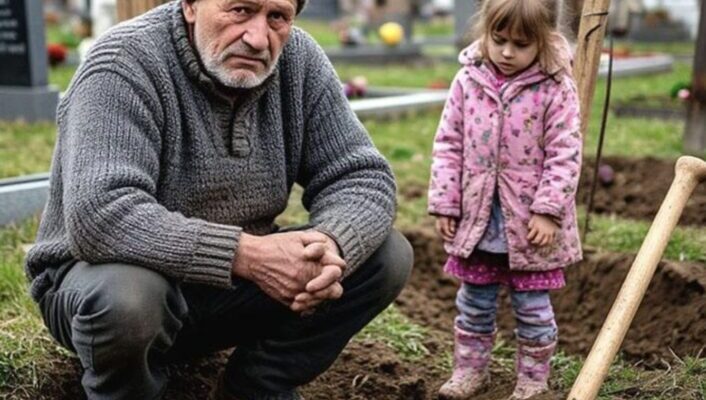
Semyon Petrovich, or simply Petrovich — that’s what everyone who occasionally came to this forgotten-by-God place called him — with a strained groan plunged the shovel into the heavy, damp earth.
Another day, like hundreds before.
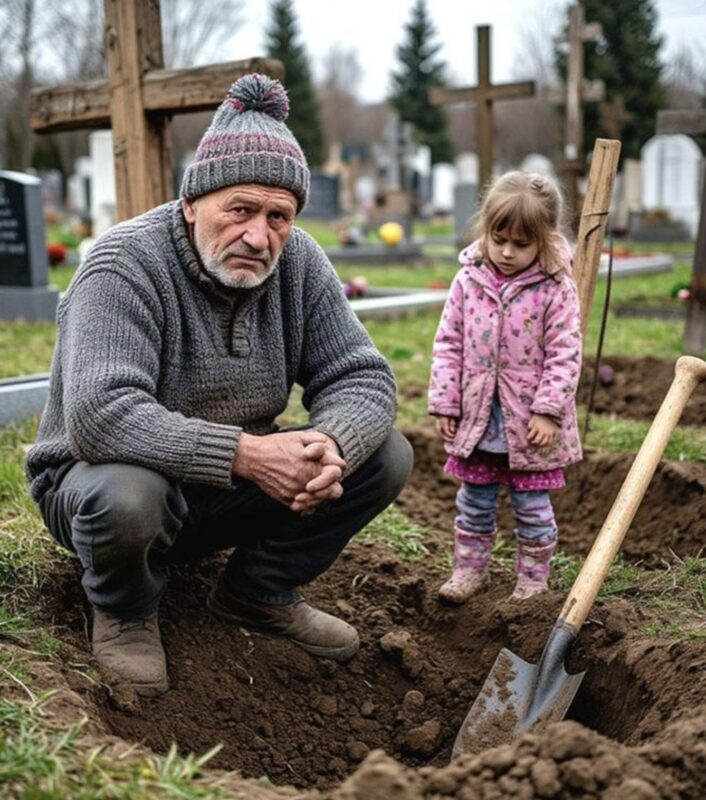
He had been working here, at the old village cemetery, for twenty years — ever since the noisy and cruel city spat him out to the outskirts of life.
Here, among the graves and crosses, reigned silence. Here there was no pretense.
Petrovich often grumbled about modern times — about young people absorbed in smartphone screens, about how people had forgotten how to feel and mourn genuinely.
But he did so without bitterness, rather with tired understanding: the world changes, and he remains in his place.
He had long grown accustomed to loneliness, the smell of damp earth, the heaviness of honest labor that ached all over, yet left the soul calm.
“Grandpa Petrovich!” — a voice rang out, clear as a little bell, scattering the old man’s thoughts.
Over the hummocks, lightly and carelessly, ran a girl of about eight — thin, with sharp shoulders, in worn sandals and a faded calico dress. Alyonka.
His little visitor, almost like family.
To this place, she was as natural an element as the ancient crosses and the silent crows on the birches.
“Here you are again, my little bird,” Petrovich rumbled, leaning his shovel against a mound.
He wiped his hands on his trousers and rummaged through his tattered bag. “Hungry, I bet?”
He handed her a sandwich wrapped in old newspaper.
The girl took it with both hands like a treasure and immediately began to eat, hurrying and openly joyful.
Her cheeks moved quickly, and Petrovich couldn’t help smiling.
“Slow down, or you’ll choke,” he reproached, though only care was heard in his voice.
He knew where Alyonka lived, and his heart ached with sympathy.
When the food was gone, the girl lifted her big, too-serious eyes to him.
“Grandpa Petrovich… Can I stay the night here today?” she whispered, tugging at the hem of her dress.
“Mom… is going to get married again.”
Petrovich understood without explanation. “Getting married” for them meant drunkenness, noise, men, strange looks, danger.
And bruises he had seen on Alyonka’s arms a couple of months ago.
Then he had come to their house, thrown the door open, and just by his presence silenced everyone.
But he knew — it was temporary.
“Of course you can, little bird,” he sighed. “Let’s go, it’s getting dark soon.”
The next day, Petrovich dug a new grave — for a young woman.
She drowned in a luxury car outside the city.
Relatives arrived — strangers, cold, clearly more interested in the inheritance than the deceased.
He worked, thinking about the unfairness of the world.
Money, beauty, youth — yet no one stood by the coffin, no one shed a real tear.
Just vanity and greed.
Alyonka sat nearby on a bench, her legs dangling.
She had already become part of this place, like its little shadow.
“Grandpa, who died?” she asked.
“A young woman,” he replied without turning.
“Do you feel sorry for her?”
“All dead deserve pity, Alyonka. They can’t change anything anymore.”
He straightened up, leaning on the shovel. The pit was ready — deep and even. The work was done.
“Let’s go warm up with some tea,” he invited. “You must be freezing.”
The girl ran to him and trustingly grabbed his calloused hand with her small palm.
That simple touch warmed something inside.
And the little guardhouse, though tiny and smelling of old herbs and smoke, was the safest place on earth for Alyonka.
In the morning, the hearse arrived. The black car stopped by the fresh grave.
Two men in strict suits stepped out, carried the lacquered coffin, and placed it on stools at the edge of the pit.
“Make it quick, we have business,” one of them said to Petrovich.
The old man frowned. He hated this fuss. You had to stand, be silent, say goodbye properly.
“It can wait,” he answered sharply. “This isn’t firewood. That’s how it’s done.”
The men shrugged, returned to the car, and drove off, promising to come back in an hour.
Petrovich was left alone — with the coffin, with silence, and with the last hour of peace for one who should not lose it.
He sat on the bench, smoking his hand-rolled cigarette, looking at the coffin.
At that moment, Alyonka silently slipped out of the guardhouse.
She crept to the grave, squatted, and peered inside.
On the white satin lay a beautiful woman with a waxen face.
It seemed she was just sleeping.
Alyonka looked for a long time, then turned to Petrovich and quietly asked:
“Grandpa, you’re not really going to bury her, are you?”
Her words hit his chest so hard he caught his breath.
Petrovich coughed, stubbed out his cigarette.
He wanted to shoo the girl away, tell her not to look, but he couldn’t.
Something in her eyes, in the certainty that everything around was a game, stopped him.
He found no words.
“Go on, Alyonka, you don’t belong here,” he croaked, approaching the coffin.
He had to close the lid. He reached for it, but suddenly his fingers touched the woman’s skin.
Cold, but not completely. Not like the dead.
His heart stopped.
He pressed his fingers again to her neck, to the carotid artery.
A second… another…
Under the skin, barely noticeable, but there was a pulse — alive!
Petrovich stepped back as if burned. His thoughts raced.
He remembered a long-ago case when doctors made a mistake and a person awoke in the morgue.
A lethargic sleep.
If not for Alyonka, if not for her question, he would have done something terrible.
His hands trembled as he dialed the emergency number.
When the doctors, puzzled, took the woman away, Alyonka ran up to him and looked up with childish delight:
“Grandpa, you saved a person! You’re a wizard!”
Petrovich sat down on the bench and pulled the girl close.
“It was you who saved her, little bird,” he said softly, stroking her head.
“Only you. Without you, I would have taken on such a sin I’d never have atoned for.”
A month passed.
Life at the cemetery returned to its usual course.
Petrovich, as before, dug graves, and Alyonka spent every day with him.
Summer slowly faded into the past, and the old man increasingly thought about school.
He carefully set aside every coin from his meager salary, planning to go to the city — to buy the girl notebooks, pens, a backpack, maybe even something warm for autumn.
That day, he was counting his meager savings when there was a knock at the guardhouse door.
Petrovich was surprised — guests rarely came.
Opening the door, he froze.
A woman in an expensive coat, with neat hair and a warm smile, stood on the threshold.
Something about her face seemed familiar, but he couldn’t remember.
“Don’t you recognize me?” she asked softly, her eyes sparkling with lively sparks. “The one who was dead.”
Petrovich’s breath caught.
Before him was the very woman he had almost buried.
Now she was alive, well, with rosy cheeks and bright, shining eyes. Marina.
“You… how…?” he managed to utter.
“Just like that. Thank you. And your granddaughter.”
“She’s not my granddaughter,” Petrovich muttered, letting her inside.
He made tea, brought out two cracked mugs.
Marina sat on a wooden bench, looking around with interest.
They talked for a long time.
She told how distant relatives, wanting to get the inheritance, bribed a doctor who gave her a drug that induced a state resembling clinical death.
Everything was planned down to the smallest detail.
But chance — or fate — intervened.
A criminal case was opened against them.
Petrovich, in turn, told of his lonely life and how Alyonka had become the most important person to him.
In the midst of their conversation, the door burst open and the girl herself peeked in.
Seeing the stranger, she froze at the threshold, shy and cautious.
“Here’s my second savior,” Marina smiled, looking at Alyonka with gratitude and warmth.
When she learned they were going to the city for school supplies, Marina declared firmly:
“No buses. I’ll take you. And don’t argue, Semyon Petrovich — it’s the least I can do.”
Petrovich snorted but didn’t object.
Half an hour later, they were driving in Marina’s brand-new car.
For Alyonka, it was a real celebration — she pressed her face to the window, not taking her eyes off the flying trees and houses.
In the city, Marina took them to a large children’s store.
She moved through the aisles like a fairy, and soon Alyonka had more clothes than she had ever owned: dresses, jeans, shoes, sneakers, a warm jacket, and the most beautiful butterfly-decorated backpack.
Petrovich stood aside, embarrassed, but seeing the girl’s shining eyes, he understood — it was worth it.
After shopping, Marina took them to a café.
Alyonka had never been to such a place in her life.
She sat straight as a stick, in her new blue dress, and reverently ate ice cream with chocolate and berries, trying not to spill a drop.
“So, beautiful girl, what school are you going to?” Marina asked.
Petrovich suddenly turned cold.
He had completely forgotten about one important matter.
“Documents…” he muttered. “I didn’t even think about the documents.”
All three understood: Alyonka’s mother was unlikely to bother with paperwork.
And the new things might soon be exchanged for vodka.
The joy of the day was clouded by worry for the girl’s future.
That night Marina couldn’t sleep.
Lying in a spacious but empty apartment, she thought about herself.
She had money, a career, but no one who would sincerely love her and grieve if she were gone.
That story at the cemetery — it was no coincidence.
It was a chance to start over, to fill life with meaning.
In the morning she made a decision.
She went to Alyonka’s mother.
The situation in the house was worse than she expected: dirt, the smell of alcohol, empty bottles.
The woman met her suspiciously.
“What do you want?”
“I need Alyonka’s documents.”
“Give me money — then we’ll talk.”
Marina silently put a stack of bills on the table.
The woman’s eyes lit up.
She pulled a folder with documents out of a dresser and handed it over.
The deal was done.
Marina left without looking back.
She knew — she wouldn’t let this girl disappear into such a life.
She would take responsibility for her.
The long process of formalizing guardianship began.
Marina hired the best lawyers, went to various agencies, proved she could be a good mother.
The things for Alyonka stayed with Petrovich for now — as a symbol of hope for the future.
On September 1st, Marina came to the cemetery.
She looked exhausted but happy.
“That’s it, Semyon Petrovich,” she said.
“I got guardianship. Tomorrow I’m taking Alyonka to live with me.”
Petrovich froze.
He was happy for the girl with all his heart, but the thought that he wouldn’t see her anymore, wouldn’t hear her voice, squeezed his heart.
His world, so familiar and settled, suddenly emptied.
He silently looked at Marina, unable to find words.
She understood his pain, sighed, and gently suggested:
“Come with me, Semyon Petrovich. See where our Alyonka will live.”
He agreed.
They arrived at a large, bright house outside the city.
Marina showed the girl’s room — cozy, with white furniture and toys.
Then she opened the door to the next room.
There was a bed, an armchair, a bookshelf.
“This is for you, Semyon Petrovich,” she said quietly.
“What kind of home is it without Grandpa?”
Alyonka needs a grandpa — a real one.
And I need a family, too.
Move in with us.
Petrovich looked at her, tears streaming down his face.
He, an old gravedigger, who had spent his life alone, suddenly had a home, family, warmth.
He silently nodded.
The next morning, the three of them walked to the school ceremony.
Alyonka — in a new uniform, with white bows, shining.
Marina — elegant, confident.
Petrovich — in a new suit, proudly straightening his back, looking younger, as if time had turned back.
Holding the girl’s hands, they entered the schoolyard filled with children dressed up and anxious parents.
Petrovich leaned toward Marina and whispered:
“Look, ours… is the prettiest of all.”