The autumn wind swirled over the cemetery, lifting yellow leaves from the ground.
Anna Alekseevna adjusted her coat collar and crouched by the grave.
The granite monument gleamed after the recent rain.
Two faces looked at her from the photograph — a man about thirty-five years old with an open, kind gaze, and a boy, as if a miniature copy of him.
“Hello, my dears,” the woman whispered quietly, pulling a small brush from her bag.
“More leaves have blown in again. I’ll clean everything up now.”
She carefully cleaned the stone, speaking almost in a whisper, as if she knew they could hear her.
She talked about matters on the farm — the very one they once built together with Vasya.
About the old tractor acting up again, and Petrovich, their mechanic, already cursing.
About greetings from the neighbor Marya Ivanovna.
Her phone vibrated in her purse. Anna Alekseevna sighed and took it out.
“Yes, Lenochka?”
“Anna Alekseevna, you asked me to remind you! The concert at the Community Center starts in an hour!”
The woman flinched. Time… how quietly it slips away when you are here, among the past.
“Thank you, dear. I’m coming now.”
Lena was her secretary but, in essence, closer than a biological daughter.
An orphan who grew up in a children’s home.
They had met a couple of years ago at a similar charity concert.
Back then, the girl helped backstage — and managed to do so much!
Comfort a distressed child, fix a dress, say the right word to each before they went on stage.
After the deaths of Vasya and Kiryusha, the only meaning in Anna’s life was to help children.
At first, she simply sent money to orphanages.
But over time, she wondered — did it actually reach them?
Then she came up with her own system: charity concerts.
Transparent, honest, giving a chance to those who had never had one before.
Anna Alekseevna stood up, brushed the leaves off her knees.
“Well, my dears… it’s time for me to go. The children are waiting. I’ll be back soon, I promise.”
A lonely tear slid down her cheek. Five years. A whole five years without them.
The community center buzzed like a disturbed beehive.
As soon as Anna Alekseevna entered the lobby, children clung to her — cheerful, dressed up, full of joy.
“Anna Alekseevna! I’ve memorized the whole poem!”
“And I put on a new dress, look!”
“Aunt Anya, are there really many people there?”
She smiled, patted each child’s head, found a warm word for every one.
Nelli Sergeevna, a young teacher burning with excitement, hurried over to them.
“Children, come on! Let Anna Alekseevna at least take off her coat!”
“It’s okay, Nelli. How are you? Is everyone ready?”
“Oh, Anna Alekseevna! The place is packed! And everyone important came!”
“Good. That means we’ll raise enough. Has Andrey Ivanovich arrived?”
“In the front row, he left a seat next to him for you.”
Andrey had entered her life a year ago. He offered to help with concert advertising — and he really did.
Thanks to him, the hall was full today. A pleasant, reliable man.
Only for some reason, he was trying to court her. As if he didn’t understand her heart had gone with Vasya and Kiryusha.
The hall was indeed packed to capacity. Only one seat in the front row was free — next to Andrey.
Seeing her, the audience applauded. Anna Alekseevna nodded and sat down.
“You look magnificent tonight,” he whispered.
“Thank you,” she replied dryly, turning her gaze to the stage.
The concert began. Little Vanechka danced cheerfully to “Kalinka-Malinka,” the hall laughed and clapped.
Girls from the senior group performed a waltz — a little awkward but with such effort that many women had tears in their eyes.
The host came on stage:
“And now, a boy with an amazing voice will perform.
His name is Kostya.
He came to us from another city.
He has had a difficult fate — he was ill for a long time, underwent several surgeries.
But that’s why his songs touch the heart — about hope, about strength of spirit…”
Andrey leaned over:
“After the concert, may I invite you to dinner?”
“Andrey Ivanovich,” Anna turned sharply to him, “how many times must I say… I…”
She didn’t finish.
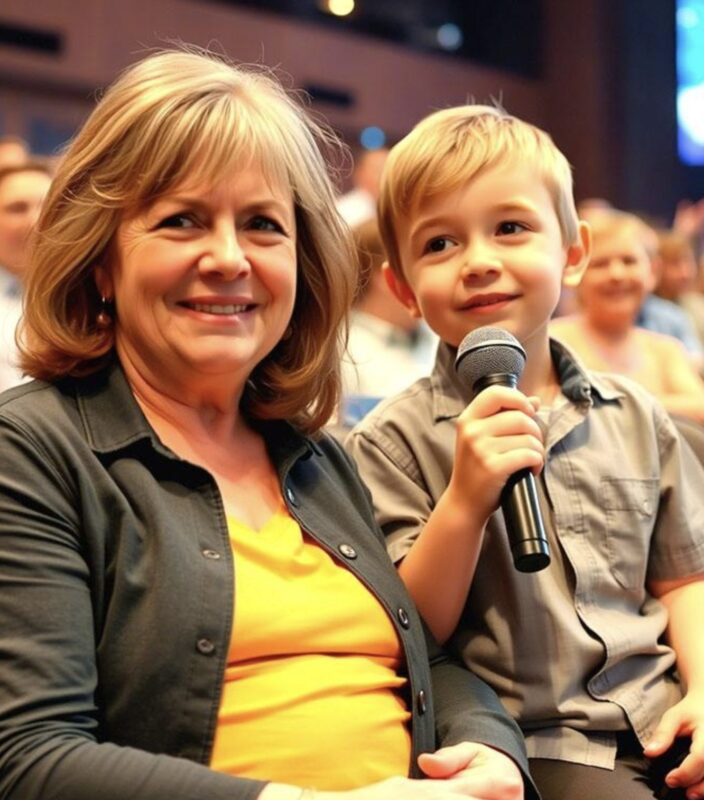
A boy about nine years old stepped onto the stage. Thin, with big gray eyes.
And Anna Alekseevna suddenly felt a blow to her chest.
It was Kirill.
No, he had grown, but she would recognize him out of a thousand. The same features, the same tilt of the head, the same posture…
“Kiryusha!” she burst out.
The boy flinched. The hall froze. And Anna Alekseevna saw nothing — dark circles flickered before her eyes.
She came to in the dressing room.
A doctor checked her pulse, Andrey held her hand, organizers crowded nearby, worriedly whispering.
“Anna Alekseevna! Thank God! How do you feel?”
She sat up sharply, pushing the doctor away:
“Where is the boy? Where is he?!”
“What boy? Anna, you need to…”
“My son! Where is my son?!”
Everyone exchanged looks. Andrey said cautiously:
“Anna, you know that Kirill…”
“Give me my bag! Quickly!”
With trembling hands, she pulled out her wallet and took out a photo.
Everyone gasped — the resemblance was striking.
“It can’t be… a coincidence…” someone murmured.
But Anna Alekseevna was already walking down the corridor. Her intuition led her confidently.
In one of the rooms, she saw him — the boy sat on a chair, scared and curled up, looking at the adults.
“What’s your name?”
“Kostya…” he barely whispered.
Anna crouched before him, studying his face. No, this was not Kirill.
Now, up close, she saw differences: no birthmark above the eyebrow, a different chin, and no scar on the temple either.
But hope, even if false, touched her heart again.
But the resemblance… God, what a striking resemblance!
“Kostya, what’s your last name?” Anna Alekseevna asked, trying to speak calmly.
“I don’t have a last name. I’m from an orphanage.”
The woman’s heart froze.
“Do you have parents?”
The boy shrugged:
“I don’t know. Aunt Valya says I went to the hospital right away. I was sick for a long time.”
Next to Kostya stood an unfamiliar woman — apparently a caregiver.
“May I have a minute?” Anna addressed her.
In the corridor, she looked the woman straight in the eyes:
“Tell me everything you know about this boy. Everything.”
The woman introduced herself — Valentina Petrovna — and adjusted her glasses awkwardly:
“What’s there to tell… He was brought to us from the hospital four years ago.
Before that, he lay there for over a year — surgeries, intensive care… He was born with a serious heart defect, doctors gave no hope.
But some foreign professor took on the operation for free.
A miracle, honestly! And he has no parents — he’s a ‘refusal case’.”
“Refusal case? Are you sure?”
“The documents say so: the mother refused him right at the maternity hospital.”
Anna Alekseevna leaned against the wall. Thoughts whirled like leaves in the wind.
A difficult twin pregnancy. The doctor’s words: “One fetus develops at the expense of the other. The second won’t survive.” Premature birth.
And then Vasya, with tears: “We have a son. One son.”
“Give me the address of your orphanage.
And I’ll need Kostya’s genetic material for testing.”
“You think he’s yours?..” Valentina Petrovna breathed out.
“I don’t know yet. But I must check.”
Two weeks were a real ordeal.
Anna Alekseevna rushed between cities, collected documents, sought permissions.
Andrey helped however he could — found the right people, arranged meetings.
And here was the result: the genetic test confirmed the incredible — Kostya was her son.
The prosecutor’s office just shrugged — the case was five years old, none of the doctors still worked at that maternity hospital.
But the fact remained: the child was officially registered as stillborn, although he was alive.
Why? Who decided this?
After a long search, they found the head nurse from the maternity hospital — now retired.
She denied it for a long time but eventually gave in:
“It was a nightmare. The twins were born prematurely — one boy healthy, the other blue, without breathing.
They took him away, and an hour later, it turned out he was alive! But the paperwork was done, the mother unconscious, the father in shock.
The chief doctor said: ‘Don’t complicate things. The child won’t survive anyway.’
So they sent him to the hospital as a foundling.”
“How could you?!” Anna almost shouted.
“What could we do?” the woman cried. “The chief doctor threatened to fire me.
I have three children, where would I go without a job?”
Anna Alekseevna left the hospital as if in a fog. Five years.
Five years her son was alive, and she thought he was dead.
Five years he grew up without family, without love, without a mother…
The papers to restore motherhood were processed urgently.
The story got wide publicity; journalists besieged the orphanage.
Kostya watched everything cautiously.
He was used to being alone.
Used to adults coming and going. And here was this woman saying — she was his mother.
“Kostya,” Anna Alekseevna said, sitting with him in the playroom.
“I know it’s hard to accept.
It’s hard for me too. But you’re my son. And I will take you home.”
“Why did you abandon me?”
Those words hurt deeply. The woman swallowed:
“I didn’t abandon you, dear. They told me you… didn’t survive birth.
I thought you were in heaven, with dad and your brother.”
“I had a brother?”
“Yes. You were twins. His name was Kirill.
He… died with dad five years ago.”
Kostya thought, then cautiously took her hand:
“You’re crying. Don’t.”
Then Anna couldn’t hold back — she burst into tears. And the little boy, whom she had mourned for so many years, gently stroked her head and repeated:
“Don’t cry, auntie… I mean, mom. Don’t cry, mom.”
On the day Kostya was officially handed over to his mother, Anna Alekseevna brought him to the cemetery.
“Here is dad and Kiryusha,” she said quietly.
“Do you want to say something to them?”
Kostya looked at the photos for a long time. Then he put his toy bear on the grave — his only toy from the orphanage.
“This is for Kiryusha. So he won’t be bored.”
Anna bit her lip to hold back new tears.
As they were leaving, Andrey, who had come to drive them, lingered by the grave.
Turning around, Anna heard him say:
“…I didn’t know you, Vasily Petrovich. But you were a good man, if Anya loved you so much.
I have come to love your wife. And your son I will love as my own.
I promise to protect them. Forgive me.”
Kostya tugged his mother’s hand:
“Mom, will uncle Andrey live with us?”
“I don’t know, son. We’ll see.”
“That would be nice. I like uncle Andrey.”
Anna looked at the man patiently waiting by the car.
Maybe… maybe life really goes on even after the worst pain?
Especially when a miracle happens.
“Let’s go home,” she said to Kostya. “Grandma Marya Ivanovna baked apple pies.
Do you like them?”
“I don’t know. They only gave them in the orphanage on holidays.”
“Then you’ll eat them every day.”
They got in the car. Kostya suddenly asked:
“Mom, do dad and Kiryusha see us?”
“Of course, dear. They’re happy for us.”
“That’s good. So now we’re all together.
They’re just in heaven, and we’re here.”
Anna Alekseevna hugged her son tightly.
Now they were really all together — not as she dreamed, but together.
And that was enough.