
The night was humid and stifling, as if the air had thickened.
Cars rarely passed the deserted intersection — their headlights briefly lit up two people frozen over a body on the wet asphalt beneath the trembling glow of a streetlamp.
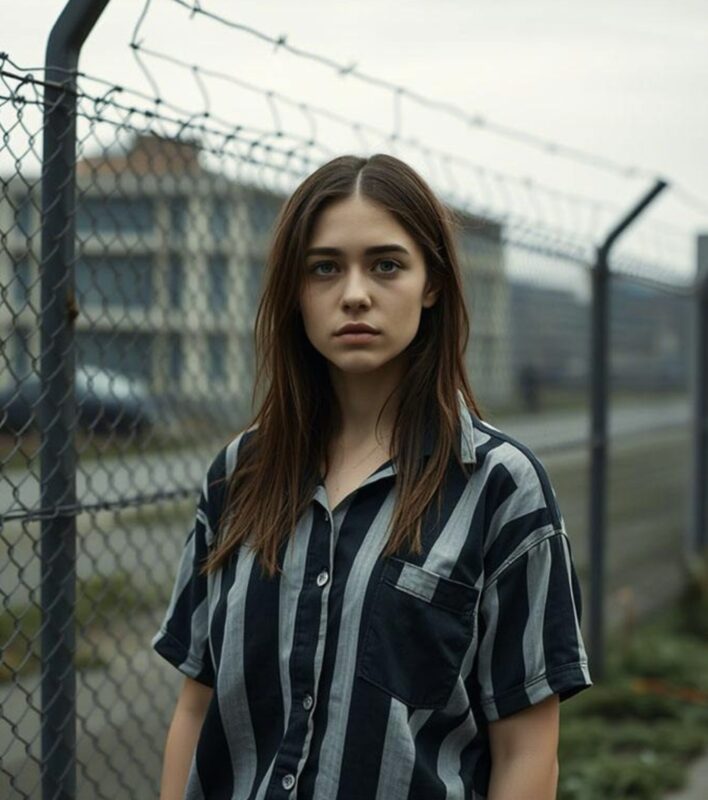
The body lay motionless, and next to it stood Igor — her husband.
He was shaking with fear, his face paler than the pavement.
Marina, on the other hand, felt a strange calm — almost icy.
The panic had vanished, replaced by a primal instinct — to protect.
To protect him, her beloved, frightened, lost man who now looked at her with the eyes of a child suddenly confronted with death.
“I… I killed him,” he stammered, his voice trembling like a terrified teenager’s. “Marina, I killed someone!”
She grabbed his shoulders sharply, shook him, trying to bring back a shred of reason before fear completely consumed him.
“It was self-defense!” she said firmly.
“He attacked us, remember? And he wasn’t alone — the other one ran.
He could come back. Or the police could.”
It was a small town, nearly provincial.
Everyone knew everyone, and any news spread faster than the wind.
The fear in Igor’s eyes, his trembling, confusion — it was all too obvious.
They would find him. Accuse him. Convict him. And he wouldn’t survive it. He’d break under the first interrogation.
A plan formed in Marina’s mind — brutal, mad, but the only option.
She looked at her husband: slumped shoulders, quivering lips, helpless hands.
No, he wouldn’t cope. But she could.
“Go home,” she said firmly, pushing him into the dark. “Go to bed.
If anyone asks — you were at home. Understand? Or you’ll go to prison.
You’re a man — they’ll give you time. I might get a lighter sentence. I’m a woman.”
She called the ambulance and the police herself. Her voice on the phone was cold, calm — as if she were reporting a burst pipe.
At that moment, as she hung up, Marina understood: there was no turning back. She had made her choice.
The police station was cold and smelled of old paint.
Marina answered the investigator calmly, confidently, almost indifferently:
“I was walking home from work, he jumped out from around the corner, tried to snatch my bag. I fought back… pushed him… he fell. I didn’t mean to.”
Her first night in the cell. The cold, the creaking wooden bunk, the flickering light overhead.
Marina lay staring into the darkness, repeating like a mantra: “I did the right thing.
He won’t betray me. He’ll wait.”
The cell was like a forgotten dormitory. The air was thick with sweat, cigarette smoke, and sorrow.
At first, Marina — neat and quiet — tried to be invisible.
But that couldn’t last.
The boss of the cell was Rys’ — skinny, sharp, with a piercing gaze.
On the second day, she approached Marina like a predator sizing up prey:
“Murder? What are you in for, little mouse?”
Next to her sat Wanda — an older woman with sad eyes that seemed to reflect a lifetime of pain.
She looked at Marina kindly, almost motherly.
“Don’t listen to her. Tell it like it is. You’ll feel better.”
And Marina told them. Almost the whole truth. About the self-defense, the fear.
But her eyes revealed more than her words.
“For a man, right?” Rys’ snorted. “Fool. He’ll dump you. They all do.”
Marina said nothing, lips tightly pressed. She wouldn’t allow herself to doubt. She believed. She had to believe.
Her only connection to the outside world was the rare letters and packages from Igor.
He brought food, sat behind the glass, told her he loved her, that he was holding on.
Every word gave her strength. “He won’t betray me,” she whispered to herself each night as she lay on the hard bunk.
After a few years, good behavior and repentance paid off — she was granted early release.
Marina was coming home.
Igor met her at the colony gates. He seemed distant, tense. He hugged her quickly, let go, avoiding eye contact.
“I was offered a job,” he said as they rode in the taxi.
“Driver in the North. Pays well. Might be gone a while.”
Marina, intoxicated by freedom, didn’t notice the warning signs in his voice.
She rejoiced in the sunshine, fresh air, city streets.
Everything will be fine, she told herself. It just needs time.
But reality was harsh. Wherever she applied for work, she hit an invisible wall:
“We don’t hire ex-cons,” they said — politely or with disdain.
Finances dried up. Before leaving, Igor left her an envelope with money:
“For now. I’ll send more.”
But no more came. The money ran out. Jobs didn’t appear. Marina pulled out her father’s old Zhiguli, fixed it up, and started driving a taxi.
It was a new kind of hell. Drunk passengers, harassment, brazen teens skipping fares.
One day a talkative client asked about her past. Marina told the truth.
His face changed immediately. He asked to stop the car, threw a crumpled bill on the seat, and got out — as if she were contagious.
That night she cried behind the wheel, feeling humiliated and utterly alone.
One rainy autumn evening, exhausted and irritable, Marina was driving home.
Dark thoughts swirled in her mind, the road blurred before her eyes.
Then — a poorly lit crosswalk. She saw the figure too late.
Brakes screeched, a dull thud followed. Her heart stopped.
Marina jumped out of the car. A man sat on the wet pavement, clutching his leg.
“Are you alive?” she whispered, feeling the ground slip from beneath her.
Panic swallowed her. Not again. Not prison. Anything but that.
The man’s name was Artyom. He tried to stand but cried out in pain.
Calling the police was out of the question — that was Marina’s first thought.
Almost instinctively, she helped him into the car and took him home.
She treated his scrapes, iced the swelling on his head, gave him hot tea.
Gradually, they started talking. Artyom turned out to be calm, kind, not accusing her, not afraid — even apologizing for the trouble.
The conversation flowed more easily, more openly.
Then Artyom’s eyes fell on a photo on the dresser: a happy young Marina and Igor — before the nightmare that had torn them apart.
“Is that your husband?” he asked cautiously. His voice was suddenly wary.
“Yes,” Marina nodded. “He’s away. Far away.”
Artyom thought for a moment.
“Sorry… but does your Igor happen to have a twin brother?”
Marina frowned. He began speaking carefully — about a friend named Vera, her common-law husband also named Igor, and strange inconsistencies in their relationship.
Marina’s blood ran cold. She tried to shake off the horrible suspicion, but the words of Rys’ from prison began to stir like a poisonous weed.
“Come with me,” Artyom offered gently. “Let’s just check.
It’s better to know the truth — whatever it is.”
The drive to the suburbs felt endless. Marina clutched the wheel, her hands cold with fear.
Here was the house. The door. The bell. A woman opened — pregnant — Vera.
Her eyes scanned Marina, then landed on Artyom.
“Artyom? What’s going on?”
A voice rang out from inside — a voice like an electric shock:
“Verochka, who’s there?”
Igor stood in the doorway. He froze when he saw Marina. His face turned ghostly pale.
Time stopped. Then Marina stepped forward and slapped him across the face — hard.
The smack echoed through the whole apartment.
“What are you doing?!” Vera screamed, rushing to his defense.
Chaos broke out. Lies, betrayal, double life — all laid bare.
Vera learned that the man she loved wasn’t just married — his wife had just been released from prison after serving time for him.
“You told me you were away on long hauls!” she shouted. “You lied to me!”
Vera had spirit. Through tears, she shoved Igor out the door and hurled his things after him:
“Get out! And never come back!”
When Marina returned home, another shock awaited — Igor was already there.
Like he still owned the place, he had dragged his things in and sat in the kitchen like nothing happened.
It took Artyom’s help to throw him out. Even Igor’s mother showed up, wailing:
“Marinochka, sweetheart, forgive my idiot son! He’s been a fool!”
After everyone left, Marina and Artyom sat for a long time in the kitchen.
She told him everything — without hiding a thing. About love, sacrifice, blindness, and the pain of betrayal.
He listened carefully, without judgment, with genuine respect in his eyes.
A week later, Artyom proposed. Simply, without fanfare.
He said a woman like her deserved real happiness.
They started a new life. They supported Vera, who gave birth to a son, Danya.
They rented out Marina’s old apartment and moved to another city — where no one knew their past.
Months passed. They were renovating a new home.
The air smelled of paint, freshness, and hope. Over tea from new mugs, they talked about plans.
Marina looked at Artyom — into his warm, kind eyes — and smiled.
“You know,” she said softly, “this whole awful story… it was worth it, if it brought me to you.”