
Marina hunched her shoulders, trying to shield herself from the sharp winter wind, but suddenly felt someone walking behind her.
Turning around, she saw a woman in a bright scarf and a painted sundress quickly closing the distance between them.
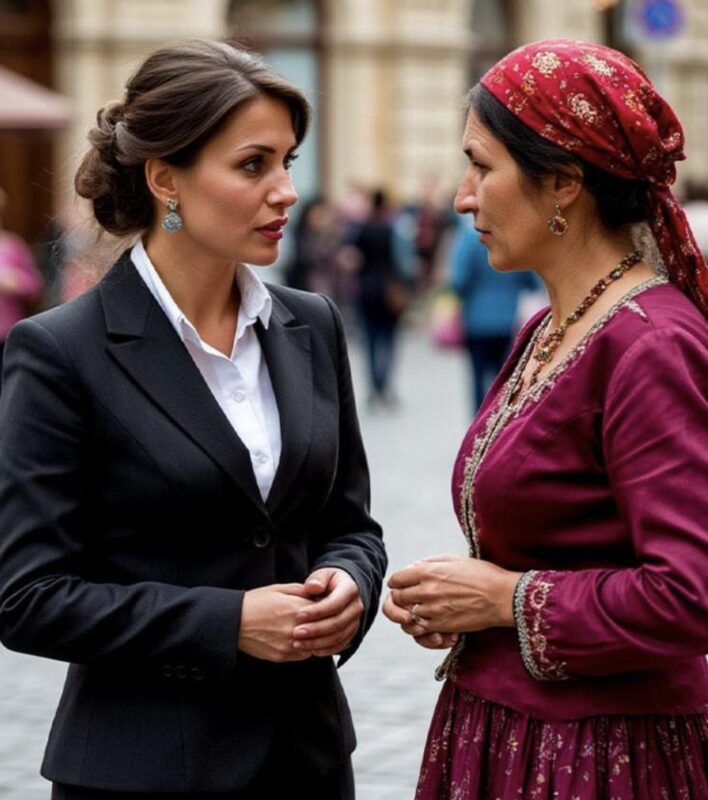
“Gypsy,” flashed through her mind, and Marina instinctively quickened her pace, hoping to avoid a conversation.
But the woman had no intention of backing off.
“Wait, darling!” the gypsy skillfully caught up to her and grabbed the edge of her coat.
“Don’t rush, I wouldn’t trouble you without a reason. I have a word for you.”
“What do you want? Let me go!” Marina tried to break free, but the grip was surprisingly strong.
The woman looked deeply into her eyes, and her voice dropped to a near whisper:
“I see… your heart is broken. Your soul — shattered. This city rejects you.
You’re a stranger here. Do you hear me? Trouble awaits you. What happened before will seem like joy compared to what’s coming. Leave. Before it’s too late.”
At last, Marina managed to pull away. She almost ran, not looking back.
Her heart was pounding as if it wanted to leap from her chest — not so much from fear, but because the gypsy’s words had touched something deep inside.
At home, in the cold room where even the blanket couldn’t bring warmth, Marina couldn’t fall asleep for a long time.
Thoughts of the strange encounter swirled in her mind like autumn leaves in the wind.
“How did she know I’m not local? How did she guess what happened to me?..
Maybe this gift of theirs is real? And if so… then was she telling the truth?”
The cold seeping from the corners of the room felt alive. The apartment was small, bare, almost unfurnished.
There was no money for more — they were barely scraping by. But they hoped — one day, things would get better.
From her memories surfaced the image of the man she loved. Mikhail.
They had met long ago, back in her hometown. At the time, Marina worked in a massage clinic, and Misha had come on a business trip — he’d injured his back at his new job.
His friend advised him to see her specifically.
From the very first glance, something invisible yet strong sparked between them.
As if they already knew each other, but had simply forgotten.
Day by day, their bond grew stronger. Misha embraced Marina like he wanted to shield her from the whole world.
And in his arms, she felt cherished and needed.
In time, she learned: he had a tense relationship with his family.
His parents were in the past, and he never wanted to go back there.
He honestly warned her: he wouldn’t invite his family to the wedding.
Marina didn’t mind — she saw how painful his childhood memories were for him.
“They might seem normal,” he said, staring out the window, “but I know who they really are.
They can’t be trusted.”
He would fall silent, collecting his thoughts, then continue:
“My mother never loved me.
Only blame, beatings, accusations… And endless stories about how terrible my father was.
I believed her for years until I saw him again.”
Misha gave a bitter smile:
“My father came back from abroad, took me in, and I realized: he had been helping me all along.
Transfers, money — it was all there. My mother just spent it all on my half-sister from her first marriage.”
Marina stroked his shoulder, feeling his muscles tense at every memory.
“Sometimes I would wake up at night and just listen to my father breathe,” he said softly.
“I couldn’t believe it was real.
Like a dream, from which I might wake up and hear her voice behind the wall.”
“My poor one,” she whispered, holding him close. “I’m sorry you went through that.”
“But now you’re here,” he ran his hand through her hair. “And I’m happy. I love you.”
“I love you too, Mishka.”
At first, he was afraid of having kids. He thought his past might make him a bad father.
But when he first held little Liza, everything changed.
His whole life began to revolve around that tiny being.
Marina would watch him and smile.
She knew he would be a good father. He was made for it.
After Liza came little Makar.
And a year and a half later, Marina learned she was pregnant again. This time there were doubts: their home was cramped, money was tight, and the two-bedroom apartment inherited from her grandmother was too small for their growing family.
“We’ll have this baby!” Misha said enthusiastically.
“Everything will be fine.
Money comes and goes. But moving — that’s the key to a better life.
My father left me a three-bedroom apartment in my hometown. Let’s go!”
He knelt before her, holding her hands:
“Believe me, we’ll all be better off there.
The kids can go to daycare, you can carry the baby in peace, and I’ll provide everything we need.”
His confidence was contagious. Marina believed him.
She decided — yes, a new, happy chapter would begin in a new place.
And at first, everything went wonderfully.
The kids started daycare, Marina registered at the maternity clinic, Misha got a good job.
Life flowed smoothly and calmly.
Misha kept his word. He cared, supported, did all he could.
In the evenings, they cooked together, laughed, made plans.
Marina felt happy. She thought it would always be that way.
But, as often happens, happiness turned out to be fragile.
Then — as if fate itself wanted to test them — troubles began.
First, Marina was hospitalized to prevent a premature birth.
Then Misha was unexpectedly fired without explanation and had to run from interview to interview to pay for expensive treatment their youngest needed.
There were more blows — small but heavy. Yet together, they endured it all.
Their eldest daughter started school, Misha found a new job, and it seemed that life was stabilizing again.
Things were supposed to get better.
But suddenly — like thunder on a clear day — tragedy struck: Misha died.
Marina felt as if the entire world collapsed in an instant.
She couldn’t breathe, couldn’t live. He was her heart, her anchor, her love.
Without him, she was alone, like a tree without roots.
He was found in the park — a man in the bushes, beaten, lifeless.
They never found who attacked him. Help came too late.
At the funeral, Marina stood apart, black with grief.
She had left the children at home — she didn’t want them to see.
None of her relatives came, even though she called them.
Only friends, colleagues, and those who truly grieved stood by her side.
The first months were the hardest.
The children often woke up crying for their father.
Financial troubles grew like a snowball.
One day, she got a call — a warning: if she didn’t leave the apartment, she’d “regret it.”
They survived as best they could. Over time, the pain receded, and caring for the children became her focus.
And then, after her first day back at work, she met the same gypsy woman again — the one who had once warned her of danger.
Only now did Marina realize: the woman’s words had been prophetic.
The next morning, the phone rang.
“Hello?”
“Marinochka? Is that you?” The voice was old but firm.
“Yes. Who’s this?”
“This is Nadezhda, Misha’s mother.” A pause. “I’d like to see you. See the grandchildren. Talk.”
Marina paused, processing what she’d heard.
“All right. When?”
“Come today at six. Will that work?”
“Okay. Give me the address.”
Marina knew her husband had cut ties with his family, so she had no illusions about the meeting.
But for the children’s sake — for possible forgiveness, or at least understanding — she agreed.
She left the children with her elderly neighbor who often helped her. She didn’t want them present.
A thin woman with a face lined by years and hardship opened the door.
“Come in, we’re not strangers,” she said with a strained smile.
Marina entered. They seated her at the table, where tea was already waiting. The woman began cautiously:
“Sorry I wasn’t at the funeral. I was very ill — even hospitalized. Why didn’t you bring the children?”
“They’re sick,” Marina lied, not wanting to reveal the real reason.
“What a pity… Anyway. Marinochka, I wanted to talk.
How are you holding up? Is it hard alone? If you need help — we can help. Even with moving.”
“Moving?” Marina asked, wary.
“Yes, to your hometown,” the woman added with an offhandedness that seemed deliberate to Marina.
“But I’m not planning to go anywhere.”
“Then where do you plan to live?” her mother-in-law’s voice carried a trace of mockery.
That’s when Marina understood. These people were behind the eviction threats.
Only now did she recognize them as the ones trying to break her.
At that moment, another woman entered the room with a tray.
Marina’s breath caught — it was the same gypsy who had warned her months ago.
“So this was a game,” Marina realized. “A game where everyone knew the rules — except me.”
“This is my daughter, Lena,” the mother-in-law introduced her.
“A gypsy name would suit you better,” Marina said quietly, rising to her feet.
She didn’t stay another minute. Saying goodbye with cold politeness, she left, boiling inside with questions: *Why all this?*
At home, she told her neighbor everything. The neighbor advised her to see a lawyer.
Marina did — and learned something crucial: Misha had left the apartment to her.
The will just hadn’t taken effect yet.
Now everything was clear — the relatives were trying to push her out to claim the inheritance.
At the meeting with the lawyer, Marina presented the documents and calmly declared that if the pressure continued, she would go to the police.
That day, she endured a lot of barbs, accusations, and slander.
But Marina remained composed. The most important thing — she had protected her children.
She defended what was hers. She didn’t break. She didn’t let them take the home Misha had left her.
And the relatives, as is fitting for those who lose, were left with nothing.
Later that evening, Marina sat on the couch, looking out the window.
Children played in the yard — happy, lively, laughing.
She held a photo of Misha in her hands and whispered:
“Thank you, my love. You took care of us even after death.
Maybe the gypsy was right — we should go home.
But by our own decision.
Not because we were driven out.”
She looked at her son and daughter. And smiled.
“We did it. We survived.
And we will keep living. For you. For us.”