— Look at her! How beautiful she is! — I exclaimed, holding close the warm little body of our newborn daughter.
Lizočka lay curled up in a soft blanket like a tiny bundle of life, quietly breathing.
I couldn’t take my eyes off her.
At that moment, my whole world shrank to one face, one breath, one thought: “She’s mine. We have her.”
Sasha stood nearby. He looked at the baby, but in his eyes was a mix of tenderness and… something else.
Something undefined, almost frightened. He reached out, gently touched the girl’s cheek with his finger.
— She looks like you, — he said quietly, almost in a whisper. But his voice lacked the bright delight I had expected.
There was no joy overflowing.
At the time, I didn’t pay it much mind. Well, she looks like me — so what?
The main thing was that our family had grown, that our daughter was healthy, and that now we were real parents.
But years went by, and when the second daughter — Masha — was born, I began to notice what I had previously refused to see.
Both girls looked remarkably alike.
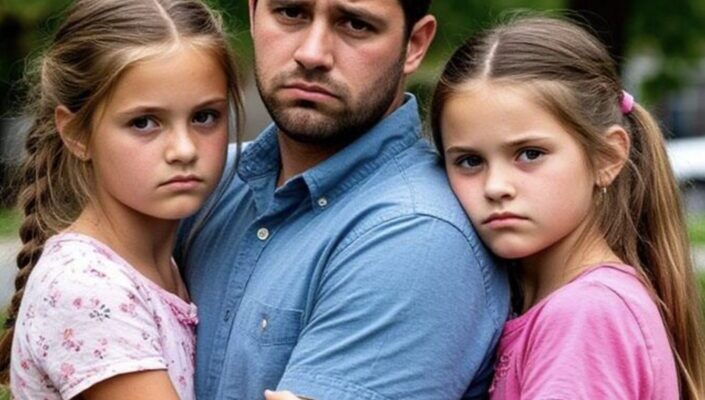
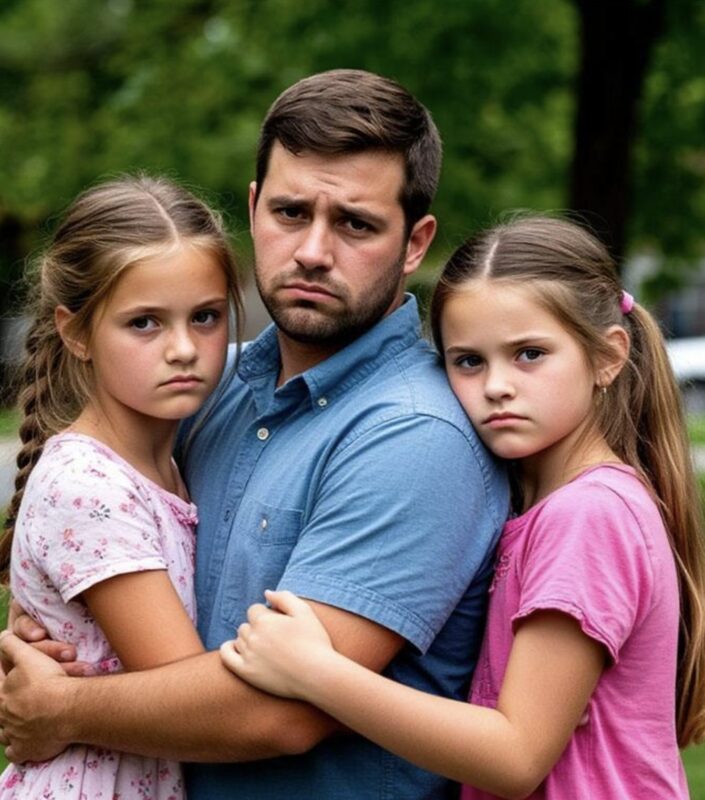
Their big brown eyes, neat little noses, high foreheads, thick dark hair — it was as if they had been copied from a portrait of my father.
They seemed like they came from the same frame, where he was captured as a child.
Not a single feature of Sasha’s was in them. No blue eyes, no dimples on the cheeks, not even his distinctive expression.
It became a problem. A serious and painful one.
I sat at the kitchen table, mechanically stirring my long-cold tea.
Behind me, I heard the even breathing of the sleeping girls, and across from me, with a strange expression on her face, sat my mother-in-law — Valentina Ivanovna.
She had “just dropped by,” as she usually said.
But I knew: such visits never just happened. Especially after recent months, when unspoken words, half-truths, and cold resentment began to build between us.
— Vika, — she began, choosing her words as carefully as if afraid to offend, — the girls, of course, are beautiful.
But… are you sure they’re Sasha’s? They look so much like your father.
Like two drops of water. Simply amazing, isn’t it?
The spoon in my hand clinked against the edge of the mug. I froze.
I had heard those words before — in jokes, hints, whispers.
But from her, from the woman who called me “dear,” it hurt especially badly. Like a blow below the belt.
— Valentina Ivanovna, what are you saying? — my voice trembled.
— Of course they’re Sasha’s! You know everything yourself!
We waited so long for them, I gave birth, he himself picked them up from the hospital! How can you doubt?
She just shrugged, as if to say, “Who knows?”
And in that gesture was all her confidence that doubt had a right to exist.
I felt hurt inside, but no less worry.
Because the worst thing wasn’t in those words.
The worst was that my husband himself began to drift away from our children.
— Sash, why didn’t you pick up Liza from daycare again? — I asked when he came home late, almost at dawn.
Liza was already asleep, Masha quietly dozing on the couch.
And I, tired after a double shift, housework, and endless worries, barely stood on my feet.
— Forgot, sorry, — he shrugged off his jacket indifferently, not even looking at me.
— Had a lot of work.
— You’re always busy, — I couldn’t hold back. — When do you even spend time with the kids?
When was the last time you played with Masha? Or at least read Liza a book?
He was silent. A long, heavy silence, then his voice cut through — quiet but so heavy:
— I don’t feel drawn to them, Vika. I don’t know why. They… they seem strange to me.
I try, I’m trying, but I don’t feel that they’re mine.
Tears welled up in my throat. How could he say that about his daughters?
About the very children he once waited for, dreamed of?
But at some point, I understood — he was sincere.
Sasha really wanted a daughter who looked like him.
He imagined playing with her, how proud he would be when she inherited his features.
He wanted to see himself in her. But instead — two girls who looked more like my father.
As if I alone had given birth to them.
I started digging into the internet, reading about genetics, inheritance, laws of dominant and recessive genes.
It turned out it happens.
Sometimes a child’s appearance can resemble grandparents more than parents.
My father had very strong genes — brown eyes, a high forehead, dark hair.
And both my daughters inherited exactly those.
But how to explain that to Sasha and his family, when they had already made up their minds?
I suggested a DNA test. Not because I doubted, but to close the question once and for all.
But he refused.
— I believe they’re mine, — he said, looking at the floor. — I just… can’t explain it.
I don’t feel connected to them.
— Have you tried? — I almost shouted.
— Tried to be near them, play, communicate, be a father?
Or are you just waiting for them to become close to you on their own?
He was silent again. And in that silence, I felt our family crumbling, the gap between us growing.
It was even worse with his relatives. My mother-in-law and sister-in-law behaved as if Liza and Masha were not their own.
They came rarely, and if they did, mostly talked about how the girls “aren’t like Sasha.”
Once Katya, my sister-in-law, laughed and said:
— Vika, are you sure you didn’t have them by your grandfather? — and laughed as if it were funny.
I couldn’t take it:
— Katya, this is no longer a joke. These are my children, and they’re your brother’s. If you don’t like it, you don’t have to come.
Of course, she got offended. But what could I do?
I was raising two daughters alone while Sasha “didn’t feel the connection,” and his family only added to the pain.
My parents lived far away, and they were getting old.
I felt lonelier than ever.
And one evening, when the girls were already asleep, I decided to have a serious talk.
I understood that it couldn’t go on like this.
Either we find a way out, or our family will fall apart completely.
— Sash, — I began, trying to speak calmly, — I know you’re upset.
I also dreamed that we’d have a daughter who looked like you.
But these are our children.
They’re not to blame for inheriting my genes. And I’m not to blame either.
It hurts me to see you drifting away from them.
He was silent for a long time, then sighed deeply:
— I hate myself for it. But every time I look at them, I see your father.
And it feels like I’m the outsider here.
I took his hand:
— You’re not an outsider. You’re their father. They love you, even if you don’t see it.
Liza asked yesterday why her dad doesn’t play with her. Masha reaches out to you, and you turn away.
They feel it, Sash. They’re still little, but they understand everything.
He lowered his head. I saw how hard it was for him.
Then I suggested:
— Let’s try starting small. Just spend more time with them.
Don’t think about who they look like. Just be there.
They are your daughters.
Several months have passed since that conversation.
Sasha began to change.
Not immediately, not perfectly, but he took steps.
On weekends, he started picking Liza up from daycare, teaching her to tie shoelaces, reading Masha bedtime stories.
He bought them building blocks, drew with them, told tales, sometimes made up his own.
I saw how the girls began to reach out to him.
Liza now proudly tells at daycare that “Dad helped me build a car from blocks.”
Masha, who used to cry when I left her with Sasha, now runs to him with squeals of joy.
It was harder with the relatives.
My mother-in-law still sometimes threw sharp remarks, but I learned to simply not hear them.
I realized: I can’t make them love my children, but I can protect my family from their influence.
We never did the DNA test.
Sasha said he didn’t need it anymore.
Over time, he began to see not only their faces but their characters, habits, and movements.
For example, Liza, like him, wrinkles her nose when she laughs.
And Masha loves it when he plays music for her — just like he did as a child.
Our family is still far from perfect.
Sometimes I catch myself still angry at Sasha for his past indifference.
Sometimes I want to shout at his family for their words.
But I see how he tries.
How he is learning to be a father.
And I believe love for children isn’t about looks.
It’s about time spent together.
About every “good night,” about every tear you wipe away.
About the bond you build with your own hands, heart, and patience.
And I’m grateful that this bond finally came to be.