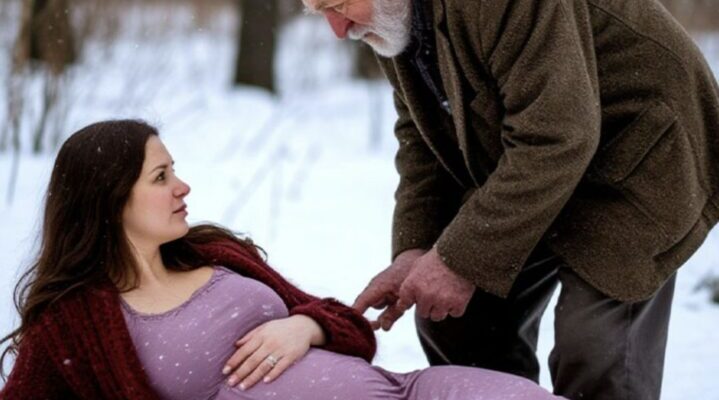
Vasily Stepanovich lived on the edge of the village, where time seemed to have stopped.
His little house, small and old, as if pressed to the ground from fatigue, was surrounded by a crooked fence and creaky gates that no one had fixed for a long time.
Around — silence. The whole street was deserted: neighbors had moved away, some to the city, others — to eternity.
Only memory and recollections remained.
He was seventy years old.
For forty years, he had served people — a paramedic at the local clinic, which was now closed, like everything that connected him to the past.
After his wife’s death, he was left alone.
His children were rare visitors, sometimes calling, sometimes remembering.
But he had long since grown used to loneliness.
Habit became his shield, his protection from pain and unnecessary talks.
That year, winter came early and harsh.
The wind howled so fiercely that even the strongest window frames trembled from its fury.
Snow fell like a thick wall, tearing off roofs and swirling in the air, as if trying to carry away the last traces of human life.
Vasily Stepanovich’s house was the only one where a light bulb still burned.
He stoked the stove, cooked himself a modest dinner — potatoes boiled in their skins and a couple of salted cucumbers from a barrel.
He always ate simply and without excess. Nothing fancy, nothing unnecessary.
He was almost about to go to bed when he heard a strange sound.
At first glance — the usual howl of a blizzard.
But then again. Quiet, almost a whisper, as if someone was asking for help.
His heart froze, then suddenly started beating faster.
It was not just alarm.
It was professional sensitivity he had never lost during all his years in emergency care.
And it returned to him, awakening as a sharp pain in his chest.
He quickly put on his sheepskin coat, pulled on his felt boots, grabbed a lantern — the same one with a worn case that had saved him many times on night calls.
He stepped outside. The cold hit his face, his breath turned into a white cloud of steam.
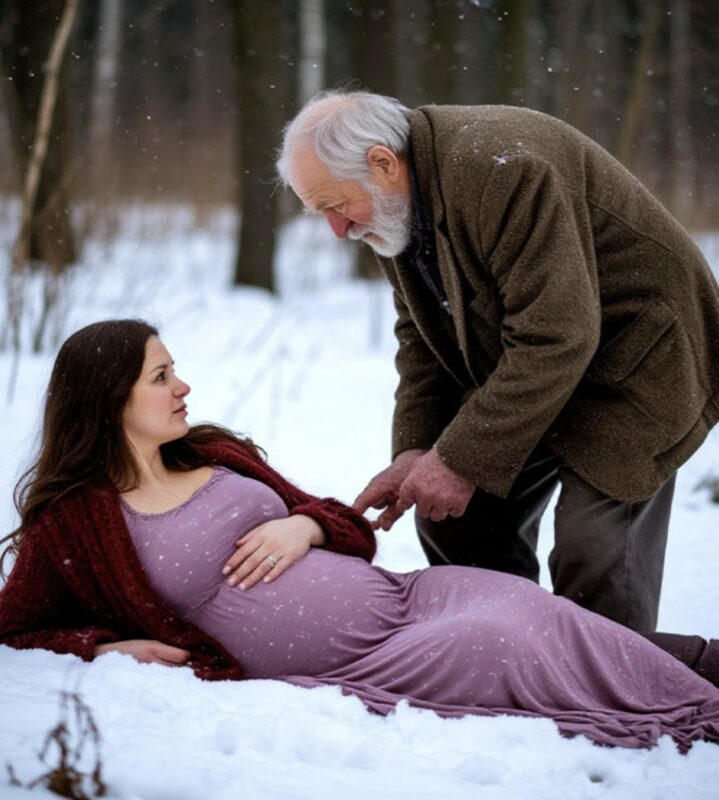
Step by step, listening to every sound, he walked down the road until he noticed a silhouette on the roadside.
At first, it seemed like a sack or some trash.
But approaching closer, he realized it was a person. A woman.
She was crawling in the snow, leaving a faint trail behind.
Her fingers were blue, her lips trembled, and her belly under the old coat was sticking out — she was pregnant.
Close to giving birth.
Vasily knelt down beside her. Carefully leaned toward her:
“Girl… can you hear me?”
She slowly opened her eyes, looked at him with difficulty, and whispered:
“Help… me… it hurts so much…”
And she lost consciousness.
The old man didn’t hesitate for a second.
He carefully lifted her — she was incredibly light, as if not alive, but a shadow.
It seemed like life itself was slipping out of her.
He slowly trudged back, overcoming snowdrifts, gusts of wind, cold, and age.
His thoughts were confused, but one thing was clear: if he didn’t make it in time, two would die — she and the child inside her.
When he reached home, the blizzard seemed even scarier, but crossing the threshold, he felt something long forgotten ignite inside — the fire of life, meaning, and purpose.
The house, which had kept only silence for years, suddenly filled with chaos, warmth, and hope.
He laid the woman on an old but warm bed, covered her with several blankets, stoked the stove so the flame roared in the chimney.
Water boiled on the stove.
He recalled everything he knew about childbirth — although many years had passed, his hands remembered how to act.
The woman was unconscious, her body convulsed, her forehead covered with sweat.
Vasily ran to the shed, took out an old wooden box — it contained everything that might be needed: bandages, antiseptics, scissors, even a clean diaper left “just in case” many years ago.
He put his hand on her forehead — fever.
Then checked her pulse — weak but steady.
He moistened her lips with water and spoke quietly:
“Wake up, girl. You’re home. No one will abandon you.”
She opened her eyes.
A faint spark of life flickered there.
“The baby… he… soon… hurts…”
“Hold on. I’m here. We will manage. I promise.”
The process began.
And it was agonizing.
But Vasily didn’t spare himself.
He carried water, changed sheets, helped her breathe, supported her when she wanted to give up.
At that moment, he didn’t feel his age, didn’t think about back pain or the cold seeping through the walls.
He was again who he had always been — a paramedic, a rescuer, a friend.
And then, in the middle of the night, a cry rang out.
Loud, clear, full of life.
A little boy was born — red, wrinkled, but alive.
The woman cried.
Vasily gently wrapped the baby in a diaper and laid him on the mother’s chest.
For the first time in many years, he felt his own eyes grow moist.
He whispered:
“Welcome, little one.
You came into the world on the scariest evening.
Maybe that’s why you will bring light.”
Morning came unnoticed.
The snow was still falling, but the blizzard had quieted.
Through the fogged window, soft grayish light entered the house.
Vasily sat in a chair, holding a cup of hot tea.
The woman slept, holding her son close, but now calmly, with a slight smile.
When she woke, her gaze became thoughtful.
Gratitude gleamed in her eyes.
“Good morning! How do you feel?” he asked, approaching and adjusting the blanket.
“Better… thank you. You… you saved us!”
Tears filled her eyes.
“You did everything, girl. I only helped a little.”
She was silent, then struggled to sit up on the pillow.
“My name is Marina.
I ran away…” her voice trembled.
“My father kicked me out when he found out I was pregnant.
He said I had shamed the family.
I didn’t know where to go.
I walked down the road until my legs gave out.
I thought I would die.”
Vasily listened silently.
Not a drop of judgment in his eyes.
Only sympathy and understanding.
He long understood: life is not black and white.
There are only people trying to survive.
“Where did you live before?”
“Near Vologda. I have no one left… except him.”
She looked at the baby.
“I will call him Alexei.”
Vasily nodded.
The name was strong, reliable, as if given by fate.
“So now you have a new path.
Here no one will judge you.
In this village, almost no truth remains, but you will have a roof, silence, warmth… and the company of an old grumbler like me.”
Marina smiled through tears.
“I would really like to stay…
I don’t even know your name.”
“Vasily Stepanovich. Just Vasily, if you want.”
They fell silent.
A calmness rare and precious hung between them.
She pressed the baby to herself, and he went to pour more tea.
A quiet life was beginning again — unexpectedly, unplanned, but with hope.
Several weeks passed.
Winter slowly gave way.
Snowdrifts still stood high, but the days grew longer and the sun already warmed like spring.
In Vasily Stepanovich’s house, laughter rang out again — childlike, ringing.
Little Lesha grew quickly, and Marina filled the house every day with care, warmth, and energy the old man seemed to have long forgotten.
One morning, there was a knock at the door.
It happened rarely — the village had long been deserted, and those who remained knew: you don’t just come to Vasily Stepanovich.
He opened the door.
A man stood on the threshold, wearing an expensive coat, with a cold look and confused thoughts.
“Does Marina Karpova live here?”
Vasily darkened.
“And who’s asking?”
“I’m her father. I was told she might be here.”
Behind him, Marina appeared.
She froze. Her eyes widened.
A moment stretched into eternity.
“Dad…”
He stepped forward.
His face was older than in her memories.
In his eyes — uncertainty, remorse.
“I was looking for you.
I understood everything when I found out you were alive.
Forgive me… I had no right…”
Marina was silent.
Her gaze held not only pain but strength.
The strength that passed through the blizzard, birth, and loneliness.
“Why did you come?”
“Because I can no longer live with what I did.
I wanted to see my grandson… at least once.
And, if you allow, to help.”
She looked at him for a long time, then glanced at Lesha, who was peacefully sleeping in her arms.
Slowly stepped aside and said:
“Come in. But know: I’m no longer the girl you drove away.
I’m a mother.
And this house is my fortress.”
Vasily stood aside.
He said nothing but felt pride inside.
And quiet gratitude for having been there when she needed support.
He thought to himself:
“That even in the harshest winter, fate can give a second chance.
The main thing is not to pass by those who froze in loneliness.”