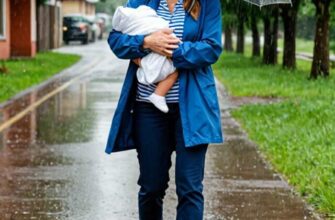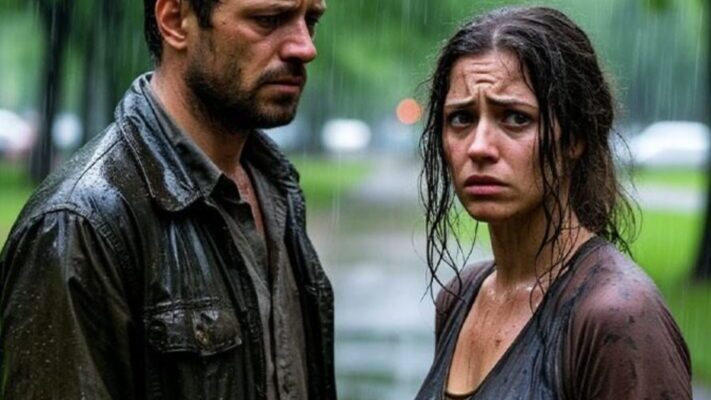
The rain poured down like a waterfall, as if the heavens were trying to wash all humanity off the face of the earth.
Huge drops beat against the asphalt with force, splashing fountains of water, and the sidewalk turned into a raging stream where every step threatened to slip or fall into an invisible puddle.
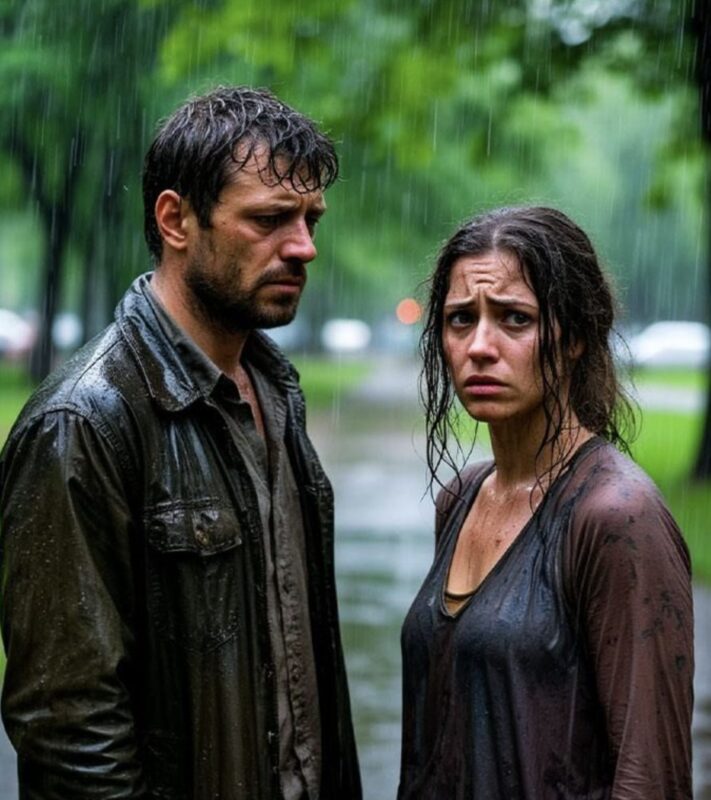
The wind tore at their clothes, howling in their ears, as if mocking anyone in its path.
Tatyana walked quickly, almost running, even though her legs barely held her up.
She tightly gripped the small hand of Alenka, who stumbled along behind her, tripping in oversized boots.
In her other arm, Tatyana clutched Mishka — he was younger, but right now he seemed the most fragile, the most defenseless.
His head jerked with every step, and sobs escaped through clenched, chattering teeth.
The bag she’d packed in a rush was soaked through long ago.
The strap dug painfully into her shoulder, but she didn’t notice.
To stop was to surrender.
And surrendering wasn’t an option.
There was no going back: her sister’s apartment was closed to them forever, after today’s shouting, the humiliation, the accusations…
After Seryozha got drunk again, disgraced himself, and burned the last bridge between them and a normal life.
Dragging behind them like a shadow was Seryozha himself. He didn’t try to help or protect them.
His steps were slow and lazy, as if he were mechanically moving one foot in front of the other.
Each of his steps landed with a splash in the puddles, reflecting a sky as dark as his expression.
Now and then he mumbled something like “To hell with it all,” but his words were drowned out by the roar of the rain and reached no one.
— Mom, I’m cold… — Alenka whispered, her voice trembling like a leaf in autumn.
The girl hugged a soaked doll to her chest — no longer a toy, just a soggy bundle of fabric dangling from her hand, a symbol of lost childhood.
— We’ll find a place to get warm soon, baby, — Tatyana replied, trying to sound confident.
But inside, she was breaking. She knew — there was no “soon,” no place to shelter.
They’d been wandering the city for two days, bouncing from one familiar entrance to another like a ball no one wanted to catch.
Where could they go? Where *can* you go with no money, no documents, no job, no roof?
At social services, all they said was: “Submit an application and wait your turn.”
Wait for what? Life? As if life could be handed out by appointment!
They turned a corner into a God-forsaken alley, where even the rain felt colder.
Under the awning of an old, nearly abandoned grocery store with a cracked sign was a bench — wet, crooked, but at least partly shielded from the wind.
Tatyana sat the children down, took off her drenched jacket and wrapped them in it, like the only blanket she had.
Mishka pressed into her, and Alenka laid her head on her brother’s shoulder.
Their faces were pale, eyes red — not just from tears, but from exhaustion, fear, helplessness.
— Seryozha, — she called softly, turning around.
— We have to do something. The kids can’t live like this.
Seryozha stood leaning against the wall, staring into space.
His hair was matted, his jacket more soaked than anyone’s.
His hands were shaking — whether from cold or constant withdrawal was unclear.
— What can I do? — he muttered, not looking at her. — No money, no job, no home.
That’s it, Tanya. We’re finished. — He spat into a puddle, and the gesture was so hopelessly helpless that Tatyana wanted to hit him — hard — just to wake him up, to shake him into becoming the man she once loved.
The one who used to carry Mishka on his shoulders, buy flowers at the metro, kiss her on the cheek before work, and talk about building a house where the children would be safe and loved.
Where she would feel like a wife, not a victim.
But in front of her stood a stranger — swollen-faced, eyes hollow, reeking of stale booze like a brand burned into his skin.
He didn’t want to be a hero anymore — it was easier to give up.
— Then leave, — she whispered, her voice shaking with restrained fury.
— If you can’t help us, just go. I’ll manage on my own.
Seryozha flinched as if struck.
For a second, something real flickered in his booze-clouded eyes — pain, shame, a memory.
But it vanished, swallowed by emptiness.
— Where would I go? — he mumbled. — You know without me, you’ll be lost.
— Lost? — Tatyana shouted, her voice cracking. Alenka jumped.
— Seryozha, we *are* lost! You drank away our apartment, got us thrown out, and you’re talking about ‘without you’?! Leave, I said!
Tears rolled down her cheeks, mixing with the rain, but she didn’t feel them. The pain was inside.
From a shattered life, from a love betrayed, from dreams destroyed.
Seryozha hunched over, then buried his face in his hands.
— I’m sorry, Tanya… — he whispered, his voice barely audible. — I didn’t mean to… I really tried…
Tatyana turned away. She didn’t want to see his tears, didn’t want to hear his excuses.
She couldn’t forgive. Not now. Not after everything.
But the children looked at her — Mishka with hope, Alenka with fear.
And she knew she couldn’t afford to fall apart. Not now. Not here.
— Mom, are we going home? — Mishka asked quietly, his voice shaking.
Tatyana swallowed the lump in her throat.
She knelt down, took his small, damp hands in hers, and forced a smile.
— Soon, sweetheart, — she whispered. — Mama will find us a home. I promise.
She stood up, wiped her tears with her sleeve, and looked into the distance.
The rain still fell, the street was empty, only a traffic light flickered far off, like a sign of one last chance.
One address echoed in her head — a shelter for women with children, mentioned by a social worker.
It wasn’t a home — just a bunk in a room with five others. But it was warm, dry, and there was at least one meal a day.
Better than a stairwell.
— Get up, — she said firmly, helping the children to their feet.
— We’re going to a place where they’ll take us in.
Alenka clung to her mother’s hand, Mishka obediently stood up, though his eyes held questions she couldn’t answer.
Seryozha stood up too, slowly, hesitantly, as if unsure he had the right to walk with them.
— Tanya, I’ll come with you, — he mumbled. — Don’t push me away.
She looked at him. Anger boiled inside her, but she had no energy left to argue. Only forward motion.
— Walk behind us, — she said coldly. — But if you get drunk again, Seryozha, I will throw you out. For the kids’ sake.
And they walked. Down the street from which they’d fled, from shouts, from shame, from themselves.
The rain still poured, but now Tatyana walked not in tears, but with resolve.
She didn’t know what lay ahead, but she knew one thing — for Mishka and Alenka, she would fight.
Even if the whole world was against her.
An hour later, they stood in front of a worn-out shelter door.
The building was old, paint peeling, but warm light spilled from its windows — so welcoming, so needed.
A woman in her sixties, who introduced herself as Vera Ivanovna, let them in without questions.
Inside, it smelled like soup and disinfectant — not pleasant, but homely.
The children were taken straight to the playroom, where other kids were building towers from blocks.
Tatyana sat in an office, holding a mug of hot tea while Vera Ivanovna filled out paperwork.
— We have strict rules here, — the woman warned, eyes on the forms. — No alcohol, no fighting.
You’ll need to find a job — I’ll help you register with employment services.
We’ll get the kids into school and daycare.
But you can only stay here for six months. Can you handle it?
Tatyana nodded. Six months. It was a time limit. It was a chance. Small, but real.
— I can handle it, — she said quietly. — For them.
Seryozha sat silently in the corner, eyes on the floor. Vera Ivanovna gave him a sidelong look, but said nothing.
That night, Tatyana lay on a narrow cot, listening to the children breathe beside her.
The room was cramped, a neighbor snored, but it was warm, and the kids had eaten.
For the first time in a week, she wasn’t afraid of being thrown out.
But sleep didn’t come.
Words from Olga rang in her ears, her mother’s shouts, Vasily’s exhausted, angry eyes.
She knew her sister would never forgive her for that night.
She knew her mother would blame everyone but herself.
And she knew Seryozha — now on a cot in the men’s room — would likely relapse again.
But in the dark, among strangers’ snores and creaking beds, she felt something new.
Not hope — it was still too far.
But resolve. Solid. Unbreakable.
She would no longer wait to be saved. Not by her mother. Not her sister. Not Seryozha.
Tomorrow, she would go to the employment office. Tomorrow, start gathering documents for assistance.
Tomorrow, take the first step so Mishka and Alenka would never again sleep in a stairwell.
Outside, the rain stopped.
In the silence, Tatyana closed her eyes and, for the first time in a long while, allowed herself to breathe — freely, deeply, like someone who had not given up.