
The phone ringing in the apartment caught Elliot Row by the stove.
An omelet was frying in the pan, filling the kitchen with the aroma of garlic and melted butter.
He wiped his hands on a towel and gave an irritated glance at the screen — the number was unknown.
“Hello?” he answered briefly, continuing to watch the dish.
“Mr. Row, this is your family’s notary.
You need to come to me tomorrow morning.
There is an inheritance matter. Documents need to be signed.”
Elliot hesitated. His parents were alive and well, so from whom could he have inherited?
He didn’t even ask questions — just silently nodded, as if the caller could see him, and hung up.
The next morning was gloomy and foggy.
As Elliot drove through the city, mild confusion gradually turned into annoyance.
At the entrance to the notary’s office, the notary himself was already waiting.
“Come in, Elliot. I understand this all sounds strange.
But if it were something ordinary, I wouldn’t disturb you on the weekend.”
The office was empty. Usually bustling with business, now only the echo of footsteps on the wooden floor broke the silence.
Elliot sat down in the chair opposite the desk, folding his arms across his chest.
“This concerns your uncle — Walter Jonas.”
“I don’t have an uncle named Walter,” Elliot immediately objected.
“Nevertheless, he bequeathed all his property to you.”
The notary carefully placed before him an old key, a yellowed map, and a piece of paper with an address.
“A mansion on the water. It’s yours now.”
“Excuse me… Are you serious?”
“The house is in the middle of Connaham Lake, in central Connecticut.”
Elliot took the key. It was heavy, covered with a faded pattern.
He had never heard of the man or the place.
Yet something clicked inside him — that very moment when curiosity overcomes reason.
An hour later, his backpack contained a couple of T-shirts, a bottle of water, and some food.
According to the navigator, the lake was only forty minutes from home.
That only increased his interest: how could he not know such a place was nearby?
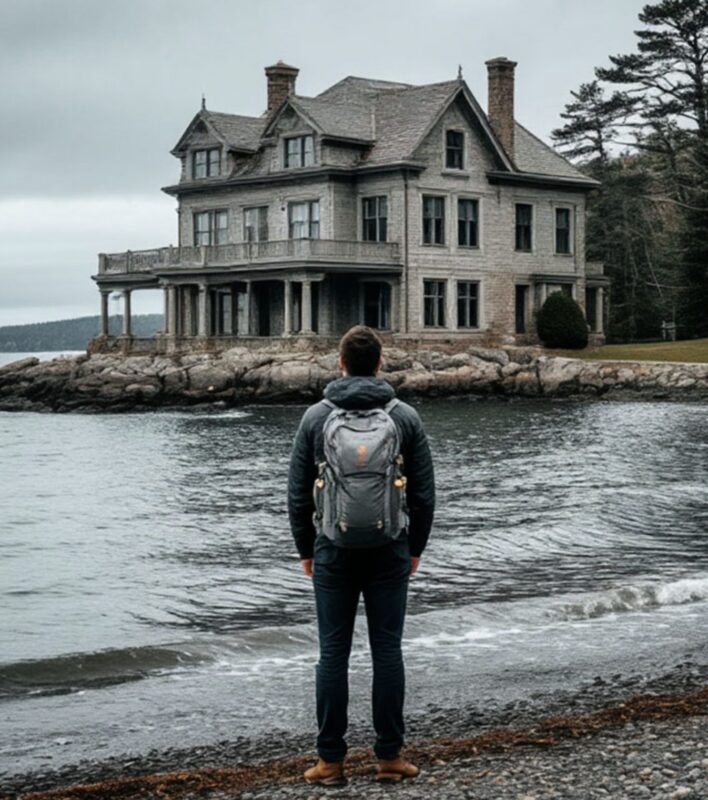
When the road ended, a lake opened before him — gloomy, still, like a mirror.
In the middle stood a house — huge, dark, as if it had grown right out of the water.
At the water’s edge cafe terrace, old men sat with mugs of coffee.
Elliot approached them.
“Excuse me,” he began, “this house on the lake…
Do you know who lived there before?”
One of the men slowly set down his cup.
“We don’t talk about that place. We don’t go there.
It was supposed to disappear many years ago.”
“But someone lived there?”
“We never saw anyone on the shore. Never. Only at night do we hear the rustle of boats.
Someone replenishes supplies, but we don’t know who. And we don’t want to know.”
At the pier, he noticed a faded sign: “June’s Boats.”
Inside, he was met by a woman with a tired face.
“I need a boat to that house in the middle of the lake,” Elliot said, handing over the key.
“I inherited it.”
“No one goes there,” she replied coldly.
“That place scares many people. Me too.”
But Elliot did not back down. His words became more insistent until she finally agreed.
“All right. I’ll take you. But I won’t wait for you. I’ll come back tomorrow.”
The house loomed over the water like a forgotten fortress. The wooden dock swayed beneath his feet.
June carefully moored, threw a rope.
“We’re here,” she muttered.
Elliot stepped onto the shaky platform, wanted to thank her, but the boat was already pulling away.
“Good luck! I hope you’ll be waiting for me here tomorrow,” she shouted and disappeared into the fog.
Now he was alone.
His hand reached for the lock. The key slid in easily.
There was a muffled click, and the door slowly creaked open.
Inside smelled of dust but was surprisingly fresh. Large windows, heavy curtains, and many portraits.
One caught his attention — a man by the lake, with this very house rising behind him.
Caption: “Walter Jonas, 1964.”
In the library, the walls were lined with books marked with notes in the margins.
In the corner office stood a telescope and neat stacks of notebooks — observation and weather records, the latest dated last month.
“What was he looking for?” Elliot whispered.
In the bedroom — dozens of stopped clocks. On the dresser — a locket.
Inside — a photo of a baby with the inscription: “Row.”
“Was he watching me? My family?..”
On the mirror hung a note: “Time reveals what seemed long forgotten.”
And in the attic lay boxes with newspaper clippings.
One was circled in red: “Boy from Middletown disappeared.
Found after several days unharmed.”
Year — 1997. Elliot paled. That was him.
In the dining room, one of the chairs was pulled out. On it lay his school photo.
“This is no longer just a strangeness…” he muttered, feeling the noise and confusion in his mind.
His stomach twisted with anxiety. He quickly ate some canned food found in an old buffet and silently went up to one of the guest rooms.
The sheets were clean, as if waiting for someone for a long time.
Outside the window, the lake caught the pale moonlight, and the house seemed alive — as if breathing along with the water’s surface.
But sleep did not come. Too many questions. Who was Walter Jonas?
Why had no one heard of him?
Why had his parents never mentioned any brother?
And why this mysterious obsession with himself?
When Elliot finally fell into restless sleep, the house was already shrouded in real darkness — such that the creak of the floor sounded like a step, and the shadow on the wall like a living being.
A sharp metallic clang cut through the silence.
He jerked awake in bed.
A second sound — as if a massive door had opened somewhere below.
Elliot grabbed his phone — no signal.
Only his own tense eyes reflected on the phone screen.
He took a flashlight and stepped into the corridor.
The shadows grew denser, almost tangible. Each step echoed with dull fear inside.
In the library, the books slightly shifted, as if someone had just touched them.
The door to the office still stood open.
Cold air pulled from behind the tapestry on the wall, which Elliot hadn’t noticed before.
He pulled back the fabric — behind it was a heavy iron door.
“Not this,” he whispered, but his fingers reached for the cold handle.
The door gave way with effort. Behind it began a spiral staircase leading under the house, under the water.
With each step, the air grew damper, thicker, soaked with the smell of salt, metal, and something ancient, as if he was entering history.
Below stretched a long corridor, lined with cabinets and drawers.
The labels read: “Genealogy,” “Correspondence,” “Expeditions.”
One drawer was marked: “Row.”
Elliot pulled it out with a trembling hand. Inside were letters. All addressed to his father.
“I tried. Why do you stay silent? It’s important to him. To Elliot…”
“So he didn’t disappear. He wrote. He wanted to know me,” Elliot whispered.
At the end of the corridor was another massive door with the inscription: “Authorized personnel only.
Jonas Archive.”
It had no handle — only a palm scanner.
Next to it was a note: “For Elliot Row. For him only.”
He placed his palm.
A click. The room gently lit up.
A projector came to life, and on the wall appeared the silhouette of a man.
Gray hair, tired eyes.
He looked directly at Elliot.
“Hello, Elliot.
If you see this, then I am no longer here.”
The man introduced himself: Walter Jonas.
“I… am your real father. You shouldn’t have found out this way, but I’m afraid your mother and I made many mistakes.
We were scientists obsessed with survival, climate, protecting humanity.
She died in childbirth. And I… I was afraid. Afraid of what I could become.
So I gave you to my brother. He gave you a family.
But I never stopped watching over you.
From here. From the house on the lake. From afar.”
Elliot sank onto the bench, feeling numb.
“It was you… all this time…”
The voice on the recording faltered:
“I was afraid to break you, but you became a strong, kind person — better than I could have imagined.
Now this house belongs to you, as part of your path, as a chance.
Forgive me: for the silence, for the cowardice, for being near but never truly near.”
The image went dark.
Elliot didn’t know how long he sat in the dark.
Then he slowly got up, as if in a dream, and returned upstairs.
By dawn, June was already waiting for him at the pier. Seeing him, she frowned:
“Are you okay?”
“Now I am,” he answered quietly.
“I just had to understand.”
He went home to talk with his parents.
They listened silently, without interrupting. Then hugged him.
“Forgive us,” his mother whispered.
“We thought it was for the best.”
“Thank you,” he said.
“I know it wasn’t easy.”
That night Elliot lay in his bed.
The ceiling remained the same.
But everything around now seemed different.
A few weeks later, he returned to the lake.
Not to live there, but to restore it.
A Center for Climate and History Studies opened in the house.
Children ran through the halls, neighbors came with smiles.
The house was no longer a refuge for secrets and ghosts.
It had become a place of life again.