I was born in the middle of winter — at the very end of February, when the cold still clings to the earth, and hope for spring feels like an illusion.
In a small town where summer seemed to never come at all.

There, snow blanketed everything as early as December and didn’t rush to melt until April.
The entrances to apartment buildings smelled of sauerkraut, vinegar, old walls, and lives lived without much light.
The town felt like it existed outside of time — as if frozen in eternal gloom, waiting for something that never happened.
At Maternity Ward No. 3, where I was born, there was no spring either.
Neither in the literal nor the metaphorical sense. Sterile emptiness ruled there, and the doctors who worked there viewed my birth as just another entry in a medical record.
They knew: in this place, spring never came.
Not because warmth wasn’t possible — but because no one ever expected it.
My mother… she didn’t cry when she left. She didn’t ask for forgiveness. She didn’t promise to return.
She simply signed the papers, leaving behind the bars of the nursery room, the smell of antiseptic, and a newborn’s first cry.
I remember someone once told me she had “given me up.”
Just like that, casually, as if the word meant nothing. But for me, it became the beginning of everything.
I didn’t have a last name. Just a blank line in the documents. The nurses gave me my name — Yaroslav.
That’s what they called all boys born in January and February.
It was their way of bringing some order to the chaos of fates that began in that maternity ward.
A list of names for each month of the year.
As if they already knew that most of us would go through life without a name, without a story, without the gaze of a parent.
They transferred me to an orphanage. Then a boarding school. Then another, and another.
Each new address became a part of my biography, but not a part of my heart.
No one wanted the “older” kids. Everyone chose babies they could imagine a future for, or younger children whose eyes still held a trace of hope.
And I kept growing, and with every year I became too old for love.
Too complicated. Too real.
And all that time, one question circled in my head: why?
Why would a woman who carried you for nine months just walk away?
What must happen inside a person to make them choose to give up?
What fear, pain, or despair could outweigh the bond between mother and child?
When I was around ten, I asked a caregiver:
— Did you ever see my mom?
She just shrugged:
— Kids like you, Slava, we’ve seen a lot. We don’t remember them.
Her words didn’t hurt me then. Maybe because I already understood: to them, we were more numbers than names.
But in my heart, that question remained. It became a stone I carried inside until I found the strength to break it apart.
When I turned sixteen, I decided to become a doctor.
Not because I wanted to save people. Not because I dreamed of a noble profession. No.
I wanted to know. To understand the body’s mechanics, how the mind works, to peer into the depths of the human soul.
I wanted to know why some people give up while others keep fighting.
Why someone gives birth — and leaves. Why some can abandon what should be most precious.
So began my journey. I studied, worked, survived. Daytime — classes at the university, evening — shifts at the clinic, nights — side jobs at the pharmacy.
No connections, no favors, no support. Only a hunger for knowledge and an anger that sometimes scared even me.
It wasn’t textbooks that taught me, but house calls, ERs, morgues, and the smells of blood, alcohol, and stale coffee.
I got my diploma at twenty-four. I became a real doctor at twenty-six.
Because a real doctor isn’t born when they get their certificate — but when they first feel the weight of someone else’s life in their hands.
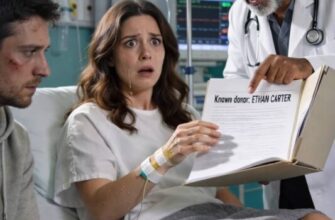
And then, one day, during a regular shift at the district hospital, I entered a room and saw her.
A woman in her fifties. Graying hair, deep wrinkles, years etched into her face.
She had been brought in from her country cottage after a stroke. A typical case. A routine condition.
But when I opened her chart, my heart clenched.
“Pregnancies — 1. Births — 1. Relinquishment — yes. Year — 1995.”
The child’s date of birth — February 16, 1995.
Exactly the same as mine.
I stepped into the hallway. Gripped the chart like that might somehow undo what I already understood.
My head pounded, my breath caught, my legs refused to move. I returned to the room.
She was awake. Staring at the ceiling, as if counting cracks in her thoughts.
— Hello, I said. I’m your attending physician.
She nodded.
— Where am I?
— District hospital. You were brought here after a stroke.
— So I’m dead?
— No. Not yet.
She smirked — crookedly, weakly, but still alive.
I didn’t tell her anything. I just treated her. Observed. Studied.
She asked questions — rare, superficial ones.
About food, medicine, prognosis.
On the third day, she said:
— Your eyes look familiar. Have we met before?
— Unlikely. You’re from the city?
— I was born here. But then I left. Came back later.
Pause.
— Do you have children?
She hesitated. Then answered:
— I had one. But I… gave him up. I was stupid. Young. Scared.
— And now?
She looked at me.
— I don’t know. I’ve never seen him. Don’t know if he’s alive. I’ve spent my whole life afraid he hates me.
And maybe he should.
I nodded. Then said:
— He’s alive.
— How do you know?
I looked straight into her eyes. Slowly. Clearly.
— Because he’s me.
Silence followed. Thick, heavy. She didn’t scream, didn’t cry.
She only gripped the edge of the sheet. Looked at me like a ghost she’d long awaited but hoped never to see.
— You… I…
— Yes.
— Why are you here?
— I work here. I heal. I live.
— You knew?
— Only from your chart. I never looked for you. But you came to me.
She was quiet for a long time. Then said:
— I don’t deserve forgiveness.
— I’m not asking you for anything.
— Do you want to know why?
— Don’t. It’s too late.
Pause.
— I was afraid. I was twenty-four. Lived in a dorm. The father left.
I had no money. They told me — you’ll lose your mind alone.
I signed the papers.
And every winter, when the snow fell, I’d wonder — where are you? That you were out there. Growing up.
That maybe… you’d forgive me.
— I don’t hold a grudge.
— Why?
I looked at her.
— Because if you hadn’t given me up, I wouldn’t be who I am today.
She stayed in the hospital for another week.
I visited her even when I wasn’t on shift.
We talked — sometimes a lot, sometimes a little, sometimes we just sat in silence.
Sometimes it felt like those thirty years separating us had simply evaporated.
There was no pain, no past.
Just two people, suddenly next to each other again.
She never asked me to call her Mom. I never did.
But one day, as I was leaving, she said:
— I’m proud of you.
— Thank you, I replied. That’s enough for me.
And it really was. Because I’d long stopped searching for a mother.
I was searching for meaning. And I found it in myself.