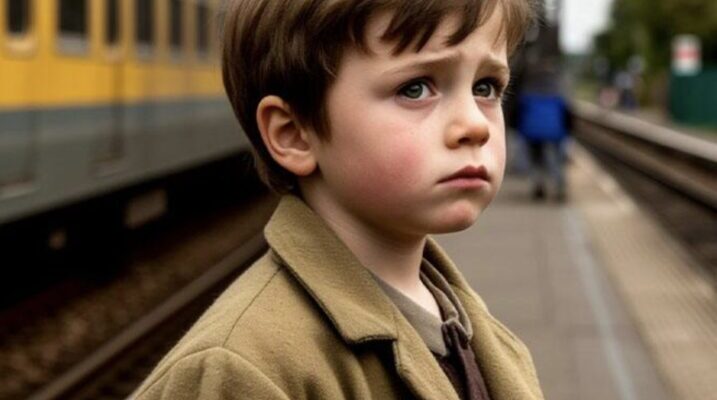
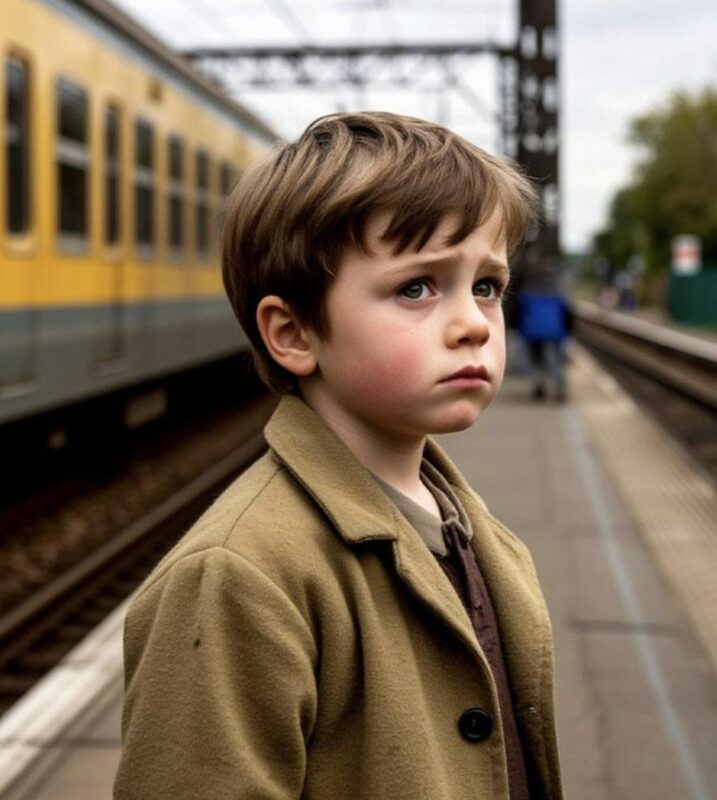
I was only five years old when I was first left alone.
Not just alone, but in a huge metal beast called a “train,” which rattled its wheels on the tracks as if mocking my childish fear.
At first, I didn’t understand what was happening.
People bustled around, dressed in gray and dark colors, with tired faces and heavy bags.
It smelled of iron, sweat, cigarette smoke, smoked fish, and something else — as if the scents of all the lives passing by had blended together.
Mom said she was stepping out for a minute: “to ask the conductor for tea.”
She always spoke briefly, as if words were hard for her.
But that day, she took a bit longer than usual.
As she zipped up my snowsuit, her hands trembled.
Not much — just slightly, almost imperceptibly to others.
But I noticed.
I noticed everything.
Especially when adults tried to act calm, so they wouldn’t scare us, the children.
She looked at me… not like usual.
Longer. Deeper.
As if she wanted to remember.
Or say goodbye.
And then she just walked out.
Simply. As if it were nothing special.
As if it was a normal trip, a normal stop, a normal day.
But it wasn’t a normal day.
I waited.
Five minutes. Ten. Half an hour. An hour.
I counted time by the seconds, which felt like eternity.
I listened intently to every step beyond the door, every random phrase, every sound that might mean she was coming back.
But she didn’t return.
The train doors slammed shut, the train began to move, and I rushed to the window, pressing my forehead to the glass.
Suddenly, the world became too big, and I — too small.
I watched the platform shrink, the people’s faces blur into smudges, and saw that my mother was gone. Completely.
And there I was — alone.
In a world where no one knew I had been left alone.
I didn’t cry. Not right away.
Probably because I had always been told, “Boys don’t cry.”
It became part of me, even if something inside was breaking.
I just sat there, staring at the seat in front of me, repeating silently, “She’ll be back soon. She’s just bringing tea.”
I wanted that to be true.
Wanted it so much, I began to believe it.
Until a woman sitting across the aisle spoke to me:
— Who are you traveling with, sweetheart?
— With my mom, — I replied. — She went to get tea…
I repeated those words the entire trip.
Every time someone asked, every time someone approached, I said the same thing.
As if, by saying it enough times, she really would appear holding a paper cup.
But she didn’t come back.
At the next station, someone met me.
Maybe a railway employee, maybe the police.
I don’t remember exactly.
All those faces blurred into one — kind, but detached.
They took me to the station master’s office.
It smelled like old wood, cigarette smoke, and something sweet.
They gave me a candy.
I didn’t want to eat it.
I couldn’t. My hands wouldn’t obey.
But I took it.
To show I was obedient.
That I could be handled carefully.
Then came the orphanage.
A short word, as if it’s nothing terrible.
But in reality — it’s a whole world, where every step echoes off the walls, where the light is never bright, and the scent of cheap soap is the only constant.
Endless corridors, creaky doors, cold floors, and the voices of caregivers that rarely sound gentle.
They put me in a corner — a bed by the wall, a sheet with a stain no one had tried to wash out in ages.
The caregiver, with the face of a strict school principal, said:
— You’re lucky, we barely have any young kids.
“Lucky.”
That word I repeated to myself at night, lying under a thin blanket, listening to the rustling of neighbors and the creak of the floorboards.
Lucky. Then why am I so cold?
Why is my heart pounding so fast, like it wants to jump out?
Why do I want to scream, but I can’t?
The first few weeks, I waited.
Waited for mom to come.
That she made a mistake, got lost, lost her ticket.
That this was all a terrible dream.
Every sound in the corridor became a warning bell.
I’d jump out of bed, run to the door, hoping it was her.
One day, a tall, stern caregiver snapped at me:
— Enough. No one’s coming for you.
His words were sharp and merciless.
They hit me like a blow.
And I stopped waiting.
From that moment, I became “nobody’s.”
Unwanted by anyone, belonging to no one.
In the orphanage, you quickly learn survival rules: don’t cry, don’t trust, don’t stand out.
If they hit you — endure.
If you’re dressed in someone else’s clothes — stay silent.
You have no past, and you matter only when you become “convenient” for others.
I shut down. On the inside.
As if I built a wall around myself.
They started calling me “The Train” — not because I loved trains, but because I always sat by the window, staring out, as if waiting to leave.
I didn’t even know where I wanted to go.
Just knew it was bad here.
Years passed.
Sometimes, one of the caregivers would try to show kindness.
One of them once said:
— With your intellect, you’ll get out. Just stay away from people.
And I did.
Not because I wanted to.
Because otherwise — it hurt. A lot.
I stopped waiting.
Stopped believing.
I even changed my name when I got my passport.
I wanted to erase everything connected to that child who waited for tea at the window.
Twenty-five years passed.
During that time, I built a career in IT, bought an apartment with a mortgage, got a dog.
I named her “Tea.”
Just because that word became a symbol of something that never existed.
But still remained important.
One day I woke up and realized: I need to go back.
Not for a reunion.
Not for answers.
Just because inside me there was still an emptiness — the size of a child’s seat by the window.
I bought a ticket to that same town.
To that same platform.
It looked almost the same.
Same iron benches, same old lanterns, same pigeons begging for crumbs from passengers.
I stood there for a long time.
Watching. Not moving.
Wanted to scream, to punch the air, like I did at five.
But I just stood.
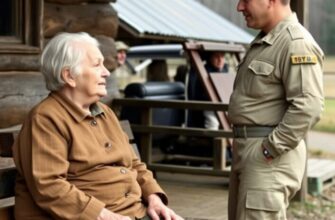
And suddenly, a woman sat down next to me.
Gray-haired, in a cheap jacket.
She stared straight ahead, and her hands were trembling.
I felt a strange sensation — like déjà vu.
As if time curled into a loop.
— Excuse me, — I said. — Are you waiting for someone?
She looked at me.
In her eyes — something familiar.
Maybe just a coincidence.
Or maybe I wanted it to be familiar.
— Not anymore, — she answered quietly. — I come here every Saturday. Just… sit.
— Why?
The woman hesitated.
Then took a deep breath:
— Because once… I left someone on this platform.
— A son?
She nodded.
In that moment, I knew: it was her.
Mom, who walked away.
The woman who left me alone.
Maybe not because she wanted to.
Maybe not because she didn’t love me.
She just — did it.
I should have asked a thousand questions.
Screamed. Walked away. Run.
But instead, I said:
— You never brought the tea.
She looked at me.
Her lips trembled.
Her eyes filled with tears.
And for the first time in 25 years, I saw an adult cry — not from pain, but from guilt.
We didn’t hug.
There was no magical reunion.
No music, no lights, no sudden forgiveness.
We just sat side by side.
Two souls, lost on the rails of life.
After a quarter of a century — again on the same platform.
And in that moment, I understood: sometimes forgiveness doesn’t begin with words.
Sometimes it begins with silence.
With the simple fact: “You were here. I was too. We are both — alive.”