The Saturday mall resembled a living anthill.
The air boiled with loud conversations, children’s laughter, and the stomping of feet.
Parents dragged shopping bags, chasing last-minute deals, children darted around their legs, and above all this splendor, bright daylight lamps shimmered, reflecting in glass storefronts.
Strange aromas drifted through the corridors: sweet vanilla buns, sharp spices, the scent of fresh textiles, and faint notes of perfume.
Polina made her way through this chaos as if in a dream.
Behind her — an exhausting week of meetings, deadlines, endless spreadsheets, and phone calls.
She had almost forgotten what it meant to be alone — not for work, not to help someone, but just by herself, for herself.
Today she had wrestled this day from reality, like a victory.
She bought her favorite syrupy coffee, splurged on a dream dress, even allowed herself to get a little lost among the fragrances in the perfume store, closing her eyes and imagining a different life — an easy one, without schedules and presentations.
She stopped at the central fountain, where streams of water, tinted pink and blue, danced to soft music.
Her arms ached from heavy shopping bags. Polina was already reaching for her phone to check her shopping list when she heard a tiny voice:
“Excuse me… lady?”
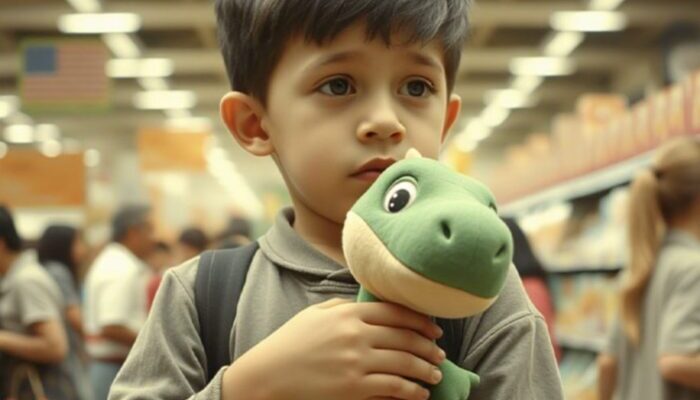
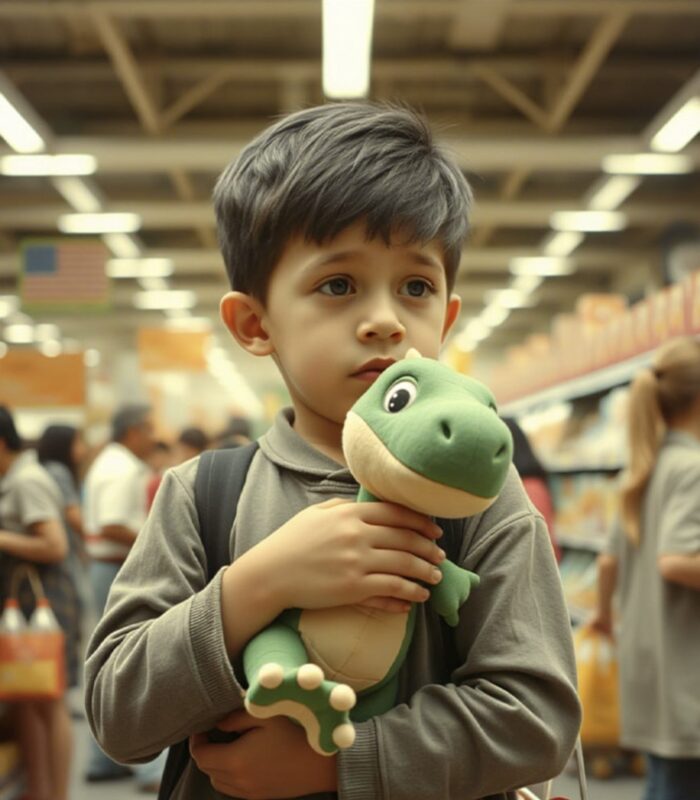
She flinched and turned. A little boy of about six or seven stood before her.
Thin, with tousled curls, wearing an oversized jacket.
In his arms he tightly clutched a worn, one-eyed dinosaur like it was his only lifeline.
“Are you lost?” Polina asked gently, kneeling beside him.
The boy nodded. His lower lip trembled.
“Mom was here… I just looked at a toy — over there, at the dinosaur display… Then I turned around — and she was gone.”
Polina’s heart clenched. Everything — shopping, plans, even her exhaustion — suddenly became irrelevant.
“Don’t worry, we’ll find your mom. Together. What’s your name?”
“Misha…”
Polina held out her hand:
“Come on, Misha. We’ll go to the information desk. They’ll make an announcement, and your mom will come right away. I promise.”
He hesitated for a moment, but eventually placed his cold little hand in hers.
And though his grip was firm, it felt like he was clinging not just to a hand — but to his last connection to a safe world.
Misha walked beside her without lagging. He never let go of his dinosaur, as if it was keeping him afloat. His eyes showed real fear — not hysteria or panic, but the kind of childhood terror when your whole world suddenly collapses.
“Do you have a favorite cartoon?” Polina tried to distract him. “I loved ‘The Lion King’ as a kid.”
Misha barely shrugged.
“I like dinosaur ones. Especially the one that says: ‘I’m not afraid!’”
“The green one with round eyes?” she smiled.
He nodded. A flicker of a smile passed across his face. Then it disappeared again.
At the information desk sat a girl with long, artificial-looking nails. Without lifting her eyes, she continued typing disinterestedly:
“Lost?”
“Not me. Him,” Polina replied, pointing at Misha. “He lost his mom. His name is Misha, about seven, he was near the fountain…”
“Got it,” the girl interrupted. “I’ll prepare an announcement.”
Her tone was indifferent, like she was discussing a lost book or umbrella.
Polina felt irritation rise, but Misha squeezed her hand tightly again — as if sensing now was not the time to lose control.
“All done,” the girl said. “Wait here.”
They sat on a bench nearby. Polina wrapped an arm around the boy’s shoulders, trying to be close without overwhelming him.
Misha stared at the floor, occasionally glancing toward the entrance, then back at his dinosaur.
Not a single worried adult appeared.
Five minutes passed. Ten. Fifteen.
“Misha, are you sure your mom was with you?” Polina asked quietly. “Where were you before this?”
He was silent for a long time, then whispered:
“We came together. She said — stay close. I did… But there was this huge dinosaur… I walked up to it… And then… she was gone.”
Polina stroked his back. Something felt wrong. No announcements. No frantic voices. No woman frantically searching the mall for her child.
Just the two of them — and the crowd.
“We’ll wait a bit longer, okay? If your mom doesn’t show — we’ll talk to security,” she said, though a creeping sense of dread was already forming.
Misha nodded, but distantly. His gaze withdrew into himself. Then he asked, almost in a whisper:
“You won’t leave me, right?”
Polina squeezed his hand.
“No. I promised, remember?”
They continued walking. Past a foggy coffee shop window, where a barista carefully drew hearts in milk foam.
Past a toy store display where a bright plastic helicopter turned slowly.
Misha didn’t speak again. Just walked.
His shadow seemed too long, and his gaze — too sad for a child.
“Want some ice cream?” Polina offered suddenly, trying to spark a little joy.
“With chocolate chips?”
The boy shook his head. Then he stopped and looked at her in a way that took Polina’s breath away:
“She’s not coming.”
“What?” she asked, confused.
“She’s not coming,” Misha repeated. His voice trembled, his eyes filled with tears.
“Because… she died.”
For a moment, the world stood still.
“What do you mean?..” Polina began, but the boy had already lowered his head.
“I just… didn’t want to be alone…” he whispered, almost apologizing.
For the lie. For the hope. For the fear.
Polina dropped to her knees in the middle of the crowded mall.
People walked around them — some curious, some oblivious.
She just held Misha. Tightly, until her arms hurt, until tears burned her eyes.
When emotions settled, she sat the boy on the bench by the fountain, placing his old dinosaur beside him.
Misha leaned into her, afraid to let go.
His face looked far too grown-up, nearly hollow. As if pain had aged him.
Polina pulled out her phone. Her hands trembled, her heart raced anxiously.
She thought frantically: what now? Who do I call?
How do I explain that this child isn’t lost — he was just alone. Completely alone.
Her decision came instantly: she couldn’t leave him here.
First — security. They led her to a small office where a uniformed man sat at a desk.
Balding, with a stern look. He listened to the story, eyeing Misha skeptically:
“Where do you live, kid?”
“I don’t know… We lived with Grandma, but she’s in the hospital.
Then I was with one aunt, then another… And then I ended up here.”
Polina’s stomach twisted.
“Do you have a dad?”
“He left when I was little. Mom said he’s far away. He has a new family.”
“And Grandma? Aunt?”
“Grandma’s in the hospital. The aunt told me to play here and said she’d be back soon.
But I’ve been here a long time, and she never came… I waited at the entrance, but no one stopped. Only you…”
Polina didn’t know what to say. This child wasn’t just lost. He had been abandoned.
“Is he an orphan?” she asked the guard.
He just shrugged:
“Could be. Or maybe the mom’s not right in the head. It happens. I’ll call the police.”
“Wait!” Polina said sharply. “Can we wait a little? Talk to him more?
He just told me his mom died. Someone brought him here and left him. He wasn’t lost — he was abandoned.”
The words hung in the air.
But the guard didn’t wait. He contacted the police. Fifteen minutes later, officers arrived.
Polina stood to meet them:
“Please, don’t take him now. He trusts me. He’s scared.”
But the decision had been made. One of the officers gently but firmly took Misha by the hand.
The boy looked back at Polina, panic in his eyes:
“You said you wouldn’t leave…”
Polina clenched her fists:
“I’ll find you. I promise. I will find you.”
They took Misha away. Polina was left alone. Inside — emptiness. As if someone had ripped out a piece of her soul.
The very next morning, she began the search.
She called every possible agency, used her contacts to find where the boy had been taken.
It was a temporary shelter on the edge of town.
Without hesitation, she went there.
She brought fruit, warm pajamas, and a new plush dinosaur — just like Misha’s, but whole.
At the shelter, they told her the truth: the boy’s name was Mikhail Lavrentyev, six years old.
His mother had died two months earlier from cancer. The father’s name was absent on the birth certificate.
After her death, his grandmother took him in, but she was later hospitalized.
Other relatives refused to take the child.
The phrase used by staff sounded terrifyingly formal: “The child is socially orphaned. Relatives are either incapacitated or declined custody.”
Polina left the office with wet cheeks and shaking hands. Her heart was breaking.
She gathered the necessary documents, submitted a petition, and filed for guardianship.
The bureaucracy resisted, but not for long. Within a week, she returned to the shelter — with official permission for temporary custody and the determination to make it permanent.
Misha was sitting in the corner of the playroom. When he saw Polina, he didn’t believe it at first.
Then he ran into her arms:
“You came back…”
“I promised, didn’t I?”
They still had many hurdles ahead — paperwork, adjusting, learning to be a family. But the most important thing was: they were together again.
The first thing they did after Misha left the shelter was visit the hospital — to see Grandma.
Because in stories like this, returning to your roots is the beginning of a new chapter.