“You’re on patrol alone today, rookie,” said Dmitrich, the senior guard supervising Pavel’s training.
“The veterans decided to take a break.”
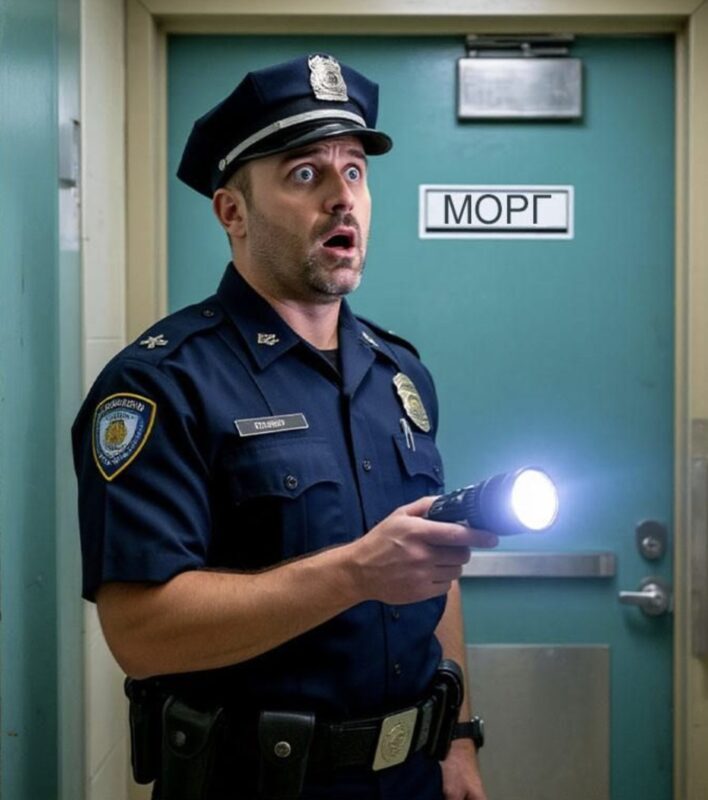
“Just don’t go near the morgue, or you’ll end up scaring yourself into soiled pants.”
The other two guards laughed. Pavel wasn’t in the mood for jokes.
Why joke about something no one truly understands? He always believed in the invisible world.
Maybe it wasn’t quite as people imagined, but there was something unexplainable about it.
How else could one explain strange incidents called miracles or coincidences?
If ghosts did exist—even in a different form—mocking them seemed foolish.
They were still someone’s souls. And how would Dmitrich feel if someone laughed at his?
Pavel shook his head, pushing away those thoughts. No need to get lost in mysticism.
At the private clinic where they worked, even small mistakes could lead to hefty fines.
Rumor had it that once, a patient had entered the wrong room and caused a commotion in the middle of the night—guess who paid the price?
Of course, the guards. And the fine was substantial.
Pavel wanted to work diligently and professionally, without giving anyone reason to complain.
After all, that’s why people take a job—to fulfill duties, not to fool around.
Moving slowly down the corridor, Pavel checked whether all the lights were dimmed as they should be.
The nurses, as always, had done a great job.
Dmitrich’s words echoed again: “Don’t get too close to the medical staff.”
But what did that have to do with anything, when doctors and nurses lived in a constant race to save lives?
Pavel smiled slightly, picturing himself as a brave knight standing guard over health.
He had once dreamed of becoming a doctor, but missed out on a scholarship, and couldn’t afford the tuition.
Now he didn’t regret it. His mother once said he was too sensitive for surgery—every loss would wound his soul. Maybe she was right.
Without realizing, Pavel had approached the morgue. Deaths were rare in that clinic—patients usually left alive.
As a result, the pathologist spent most of his time reading magazines and sipping hot tea.
Pavel didn’t envy him—it must be hard, sitting alone while life buzzes around you, yet you’re apart from it.
As he passed the metal door, he suddenly heard a faint female voice.
Someone was singing. Softly, barely audible, but clearly. The melody seemed familiar, though he couldn’t place it.
He stopped. A wave of anxiety gripped his heart.
Dmitrich’s warning flashed through his mind: “Stay away from the morgue!” A chill ran down his spine.
Pavel felt uneasy. He hadn’t imagined it—the singing was coming from inside.
Was someone in there? Was there a body?
The voice grew a little louder, then suddenly turned into a raspy cough, as if someone was gasping in the dark.
“Is someone there?” Pavel asked softly, unsure who he was addressing.
Silence. Then a scraping sound—like fingernails against metal.
Pavel went cold. What was that? Someone trying to get out?
Images from horror films flashed through his mind.
His chest tightened with dread. He could call for help via radio—but what would he say?
That he was afraid of a ghost? Ghosts don’t sing.
Which meant… someone alive—or nearly alive—was inside.
Whoever it was, they needed help. He couldn’t just walk away.
He took a deep breath and radioed in:
“I’m opening the morgue door. I hear noise from inside.”
“Another ghost joke?” Dmitrich scoffed. “That legend’s old news.”
“Believe it or not—I’m not alone. Just letting you know.”
Fumbling with trembling hands, Pavel struggled with the key.
The door creaked open, and he cautiously stepped inside.
His flashlight lit up the cold room. The smell of medical chemicals hit his nose.
He covered his face with his sleeve and stepped forward—then came a dull thud.
Something fell. At his feet—someone’s hand.
Pavel jumped back, heart pounding. His throat went dry. His vision blurred.
A girl lay on the floor. She wore a white lab coat, her hair disheveled, makeup smeared.
In the dim light, she could’ve passed for anything—even the undead.
But she had a pulse. Weak, but there. She was breathing. Barely.
Pavel wrapped her in his jacket and gently lifted her in his arms.
Everything happened so fast, like a sped-up film.
He didn’t remember how he raised the alarm, how the medics surrounded them, or how his colleagues questioned him.
Only in the morning, as dawn bathed the city, did he come to his senses.
“How is she?” he asked first thing.
“She’s alive,” Dmitrich smirked. “Our little ghost will survive. Turns out you’re a hero.”
“Didn’t expect it. Consider yourself battle-tested.”
“The higher-ups will definitely take you seriously now.”
“No probation period for you.”
Pavel nodded. He hadn’t sought heroism. He just couldn’t walk away.
Only now did he understand—fear isn’t always an enemy. Sometimes it’s a guide that helps you take the first step into the unknown.
It brought him no joy to realize that if he’d hesitated, even for a minute, she might have died.
Would anyone else have saved her?
The thought gave him a splitting headache.
Pavel returned home but couldn’t eat or sleep. Childhood fears resurfaced—like the time he’d been locked in a dark, damp basement.
He’d screamed for help, but no one came. He still didn’t remember how he got out.
Since then, many things frightened him. But he always reminded himself: if you let fear win, you might pass by someone who needs help—just like they once passed by him.
He still had a scar from a rat bite. Thankfully, there weren’t many—otherwise, he might not have survived.
At his next shift, the hospital’s chief doctor called him in. Pavel was officially hired full-time and awarded a bonus for bravery.
“Thank you, but it’s not necessary,” Pavel said. “I was just doing my job.”
“Can I visit that girl? I just want to make sure she’s okay.”
“Of course. You know her room number?”
Pavel nodded. He hadn’t brought flowers or fruit—he just wanted to see with his own eyes: she was alive. Truly alive.
The girl lay alone, reading. Hearing footsteps, she looked up and met his eyes.
“Do I know you?” she asked softly.
Pavel shook his head.
“I heard you… singing. The melody seemed familiar, but I don’t know why.”
She smiled faintly, but there was sadness in her eyes.
“You saved me. Thank you. If it weren’t for you, I wouldn’t have woken up.”
“Why did you sing, not scream?”
“At first I screamed. But no one heard me. My hands were bloodied—I tried to break out.”
“When I had no strength left, I tried to calm myself. My mom used to say singing helps.”
“After she died, I often hummed her favorite song.”
“So I did it again. I don’t know if it saved me, but it gave me hope. And it seems it wasn’t in vain.”
Her name was Elena. She had been doing an internship at the hospital.
Her classmates played a prank—spiked her drink.
She remembered little, just laughter and someone saying, “The pathologist will be thrilled!”
They thought she’d woken up and gone home. No one realized the doctor had left early, and no one checked if there was a ‘patient’ in the morgue.
Because of a dumb prank, she almost died.
Her classmates now apologized—but it was too late.
Only one thing mattered: Pavel didn’t walk away.
He thought again. Why did that song feel so familiar?
He didn’t have the answer. But he kept visiting Elena.
He brought flowers, fruit, or just talked with her about anything and everything.
One day, she shared a childhood memory:
“I was really young. Once, I heard someone crying in an old basement.”
“The door wouldn’t open, so I ran for help.”
“While I waited, I sang my mom’s lullaby.”
“I thought it would help whoever was inside not lose hope.”
Pavel laughed without thinking.
“What’s so funny?” she asked.
“That was me,” he said. “In that basement. You saved me.”
“And now I’ve saved you. Who would’ve thought our paths would cross again?”
Elena was silent for a long time. Her eyes filled with tears.
“So fate brought us together twice?” she whispered.
“Looks like it,” Pavel smiled.
After Elena was discharged, she returned to her studies and later to work.
They kept seeing each other—at work, after shifts, on walks.
Their closeness grew naturally.
A year later, after Elena graduated and got a job, they decided to build a life together.
Pavel admitted he’d had feelings for her for a long time but was afraid to say it.
“As if I didn’t know,” she laughed.
“I loved you too. I was just waiting for you to say it first.”
So two lives, linked by chance, became one.
Their story began with a cry in the dark, a song in a cold morgue, one fear and one decision.
Though challenges lay ahead—they faced them together.
Because such coincidences don’t happen.
Only fate gives second chances—to those who deserve them.