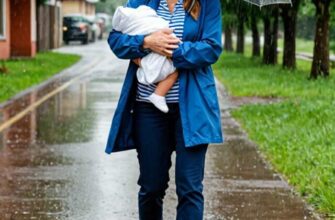
In the pouring rain, as if it were washing away all the tears of the world, Gleb rushed to the ICU to see his sick daughter.
In one hand, he clutched a small vial containing a rare medication he had obtained through connections.

In the other — the thin hand of a girl around nine years old, whom he had found at the city dump.
Frightened, freezing, with the empty eyes of someone much older, she didn’t cry.
She just stared ahead. He didn’t even know why he had brought her with him.
His heart simply said: you can’t leave her behind.
“Sit here,” he told her at the entrance to the ward. “I’ll be right back.”
The girl nodded silently. Through the glass, she watched the doctors lean over the pale figure on the bed.
Then her eyes fell on the vial Gleb had left on the chair.
She picked it up carefully, turned the label — and froze.
Swedish. She knew it. Once, before the war, before the orphanage, before all the loss — her mother had taught Swedish.
Marta used to learn alongside her, repeating the words like a game.
And then… her mother never came back. Her father disappeared. She was left at a train station.
Now, she was just “that girl from the dump.”
But her memory had not failed her.
She read slowly, whispering the words:
“Contraindicated in heart failure. May cause seizures.
Not recommended for children under 12…”
When Gleb returned, she was still holding the vial. Her face was pale, her lips trembling:
“This… this can’t be given! It could kill her!”
Gleb froze.
“What did you say? You… read it?”
“Yes. It’s in Swedish. And your daughter — she’s only nine?”
A passing doctor snatched the vial from her hands, quickly scanned the label, then looked at Gleb:
“You were right. We could’ve lost the child. Thank you, young lady.”
Gleb collapsed to the floor in the corridor. His heart was pounding like a jackhammer.
In front of his eyes — only hers. Not childlike. Not innocent.
Too deep. As if they held entire lives inside them.
Three months passed. Gleb’s daughter was recovering. And the girl from the dump — now lived in their home.
Her name was Marta. And she had saved more than one life.
She had saved Gleb himself — crushed by grief, weary from loneliness, hardened on the inside.
When the school assigned the topic “Who is your hero?” his daughter wrote:
“My sister Marta. She found us when we had already stopped believing — and brought us back into the light.”
To be continued: “She just read the instructions in Swedish…”
The first few days at home, Marta spoke almost nothing. Gleb gave her a room — small, but cozy.
He bought wallpaper with yellow flowers, hung the curtains once chosen by his late wife.
He wanted her to feel safe.
And she would sit by the window for hours. Motionless. Silent.
Sometimes, he would hear her whisper something in an unfamiliar language, staring into the clouds.
— Mamma… jag minns dig… jag saknar dig…
“You miss your mother?” he gently asked one day.
Marta flinched. Fear flickered in her eyes. Then — a nod.
“You speak Swedish?”
“Mom was a teacher. I forgot a lot… but her voice… I still remember it.”
Gleb knelt in front of her:
“I can’t be her. But I can be someone who will never leave you again. I promise.”
She didn’t answer. But for the first time — she smiled. Gently, barely noticeably.
A week later, Gleb filed for guardianship. His friends were baffled:
“Have you lost your mind? A street girl, no documents, no past? What if she’s dangerous?”
But he didn’t listen. That night, when he held his daughter’s hand and begged God for one more chance, something in him broke — and reformed.
Marta wasn’t an accident. She was a sign. A gift.
Maybe even a debt he hadn’t known he owed.
At the shelter, they looked at him with suspicion:
“She doesn’t have a single document. No records, no certificate.”
“She has a name. She has a heart. She has memories. I’ll find where she came from. I’ll do whatever it takes.”
And he began to search.
One evening, Marta asked for an old box of papers.
She cut letters from magazines, glued sheets together, and started writing something.
“What is that?” Gleb asked.
“Letters,” she replied softly.
“To whom?”
“To Mama. I don’t know where she is. But maybe she’ll hear. Or at least feel it.”
He hugged her — gently, like he had long ago when his own daughter was afraid of thunder and woke up at night.