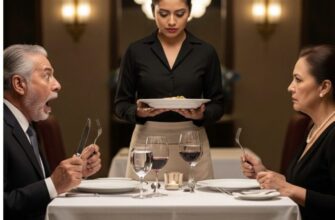
— Sweetheart, do you know how to cook anything at all? — asked Galina Petrovna.
Her lips stretched into a smile, but her eyes remained cold.

I placed the salad on the table and nodded briefly:
— I do.
— Igoryok has been used to real food since childhood. He needs something hearty, homemade, real.
My husband coughed nervously and squeezed my hand under the tablecloth.
We had only been married for three months, and this was my first time meeting his parents.
The apartment was small, filled with old furniture, the walls decorated with framed photos, and the air was thick with the smell of over-fried oil.
— Where do you work, dear? — Galina Petrovna speared a piece of avocado with her fork and examined it as if expecting it to speak.
— In the food industry. Consulting, — I took a sip of water, trying to keep things vague.
— In plain human language — what does that mean?
— Mom, Vera works with restaurants. She does analytics, — Igor stepped in.
Technically, it wasn’t a lie.
I really did evaluate food quality — every single day.
I just happened to do it as the head chef of “Lune,” a two-Michelin-starred signature restaurant with a months-long waiting list.
— I see, — my mother-in-law drawled. — So your job isn’t exactly real. Just some projects, consultations…
I saw Igor about to step in again. I placed a hand on his shoulder — enough.
Even before we arrived, I had asked him not to tell the truth about my profession.
— If she finds out what I really do, she’ll either start bragging or criticizing, — I had explained.
— I want her to talk to me as a person, not as a chef.
He didn’t fully understand, but he agreed. He always avoided conflict and preferred compromise.
— Looks odd, — Galina Petrovna continued, scrutinizing the salad.
— Why so much greenery? Are you on a diet?
— No. I just like balanced food.
— We have a man living here. He needs meat. Something he can pick up with a fork.
After the salad, I served the main dish — baked trout with steamed vegetables.
Minimalist, elegant, a light citrus accent and hand-picked herbs.
Galina Petrovna examined the plate for a long time before slicing off a tiny piece of fish.
— Undercooked, — she announced after a few seconds of chewing.
— The fish is perfectly cooked, Mom, — Igor objected. — Try it again.
I smiled. After thousands of hours in the kitchen, leading a team of a dozen chefs, creating hundreds of recipes, and cooking tens of thousands of dishes, I knew exactly when a dish was done.
— Too fancy, — my mother-in-law shook her head, putting down her fork.
— Everything should be simple. Potatoes and meat — that’s food. This… must be for Instagram photos.
I didn’t argue. People rarely change their minds because of words. Only because of experience. And experience takes time.
— Next time, I’ll teach you how to make real borscht, — Galina Petrovna placed her hand on my wrist.
— Don’t take it personally. Every homemaker should have her signature dishes. And borscht is a classic.
I nodded, remembering how my borscht with beef cheeks and truffle oil had been praised two years ago by a French critic: “A gastronomic love letter to Slavic cuisine.”
— I’d love that, — I replied. — I’m always happy to learn.
As we left, Igor whispered:
— Sorry about my mom. She’s old-school. The kitchen is where she feels in control.
— It’s fine, — I kissed him on the cheek. — In any complicated dish, the key is patience.
On the way home, I was silent.
I was thinking about how I’d now have to cook a little worse to avoid suspicion.
About how strange it was to pretend to be bad at the very thing that gave your life meaning.
— What are you thinking about? — Igor asked.
— The next family dinner, — I replied. — Looks like I’ve got a borscht masterclass coming up.
I smiled.
She didn’t know it yet, but time would sort everything out. I wasn’t in a hurry.
— Even a dog wouldn’t eat your borscht, — Galina Petrovna sneered, inspecting her portion.
— It’s kind of sweet. Where’s the richness? Where’s the fat?
Igor and I sat at the dining table in our apartment. It had been three months since we met, and Galina Petrovna had finally agreed to come over for a family dinner.
I set the table just the way she liked: borscht, pastries, casserole.
Only everything was done in my style — no excess, perfectly balanced flavors, precise proportions.
Igor nervously tapped his fingers on the tablecloth. Sitting with us were his cousin Andrey and his wife Marina.
Tension was written on their faces.
— It’s very tasty, — Marina tried to ease the atmosphere. — The presentation is especially interesting.
— Exactly — the presentation, — my mother-in-law snorted. — But where’s the substance? Where’s the soul?
She abruptly stood up and headed to the stove. I saw Igor tense, ready to stop her, but I subtly shook my head.
— Now I’ll show you, — Galina Petrovna took a ladle, — how real borscht is made.
— First, the meat — only with bones. Second, the beets must be sautéed with vinegar…
I silently watched her add more salt and spices to my borscht, making it “authentic.”
In a restaurant, this act would cost someone their job. Here, I simply sat and said nothing.
— There! — she announced triumphantly, pouring her version into bowls. — Now taste it!
Everyone obediently took their spoons. Igor cast me an apologetic look.
— Too salty, — Andrey remarked carefully and immediately shrank under her stern gaze.
— You’re just used to bland food. A real man should eat real food.
Dinner continued in a tense atmosphere. Igor tried to steer the conversation in other directions, but Galina Petrovna kept circling back to my “mistakes” in the kitchen.
— The pastries are too brittle. The dough should be soft, — she said, breaking open my mushroom and cheese pastry.
— And the filling is strange.
I listened, smiled, and nodded.
Fifteen years in a professional kitchen had taught me one crucial rule: not all criticism deserves a response.
Sometimes it’s just noise you can ignore.
After dinner, once the guests had left, Igor and I washed the dishes together. He looked dejected.
— I’m sorry about today, — he said, drying a plate. — You don’t have to put up with this.
— I’m not putting up with it, — I replied, placing cups on the shelf.
— I’m just waiting. When someone is confident in themselves, they don’t need to prove anything. She’ll understand — but not because of me.
— What do you mean?
— I don’t want to put on a show or prove my skills.
I could call a dozen critics and have them praise my borscht.
But what’s the point? I want her to accept me not for my titles, but as a person.
I placed a finger on his lips:
— Give her time.
Later that evening, I sat on the balcony, looking at the city lights.
Somewhere out there in the center, the windows of my restaurant “Lune” were glowing, where my team was now preparing dishes for hundreds of guests.
And here, at home, I was seen as a housewife who couldn’t even cook borscht.
I smiled at the irony and began sketching out a new menu for the restaurant.
Maybe I should add a modern version of borscht — with beetroot foam and black bread chips.
— Surprise! — Igor walked in holding an envelope. — Tomorrow is our little anniversary — three months since the wedding.
— I’ve reserved a table.
— Wow, — I said, genuinely surprised. — Where?
— At “Lune”, — he announced proudly. — And I invited Mom. She’ll be interested.
I froze, unsure what to say.
— That’s my restaurant.
— Exactly! — he exclaimed joyfully. — It’s time to show her who you really are. Three months of trials is enough, right?
— You want to put on a performance? — I frowned.
— No. I want her to see you — not just as a wife, but as an incredible professional, — Igor hugged me.
— I arranged it with Michel. You’ll be in the kitchen — no one will know it’s your restaurant.
It was a bold plan, but I agreed. Patience is important, but sometimes a dish needs a bold accent.
The next day, I arrived early at “Lune.” Michel, my sous-chef, greeted me with a knowing smile.
— Is this the same mother-in-law who thinks you can’t cook? — he asked while checking the prep work.
— Yes, that’s the one, — I nodded. — Today’s a special menu.
We’ll start with seasonal vegetables, then beef tartare with truffle aioli. And of course, borscht.
— Your famous borscht?
— Exactly. With beef cheeks marinated for 48 hours and beetroot sorbet.
When Igor brought his mother into the restaurant, I watched them through the kitchen window.
Galina Petrovna was dressed in her finest and looked a little lost amidst the elegant surroundings.
— Very expensive place, — I heard her whisper as the waiter brought menus without prices.
— It’s a special night, — Igor smiled. — Order whatever you like.
I returned to the stove. My hands moved instinctively, eyes tracking every detail, but my thoughts were in the dining room. I checked every dish more than once before sending it out.
— Starter for table four, — one of the waiters reported, returning with empty plates.
— The guest is thrilled. She’s asking what sauce you used.
I nodded and began preparing the main course. When it came time for the borscht, I personally inspected every bowl before it left the kitchen.
Velvety soup, meat that melted in the mouth, aromatic croutons, and beet broth — everything had to be flawless.
— Table four asks to thank the chef, — the waiter said fifteen minutes later.
— The guest says it’s the best borscht she’s ever had in her life.
It was time for the final act. I removed my apron, adjusted my jacket, and walked out into the dining room.
Galina Petrovna was animatedly telling Igor a story when I approached their table.
Seeing me, she froze, her mouth half open.
— Good evening, — I smiled. — I hope you enjoyed everything. Everything you ate tonight was prepared by me personally.
— Vera? — she blinked several times, as if she couldn’t believe it. — You… work here?
— She doesn’t just work here, Mom, — Igor said proudly.
— She’s the head chef and co-owner of “Lune.” One of the most respected restaurants in the country.
My mother-in-law slowly stood up. Emotions flickered across her face — surprise, embarrassment, even shame.
— I… I’m sorry, — she finally said. — I didn’t know. I was too harsh. I judged without knowing the truth.
— It’s okay, — I gently touched her hand. — You judged as a mother. I’m not offended. But I’m glad that now you see not just the food, but the person who made it.
She thought for a moment, then suddenly laughed:
— And I kept wondering why Igor smiled so strangely every time I criticized your borscht!
We all laughed, and the tension that had built over the past few months began to melt away.
A week later, Galina Petrovna called me herself.
— Vera, dear, — her voice was unusually soft — I just can’t get my cherry pie to turn out. Do you have any tips?
I smiled into the phone:
— Of course. Come by this evening — we’ll bake it together.
After our call, I headed to the kitchen at “Lune,” where my team and new challenges awaited me.
As I kneaded dough for a complex dessert, I thought: the truth is like a good sauce — it doesn’t need to be proven.
It needs to be created — slowly, with love, and served at just the right moment.