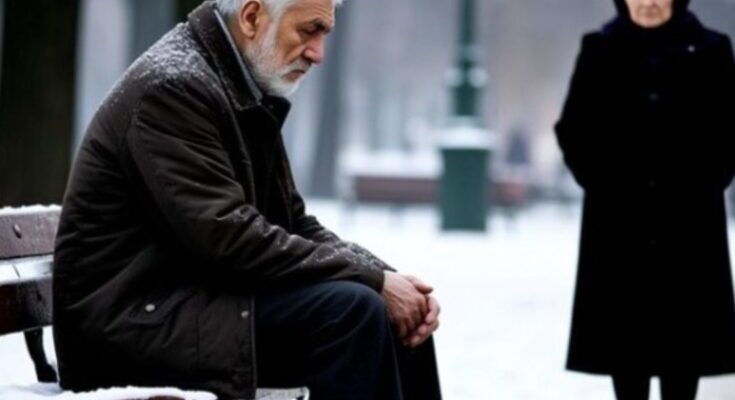
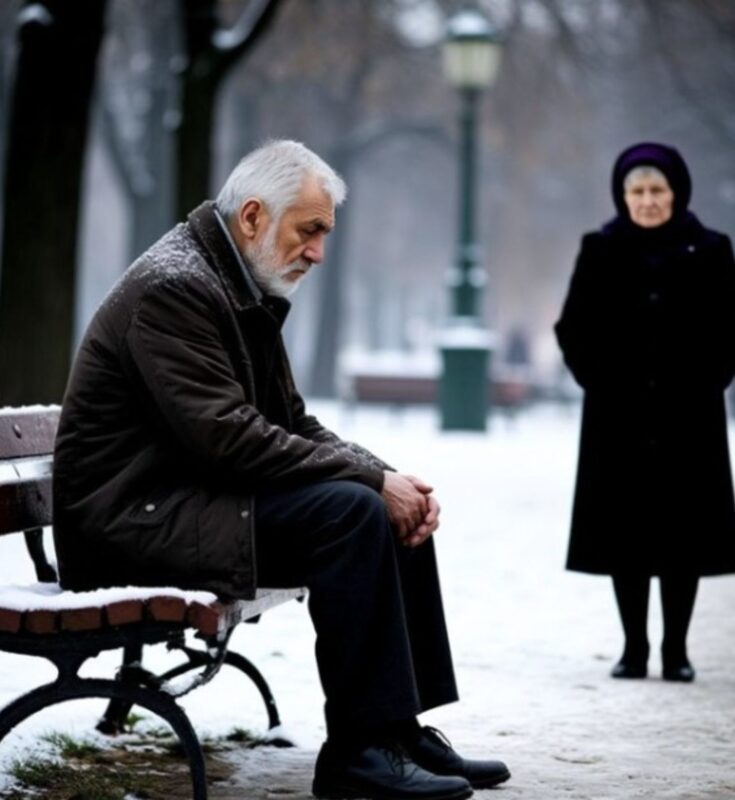
He sat on a cold iron bench, wrapped in a worn-out coat — the one he used to wear when he worked as a maintenance technician.
His name was Nikolai Andreyevich. A pensioner. A widower. The father of an only son and, as he once believed, a happy grandfather.
But all of that crumbled one day.
When his son brought Olga home, something froze inside Nikolai.
Her energy was too sharp, her gaze too cold, hidden behind a charming smile.
She didn’t shout or create scandals — she simply, subtly, and methodically pushed out everything from the man’s life that got in her way.
And Nikolai felt it immediately. But by then, nothing could be changed.
First, his belongings disappeared: books were moved to the attic, his favorite chair was deemed “unnecessary,” the kettle suddenly vanished. Then came the hints: “Dad, maybe you should take more walks? Fresh air is good for you.”
Soon after, the suggestion: “Maybe it’s best for you to live in a retirement home or with Auntie in the village.”
Nikolai didn’t respond. He simply packed what little he still had and left.
No words of reproach, no tears, no begging — only pride and pain lodged deep in his heart.
He wandered through snowy streets like a ghost.
Only one park bench gave him comfort — the one where he used to stroll with his wife, and later with his young son.
He spent hours there, staring into emptiness.
And then, on one particularly cold day, when the frost bit at his cheeks and his eyes were blurred from cold and sorrow, a voice called out:
— “Nikolai? Nikolai Andreyevich?”
He turned around. Standing before him was a woman in a warm coat and headscarf.
He didn’t recognize her at first, but memory nudged him — Maria Sergeyevna.
His first love. The one he lost because of the military, then forgot after marrying Lidia.
In her hands were a thermos and a bag of homemade pastries.
— “What are you doing here? You’ll freeze…”
That simple question, filled with care, warmed him more than any coat could.
Nikolai silently accepted the tea and buns.
His voice had long faded, and his heart ached so much that not even tears would come.
Maria sat beside him, as if time between them had frozen.
— “I take walks here sometimes,” she began gently. “And you… why are you here?”
— “Just a familiar place,” he smiled faintly.
— “My son took his first steps here. Remember?”
Maria nodded. Of course, she remembered.
— “And now…” Nikolai sighed. “He’s grown, married, bought an apartment. His wife said: ‘Choose — me or your father.’ He chose. I don’t blame him. Young people have their own lives.”
Maria said nothing, only looked at his red, cracked hands — so familiar, so lonely.
— “Come with me, Nikolai,” she offered suddenly. “It’s warm. We’ll eat. Tomorrow we’ll figure things out.”
“I’ll make you soup, we’ll talk. You’re not a stone — you’re a person. And you don’t deserve to be alone.”
He didn’t move for a long time. Then quietly asked:
— “And you… why are you alone?”
Maria sighed. Her eyes turned glassy.
— “My husband died long ago. My son… passed away before birth. Then came life, work, retirement, a cat, and knitting.”
“All in a circle. You’re the first person I’ve had tea with in ten years.”
They sat together for a long time. Passersby grew sparse, and the snow fell gently, as if trying to soothe their pain.
The next morning, Nikolai woke not on a bench, but in a cozy room with daisy-print curtains.
The air smelled of pies. Outside, frost dusted the trees.
And inside — a strange feeling of peace, as if someone had given him permission to live again.
— “Good morning!” Maria came in with a plate of cheese pancakes. “When was the last time you had homemade food?”
— “Ten years ago,” Nikolai chuckled. “My son and his wife mostly ordered takeout.”
Maria didn’t ask questions. She just fed him, tucked him in with a blanket, and turned on the radio — to chase away the silence.
Days passed. Then weeks. Nikolai came back to life.
He repaired chairs, helped around the house, told stories of work, how he once saved a colleague from a gas explosion.
And Maria listened. Making soup from his childhood, washing his socks, knitting him a scarf — she gave him what he hadn’t felt in years: care.
But one day, everything changed.
Maria was returning from the market when she saw a car at the gate.
A man stepped out — and Nikolai would’ve called him his son. Valery.
— “Hello… excuse me… Do you know if Nikolai Andreyevich lives here?”
Maria’s heart tightened.
— “And who are you to him?”
— “I… I’m his son. I’ve been looking for him. He left, and I didn’t know… Olga left. Turns out, all this time…” he lowered his head. “No lies — I was a fool.”
Maria looked at him carefully.
— “Come in. But remember: a father isn’t a thing, not furniture. He doesn’t have to return just because you’re lonely now.”
Valery nodded:
— “I understand.”
At home, Nikolai sat in an armchair with a newspaper. Seeing his son, he immediately knew it wasn’t just a visit.
His chest tightened with memories — of years, of frost, of homelessness.
— “Dad…” Valery croaked. “Forgive me.”
Silence filled the room. Then Nikolai said:
— “You could’ve said that earlier. Before the bench, before the nights under the bridge, before all of this. But… I forgive you.”
And a tear slowly rolled down his cheek — heavy like memory, but warm like forgiveness.
A month later, Valery invited his father to return home. But Nikolai declined.
— “I’ve already found my place,” he said. “It’s warm here. Here I have real tea and real care.”
“I’m not offended. Just tired of starting over. Forgiving doesn’t mean forgetting.”
Two years later, Nikolai and Maria came to the park bench together.
They held hands, brought bread for the birds, shared tea from one thermos.
Sometimes they sat in silence. Sometimes they talked about everything.
One day, standing in the street, Nikolai looked up at the sky and softly said:
— “Life is a strange thing. They kick you out — and it feels like everything inside is shattered.”
“But then someone comes, not through the door, but from the warmth of their heart, and gives you a new home — not of walls, but of love.”
Maria hugged him.
— “Then it wasn’t in vain we met. Even if it happened on a bench in the park.”
Nikolai and Maria lived quietly. They didn’t rush to get married, didn’t call each other husband and wife.
But their home was filled with family — invisible, yet present in every detail.
Mornings began with the sound of the samovar, the smell of fresh tea, Maria’s voice humming in the kitchen.
Their bond wasn’t in words, but in actions — in every glance, in every movement.
One spring day, Valery returned. He wasn’t alone — with him was a boy of about eight.
— “Dad…” he began cautiously. “This is Sasha. Your grandson. He wanted to meet you.”
Nikolai froze. The boy looked up at him, trusting and a little shy.
In his hands, he held a drawing: an old house, a tree, two people on a bench.
— “That’s you and Grandma Maria,” he said. “Dad told me. Now I want to have a grandpa too.”
Nikolai knelt, hugged the boy, and felt warmth return to his chest.
From that day on, Sasha became part of their life. He didn’t just play in the garden — he brought the house to life.
Nikolai started building again: swings, a toy ship, even repaired the old radio.
In the evenings, he read Sasha fairy tales — just like he used to read to his son.
One day, watching them, Maria quietly said:
— “Kolya, you’re living again. Not just existing — living.”
He took her hand and pressed it to his cheek.
— “Because of you.”
That fall, Nikolai took an important step. He brought an application to the civil registry office.
He and Maria signed the papers with Valery and Sasha as witnesses. No fanfare, no gown, no banquet.
Just two people who found each other after a long journey.
When the clerk joked, “Isn’t it a bit late?” Maria replied:
— “Love has no age. It either exists or it doesn’t. And we have it. We made the right choice.”
Years passed. Nikolai began to write. From old, worn notebooks, the story of his life emerged — from post-war childhood to his job, from losing Lidia to being cast out, and finally — to meeting Maria.
He wrote it all for his grandson, so he would know: life isn’t always fair, but light can always be found.
Sasha read the notes with bated breath.
And when he turned sixteen, he said:
— “Grandpa, I want to turn your writings into a book. So people understand: never abandon your loved ones, never be blind to someone else’s pain. Learn to forgive. And to walk away, if staying only brings hurt.”
Nikolai silently nodded. There was no greater pride for him.
One day, Olga appeared at the door. She was thin, gray-haired, and hollow-eyed.
— “Forgive me,” she said. “I lost everything. The man I left with turned out to be no one.”
“My health is gone, my stability… Back then I thought you were in Valery’s way.”
“Now I realize — you were his foundation.”
Nikolai looked at her for a long time.
— “I’m not angry,” he finally said. “But I won’t invite you in. This house is filled with kindness.”
“And you brought cold. And now you want warmth from a place you never helped warm. It doesn’t work like that.”
“I wish you peace — just not here.”
And he closed the door.
Ten years later, Maria passed quietly. She didn’t wake up one morning. The room smelled of lilies of the valley — her favorite flowers.
Nikolai sat beside her, held her hand, whispered words of gratitude. He didn’t cry. Only whispered:
— “Thank you. I’ll be there soon. Wait for me.”
Neighbors came to the funeral. Acquaintances. Children from the playground.
Everyone knew Marusya — kind, quiet, always ready with tea and a listening ear.
Sasha published the book. He called it:
“The Bench Where Life Began”
He dedicated it to his grandparents. The book reached thousands.
People wrote letters, thanked them for honesty, for truth, for restoring faith — that even in old age, one can find love and a home.
And Nikolai… lived a little longer. One day, he simply lay down on that same bench where it all began.
Closed his eyes. And saw Maria walking toward him in the snow.
She smiled. And said:
— “Time to come home, Kolya.”
He smiled back and took a step toward her.
Epilogue.
Now, a small plaque hangs on that bench:
“Everything changed here. Hope was born here.
Don’t pass by the elderly — they need love too.”
Every evening, grandchildren sit here, holding their grandparents’ hands.
Because love isn’t about grand ceremonies.
It’s about being able to say:
“I found you. Now you are not alone.”