“Alright then, guys, bye!” shouted Tamás as he jumped onto the step of the already moving train.
His friends were waving from the platform – someone even shouted something after him.

He waved back, smiling.
Three years had passed since he had finished his military service.
Since then, he had found a job and enrolled in a correspondence course at the technical university.
But this was the first time he was traveling to another city.
Their friendship had grown from shared roots – from state care.
They had spent their childhoods in a children’s home, without families, and by now they had become young adults, with plans and dreams.
András and Anna had gotten married, bought a small apartment with a mortgage, and were expecting a child.
Tamás was happy for them – even a bit envious, though good-naturedly.
He was occupied by different questions.
Even as a child, he had tried to understand: who was he really?
Where did he come from?
Why had he ended up in the orphanage?
His memories were hazy, almost intangible, yet something warm was tied to his past.
One thing was certain: a man had brought him in.
A young man, well dressed, probably in his thirties.
The cleaner at the home, Aunt Nyura – full name Julianna Nyáry – had seen them back then.
“I was still quite young in those days,” she often said.
“I was just over fifty, and my eyes were still sharp as a hawk’s.
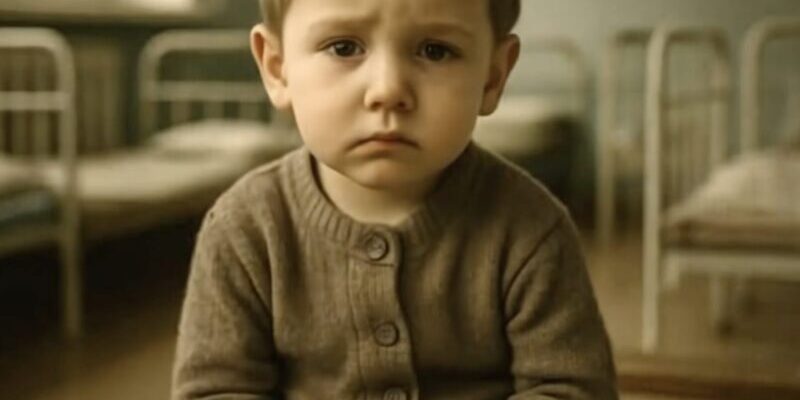
I looked out the window and saw a man standing under the streetlight with a little boy.
The boy – you, my dear Tamás – must have been about three.
The man bent down to you, spoke to you seriously, like to an adult.
Then he rang the bell and ran off as if boiling oil had been poured over him!
I chased after him, but he vanished.
If I saw him again now – I’d recognize him among a thousand.
His nose was like something from a fairy tale – long and pointy.
He didn’t have a car, so he must have been local.
And you didn’t even have gloves on those little hands of yours!”
Of course, Tamás didn’t remember anything.
But after much pondering, he decided: that man must have been his father.
What happened to his mother remained a mystery.
But when he entered the home, he was clean, well cared for, his clothes neat.
Only one thing puzzled the doctors: a strange, pale mark ran across his chest up to his neck.
At first, they suspected a burn, but later it turned out – it was a rare birthmark.
According to Aunt Nyura, such things are often hereditary.
“Oh, Aunt Nyura,” Tamás laughed, “you think I’m going to peek at birthmarks at the beach?”
“Oh, my boy,” she sighed, “you’re a fool.
But I love you anyway.”
She had been Tamás’s true support.
When school ended, she took him in.
“Until you get a proper place,” she said, “you’ll stay with me.
I won’t let you wander the streets.”
Tamás tried to hold himself together – after all, he was already a man.
But it would have been hard to forget how many times he cried in Aunt Nyura’s lap after stumbling into the storeroom following a “justified” beating.
He always wanted to protect others, even if it meant standing up to bigger kids.
The old woman would stroke his head at times like that.
“You have a good heart, my dear Tamás.
But with that sense of justice, you’ll have a hard life.
A very hard one…”
He hadn’t understood it then.
Later, he realized what she meant.
Anna had lived in the children’s home since birth.
András came later, when Tamás was already eleven.
Tamás was tall and slim, András was quiet – he was brought in after a tragedy; his parents had died from poisoned drinks.
He was quiet and withdrawn for a long time.
Then one day something happened that bound them together forever.
Anna wasn’t popular.
With her red hair, soft voice, and small stature, she was an easy target.
Some mocked her, others pulled her hair, some even kicked her.
One afternoon, the older boys were particularly cruel.
Tamás couldn’t watch anymore.
He stepped in – but the odds were overwhelming.
Within minutes, he was on the ground, shielding his face.
Anna was screaming, swinging her bag.
Then suddenly the noise stopped.
Someone helped Tamás up.
It was András.
“Why do you get involved if you can’t even fight?”
“You want me to just stand by while a girl gets beaten up?”
András was silent for a moment, then offered his hand.
“You’re a decent guy.
Let’s be friends.”
Anna looked at András with such adoration that Tamás had to joke:
“Close your mouth, kiddo, or you’ll swallow a fly.”
András laughed.
“Alright, little girl.
If you ever have a problem, just tell everyone I’m looking out for you.”
From that day, András started training Tamás.
At first, he hated it – he would’ve rather read a book.
But András was persistent, and over time Tamás got into it.
His PE grade improved from a C to an A, his muscles grew, and he began to notice how girls started looking at him more.
András was the first among them to leave the institution.
Anna cried at the gate, but András hugged her and said:
“Don’t cry, little girl.
I’ll come back for you.
I never lie.”
And he did come back – once.
Just as Anna was packing her suitcase.
András showed up in military uniform, a bouquet in hand, and firmly declared:
“I came for you.
Life has no flavor without you.”
By then, Anna had grown into a beautiful woman, with flowing red hair and a kind face.
When she turned around, András was so stunned that he dropped the flowers.
“This is unbelievable… You’ve become some kind of fairy-tale beauty!
Maybe you don’t even want me anymore?”
Anna smiled, tears in her eyes.
“Of course I do, András.
I’ve always waited only for you.”
András had been stationed in the very city where Tamás was now heading.
He had decided to visit them when the baby was born.
He would be the godfather – there was no other option.
For once, he hadn’t skimped on the train ticket – he bought one with a sleeper cabin.
He needed rest, as he worked on a construction site back home – at great heights.
He loved the job: it paid well, no overtime, and he could continue his studies.
He was just getting ready for bed when shouting shattered the silence.
An angry man was yelling, demanding someone leave the cabin.
At first, Tamás didn’t want to get involved, but then he heard a trembling, crying woman’s voice – an elderly lady.
It sounded so familiar…
So much like Aunt Nyura’s voice.
He looked out into the corridor.
A frightened female conductor stood in front of the neighboring cabin.
“What happened?” Tamás asked.
“A passenger,” whispered the girl.
“The grandmother accidentally spilled her tea.
It got on the man’s shirt.
He’s been raging ever since.”
“Get out of here, you old hag!” came the shout from inside the cabin.
“You’ll end up ruining everything!”
Tamás stepped into the corridor and spoke calmly.
“Hey, buddy.
We’re talking about an elderly woman.
It was an accident, and anyway, she paid for her ticket.”
“Do you know who I am?! One phone call and you’ll never ride a train again!”
Tamás didn’t raise his voice.
“You know, pal, jaws break the same way for everyone – whether you’re a nobody or a big shot.”
The man froze.
Tamás walked over to the old woman.
“Come on, let’s switch places.
My cabin is yours.”
The woman burst into tears and nodded gratefully.
The conductor gave Tamás a nod of respect as he returned and dropped his bag.
He unbuttoned his shirt to calm down.
The man who had been threatening him turned pale.
“What… what’s that on your chest?”
Tamás glanced at the pale birthmark.
“This? A birthmark.
I’ve had it since birth.
But relax, it’s not contagious.”
“Oh my God…” the man sat down, trembling.
Tamás looked at him suspiciously.
“What is it?”
The other man slowly unbuttoned his shirt. On his chest—an identical birthmark.
“I belong to you… Tamás. I came to ask for forgiveness.”
“I can’t sleep at night. I hear your crying. That day, over and over again…”
“It was you… You left me at the orphanage door?”
“Yes,” he nodded, broken. “I was a coward. I was married then, and your mother—Erika—she came to me.”
“She had cancer. She asked me to look after you while she was in the hospital. But a few hours later, my wife came home… I panicked.”
“And I took you to the institution. A week later, we moved away. Years later, Erika found me.”
“She recovered and started looking for you. And I… I lied and told her you had died.”
Tamás stood up. His voice rang softly.
“Where is she now?”
“I heard she had a stroke. She lives in a nursing home—in the same town as you.”
Tamás walked out to the corridor and approached the train attendant. The girl was already waiting for him.
“I heard everything,” she said quietly. “If you want… you can use my compartment. Rest for a while.”
Tamás nodded.
“Thank you. I think I know which home it might be.”
The next day, he didn’t go to work. He called his boss and explained the situation.
The girl—Katalin—went with him. Tamás was grateful: facing this alone would have been too scary.
“Erika… came ten years ago, after a stroke,” the receptionist said.
“Yes, we have a resident by that name. But she always said she had no family, that her son had died. And you are?”
Tamás shrugged.
“Maybe her son. If what I heard is true.”
“Go on in.”
The nurse escorted him in. An elderly woman sat in a chair, knitting. When she looked up and saw Tamás—she smiled.
“Tamás… I knew. I knew you were alive. I felt it.”
The nurse had tears in her eyes.
“Two peas in a pod, I swear…”
Tamás couldn’t speak. A storm of anger, pain, curiosity, and love swirled inside him—love he was never taught, it just came from within.
Erika tried to stand but trembled, so Tamás quickly stepped forward and gently hugged her. Her fingers clutched his coat, trembling.
“Don’t be angry with me… I didn’t want to let you go, but I had no choice.”
“Back then, there weren’t as many treatments, and the doctors said I was going to die. I didn’t want you to see me suffer.”
Tamás answered softly:
“I’m sorry you weren’t there. But you’re here now.”
Erika’s tears fell on Tamás’s shoulder.
“Please forgive me. I can’t turn back time. But I imagined so many times that one day you would come, and I could tell you how much I love you.”
Tamás simply said:
“I know.”
In the months that followed, Tamás spent all his free time with Erika. After work, he went to the nursing home, read to her, walked with her in the garden, talked with her.
Erika slowly grew stronger. Tamás paid for new therapies, caregivers—everything that could help her recover.
Katalin, the train attendant, began to appear more often.
At first, she just helped him run errands. Then there were more shared laughs, glances, touches. One afternoon, Erika smiled and remarked:
“That girl loves you. Do you love her too?”
Tamás blushed.
“I think so. It just feels… strange still.”
“All beautiful things start out strange,” Erika said.
And it was true. A few months later, Tamás and Katalin moved in together.
A year later, they got married. Their witnesses were Anna and András, and Tamás baptized their baby.
Erika was there at the wedding—moving a little slower, but her eyes sparkled. When she stood to give a toast, everyone fell silent.
“Many people think life only moves in one direction,” she said. “But sometimes, it turns back. And if you have courage, love, and forgiveness, you can rewrite the ending.”
Everyone applauded. Tamás just sat there, watching her—his mother, no longer just a memory but real.
A woman who had made mistakes, but was now present again. A woman who would someday read stories to her grandchildren.
Two years passed. Erika fully recovered and moved into a small apartment near Tamás and Katalin.
She often came over to babysit the grandchild. Tamás hugged her every time she arrived.
One day, while Erika was cooking in the kitchen, Katalin whispered to Tamás:
“I never asked… what happened to that man? You know… your father?”
Tamás shrugged.
“He wrote once. Apologized. That’s it.”
“That’s it. I don’t know what I could say to him that he doesn’t already know.”
There was a brief silence, then Katalin took Tamás’s hand:
“You’re not like him. You don’t leave people behind.”
Tamás smiled.
“Because I had people to learn from. Aunt Nyura. A red-haired girl. A friend who taught me how to fight.”
“And a mother who, even after ten years, knew I was alive.”
That evening, while Erika read a story to her grandchild, Tamás stood leaning against the doorframe, watching them.
The child listened with sparkling eyes, Erika read with a soft voice, and Katalin cooked dinner in the kitchen.
Tamás’s heart filled with a special kind of warmth.
What was once a lonely child was now a father. A man with a past, but an even greater future.
A boy once left at an orphanage by a stranger—now building a family out of love.
And the birthmark… was no longer a stain of shame. But a memory. A family trait. A bond.
Tamás closed his eyes.
This was his story.
And now, he was no longer afraid to tell it.